
Whole lettuce,
does it really help with Reduced incidence of estrogen-receptor-negative breast cancer?
research showsThe grade is C. There is no randomized trial. In two nurse cohorts, each additional two weekly servings reported was associated with ER-negative breast-cancer HR 0.96 (95% CI 0.93 to 0.99), but about 30 individual fruits and vegetables were each tested across two subtypes, producing about 60 tests without multiplicity correction. Lettuce dropped out of the authors' own stepwise selection, leaving only carrots and winter squash. This small observational signal gives 40 points.
ads claimAn association among people reporting more lettuce is not proof that assigning lettuce prevents cancer. This verdict concerns the whole food, not lettuce extract.
Useful facts when choosing a product
- Lettuce follow-up began in 1984 because it was absent from the 1980 questionnaire; lettuce-specific person-time and cases were not reported.
- Donguibogam and Shiliao Bencao said lettuce reduces sleep, while Dioscorides, Galen, Culpeper, and Evelyn said it induces sleep. These opposing traditional records concern sleep, not breast cancer.
- Verdict 350 is C with 56 points for Heukharang lettuce extract and sleep; verdict 359 is ? for wild-lettuce extract. This is a different whole-food and cancer-incidence question.
Chamgap Semantic Classification Code
Candidate index · review held
UNK.whole-lettuce.UNK.incidence-of-estrogen-receptor-negative-breast-cancer.reduce.UNKUnknown > Whole lettuce > Unknown > incidence of estrogen-receptor-negative breast cancer > Reduction claim > Unknown
An automated migration candidate, not an issued permanent code; exact claim scope remains under review. This machine-generated migration candidate helps retrieval but is not a permanent assignment. The original verdict ID and URL remain authoritative.
What the research actually shows
Farvid and colleagues did not assign lettuce; they followed people who reported eating more of it in NHS and NHSII. Lettuce was absent from the 1980 questionnaire, so its follow-up began in 1984. The paper's overall 182,145 women and 1,794 ER-negative cases are not the lettuce-specific denominator, and lettuce-specific person-time and case counts were not reported. The ER-negative HR per two additional weekly servings was 0.96 (95% CI 0.93 to 0.99); ER-positive disease was 1.00 (0.98 to 1.01). About 30 individual fruits and vegetables were each tested across two receptor subtypes, producing about 60 tests without multiplicity correction; lettuce dropped out of the authors' own stepwise selection, leaving only carrots and winter squash. A 20-cohort pooled analysis of 993,466 people reported lettuce/salad RR 0.91 (0.84 to 0.98), but it included NHS-family data and overlapped in investigators, so it is not fully independent replication; its conclusion concerned overall produce rather than specific foods. No trial randomized lettuce intake. WHEL was neither a lettuce-only trial nor a primary-prevention trial in healthy people. It tested a multicomponent vegetable, fruit, fiber, and low-fat diet in breast-cancer survivors for recurrence and second primary cancers; its primary outcome was null, HR 0.96 (95% CI 0.80 to 1.14), p=0.63, but it is not a direct refutation trial of lettuce.
Why this is classified as C (54)
About 30 individual fruits and vegetables were each tested across two subtypes, producing about 60 tests without multiplicity correction, and lettuce dropped out of the authors' own stepwise selection while only carrots and winter squash remained. This is not a study without a notable bias defect; with no randomized lettuce trial and only a small cohort association, the grade is C with 54 points.
Counterpoint. The large prospective cohort and below-one confidence interval are acknowledged, but they cannot establish causality.
Rejudgment record. Cross-check applied — No randomized lettuce trial exists; the cohort association was small, uncorrected for multiple testing, and lettuce added no independent information in the authors' selection and total-vegetable models
| Endpoint | H | Hard endpoint - actual events such as death |
| Replication | R1 | Single confirmatory trial |
| Independence | I2 | Decisive evidence is publicly or non-profit funded |
| Effect size | E~ | Statistically positive but below the threshold |
Stored derived and displayed grades match; this is not a current recalculation or validity check (C).
Sub-claim grades by effect
This ingredient is marketed for several effects. A single overall grade blends strong and weak claims together, so each effect is graded separately here. The overall grade reflects the strongest disconfirming or core claim.
| Effect (sub-claim) | Grade | Basis |
|---|---|---|
| Lower ER-negative breast-cancer incidence | C | A small observational association that dropped out of variable selection. |
| Lower ER-positive breast-cancer incidence | D | Null at HR 1.00 (0.98 to 1.01). |
| Randomized preventive effect of lettuce alone | ? | No randomized trial assigned lettuce alone. |
Cross-check — AI research and Codex final gate
Evidence Table
| Study | Design | Sample | Funding | Endpoint | Result | Weight |
|---|---|---|---|---|---|---|
| Farvid MS et al. 2019 | Prospective observational NHS and NHSII cohort analysis | Overall paper: 182,145 women and 1,794 ER-negative cases; lettuce-specific denominator not reported | Public US NIH funding | Incident ER-negative and ER-positive invasive breast cancer | Per two additional weekly servings: ER-negative HR 0.96 (0.93 to 0.99); ER-positive 1.00 (0.98 to 1.01) | Direct observational evidence, unstable under multiplicity and model selection |
| Pierce JP et al. WHEL 2007 | Randomized multicomponent-diet trial in breast-cancer survivors | 3,088 participants | US NIH and public funding | Breast-cancer recurrence or new primary cancer | HR 0.96 (95% CI 0.80 to 1.14), p=0.63 | Not used as direct refutation because it was neither lettuce-only nor primary prevention in healthy people |
Receipt — 3 References
All 3 cited sources were verified for existence at the original page (as of 2026-08-02).
Final verification and publication gate: Codex · Evidence date: 2026-08-02 · Corrections: none
Cite this verdict
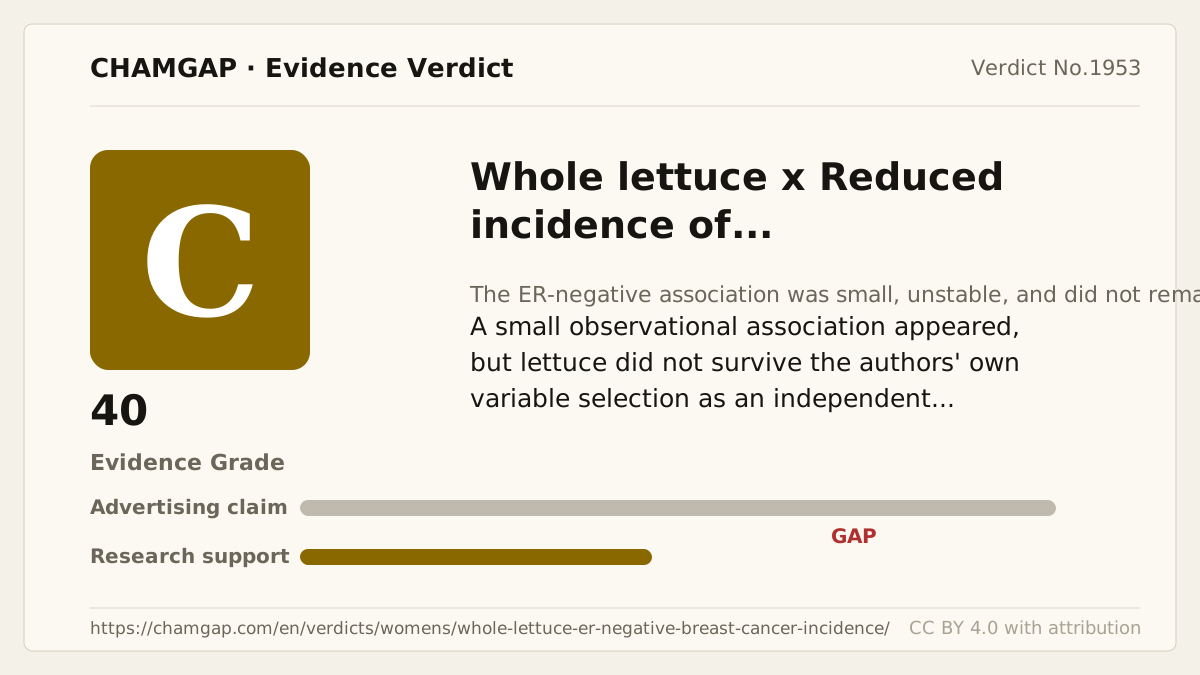
[Chamgap] Whole lettuce x reduced ER-negative breast-cancer incidence — Evidence Grade C·54. 3 cited sources checked. Source: https://chamgap.com/en/verdicts/womens/whole-lettuce-er-negative-breast-cancer-incidence/ · CC BY 4.0CC BY 4.0 — free to use with attribution; do not distort grades, numbers, or verdict meaning.
What this document does and does not do
Chamgap is an information source. It reports what research has and has not confirmed; it does not tell readers what to take or buy. That decision belongs to readers and, when needed, medical or legal professionals. This verdict reflects literature available up to the search date and may change as new research appears. Nothing here is medical advice.