
Trastuzumab,
does it really help with Reduced recurrence and mortality after surgery and chemotherapy for HER2-positive early breast cancer?
research showsTrastuzumab is rated A because strong evidence shows that it reduces recurrence and mortality after surgery and chemotherapy for HER2-positive early breast cancer. HERA randomized 5,102 participants and followed them for a median of 11 years; one year of trastuzumab versus observation produced a disease-free-survival event hazard ratio of 0.76 and a death hazard ratio of 0.74, with durable benefit despite later selective crossover by more than half of the observation group. A separate joint analysis of 4,046 participants in NSABP B-31 and NCCTG N9831 replicated the result, with hazard ratios of 0.63 for overall survival and 0.60 for disease-free survival. Multiple large randomized trials therefore converge on direct recurrence and mortality outcomes, supporting A with 96 points. Left-ventricular dysfunction, heart failure, and infusion reactions remain separate safety issues.
ads claimA 26% relative reduction in mortality risk or a higher 10-year survival rate does not mean cure for every patient or the same proportional extension of life for each individual. Benefit is tied to accurately confirmed HER2-positive early breast cancer and appropriate surgery and chemotherapy, and it does not remove the need for cardiac monitoring.
Useful facts when choosing a product
- Trastuzumab is a prescription anti-HER2 monoclonal antibody for tumors with validated HER2 overexpression or gene amplification, which should be confirmed with an approved test.
- The one-year HERA regimen used an intravenous loading dose of 8 mg/kg followed by 6 mg/kg every three weeks; actual regimens and formulations follow jurisdiction-specific labeling and oncology protocols.
- Left-ventricular ejection fraction should be assessed before and during treatment, and symptomatic heart failure or a clinically important decline may require holding or stopping therapy and cardiac evaluation.
- Infusion reactions, fever or chills, uncommon serious pulmonary toxicity, and embryo-fetal harm require infusion observation and pregnancy-prevention counseling.
Chamgap Semantic Classification Code
Candidate index · review held
M.trastuzumab.UNK.recurrence-and-mortality-after-surgery-and-chemotherapy-for-her2-positive-early-breast-cancer.reduce.UNKMedicinal interventions > Trastuzumab > Unknown > recurrence and mortality after surgery and chemotherapy for HER2-positive early breast cancer > Reduction claim > Unknown
An automated migration candidate, not an issued permanent code; exact claim scope remains under review. This machine-generated migration candidate helps retrieval but is not a permanent assignment. The original verdict ID and URL remain authoritative.
What the research actually shows
The final analysis by Cameron and colleagues reported that HERA enrolled 5,102 participants across 39 countries and analyzed 5,099 after excluding three without documented written consent. One year of trastuzumab improved long-term disease-free and overall survival, while two years did not improve disease-free survival further than one year, with a hazard ratio of 1.02. The planned joint analysis by Perez and colleagues enrolled 4,046 participants with operable HER2-positive breast cancer and added trastuzumab to paclitaxel after doxorubicin and cyclophosphamide, substantially reducing recurrence and death at a median 8.4 years. HERA and the North American cooperative-group program differed in sequencing and some eligibility details, but concordance on direct recurrence and mortality outcomes strengthens external credibility.
Why this is classified as A (96)
The 5,102-participant HERA trial with 11-year follow-up showed hazard ratios of 0.76 for disease-free survival and 0.74 for death, while the separate 4,046-participant NSABP B-31 and NCCTG N9831 analysis replicated benefit with hazard ratios of 0.60 for disease-free survival and 0.63 for overall survival. The manufacturer ceiling was not applied to these large prescription-biologic trials with hard endpoints, and replication across programs supports A with 96 points. Cardiotoxicity remains a separate safety issue.
Counterpoint. Absolute benefit varies by stage, nodal status, hormone-receptor status, concomitant chemotherapy, and baseline recurrence risk. Two years was not better than one year, so the evidence does not support assuming that longer treatment is more effective.
Rejudgment record. New verdict — Applied grade A for direct disease-free-survival and death hazard ratios of 0.76 and 0.74 in the 5,102-participant long-term HERA trial and replication with disease-free- and overall-survival hazard ratios of 0.60 and 0.63 in the separate 4,046-participant NSABP B-31 and NCCTG N9831 program; applied the hard-endpoint exception to the manufacturer ceiling for a prescription biologic and corpus alignment with other grade-A cancer recurrence and survival verdicts
Sub-claim grades by effect
This ingredient is marketed for several effects. A single overall grade blends strong and weak claims together, so each effect is graded separately here. The overall grade reflects the strongest disconfirming or core claim.
| Effect (sub-claim) | Grade | Basis |
|---|---|---|
| Improved disease-free survival and reduced recurrence in HER2-positive early breast cancer | A | Hazard ratios of 0.76 in HERA and 0.60 in B-31 and N9831 directly demonstrated durable recurrence reduction in large randomized trials. |
| Improved overall survival and reduced mortality in HER2-positive early breast cancer | A | The direct mortality endpoint was replicated with a death hazard ratio of 0.74 in HERA and an overall-survival hazard ratio of 0.63 in the separate cooperative-group analysis. |
| Additional disease-free-survival improvement from two years versus one year of trastuzumab | D | In HERA, the disease-free-survival hazard ratio for two years versus one year was 1.02, showing no additional benefit. |
Cross-check — AI research and Codex final gate
Evidence Table
| Study | Design | Sample | Funding | Endpoint | Result | Weight |
|---|---|---|---|---|---|---|
| Cameron D et al.; Herceptin Adjuvant (HERA) Trial Study Team. 2017 | Final 11-year analysis of an open-label randomized phase 3 trial across 39 countries | 5,102 randomized; 5,099 analyzed after exclusion of three without documented consent | F Hoffmann-La Roche with Breast International Group cooperative-group participation | Primary disease-free survival, overall survival, and comparison of one versus two years | One year versus observation yielded hazard ratios of 0.76 for disease-free survival and 0.74 for death, with 10-year disease-free survival of 69% versus 63%; two years versus one year yielded 1.02. | Pivotal large long-term randomized recurrence and mortality evidence |
| Perez EA et al. 2014 planned joint analysis of NSABP B-31 and NCCTG N9831 | Planned joint overall-survival analysis of two large adjuvant randomized trials | 4,046 participants with operable HER2-positive breast cancer | United States National Cancer Institute cooperative-group support plus drug supply and partial funding from Genentech | Planned definitive overall survival and updated disease-free survival | Overall-survival hazard ratio was 0.63 with 10-year survival of 84.0% versus 75.2%; disease-free-survival hazard ratio was 0.60 with 10-year rates of 73.7% versus 62.2%. | Separate large cooperative-group replication with direct outcomes |
Receipt — 2 References
All 2 cited sources were verified for existence at the original page (as of 2026-07-22).
Final verification and publication gate: Codex · Evidence date: 2026-07-22 · Corrections: none
Cite this verdict
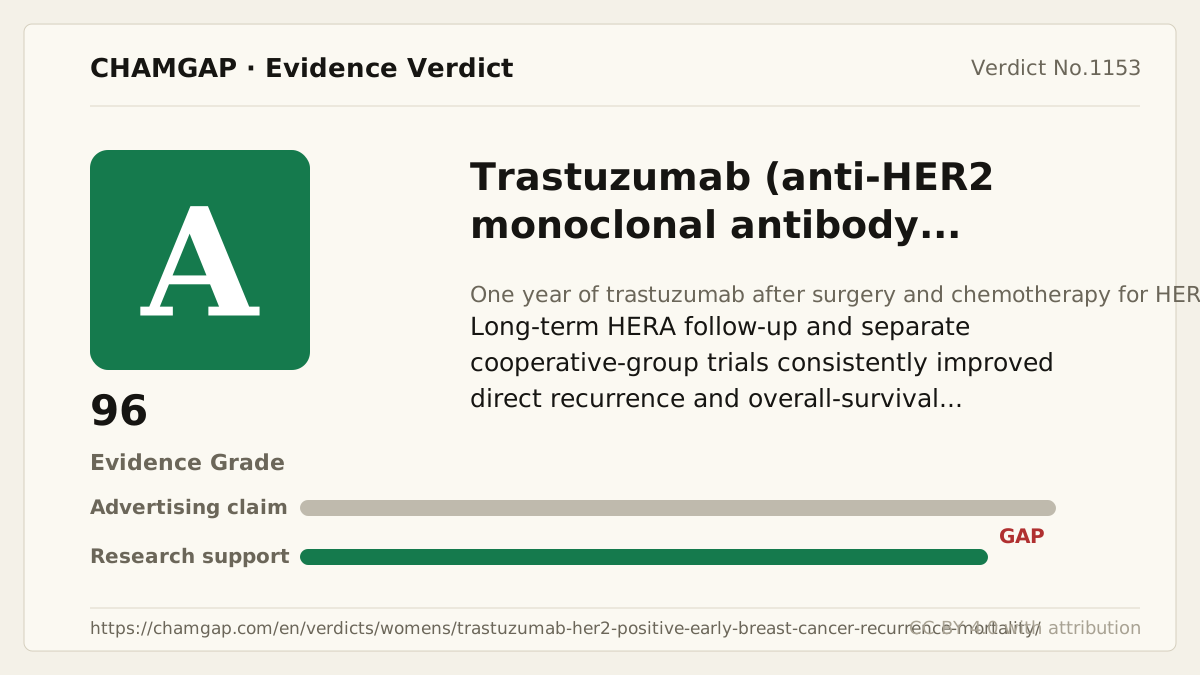
[Chamgap] Trastuzumab x reduced recurrence and mortality after surgery and chemotherapy for HER2-positive early breast cancer — Evidence Grade A·96. 2 cited sources checked. Source: https://chamgap.com/en/verdicts/womens/trastuzumab-her2-positive-early-breast-cancer-recurrence-mortality/ · CC BY 4.0CC BY 4.0 — free to use with attribution; do not distort grades, numbers, or verdict meaning.
What this document does and does not do
Chamgap is an information source. It reports what research has and has not confirmed; it does not tell readers what to take or buy. That decision belongs to readers and, when needed, medical or legal professionals. This verdict reflects literature available up to the search date and may change as new research appears. Nothing here is medical advice.