
Magnesium sulfate,
does it really help with Prevention of eclamptic seizures in pregnant women with pre-eclampsia?
research showsMagnesium sulfate is rated A for preventing eclamptic seizures in women with pre-eclampsia. In the 10,141-participant Magpie randomized placebo-controlled trial across 33 countries, eclampsia fell from 1.9% to 0.8%, a 58% relative reduction and about 11 seizures prevented per 1,000 women. A 2010 Cochrane review confirmed RR 0.41 (95% CI 0.29 to 0.58) across six placebo or no-anticonvulsant trials and 11,444 women. Among women with established eclampsia, the 1,687-participant Collaborative Eclampsia Trial also reduced recurrent seizures by 52% versus diazepam and 67% versus phenytoin. The very large randomized direct seizure outcome and concordant synthesis support A with 96 points. Loss of reflexes, respiratory depression, and magnesium toxicity remain separate safety issues requiring hospital monitoring.
ads claimClinical summaries can blur magnesium sulfate into a general treatment for pre-eclampsia. Its strongest evidence is prevention and recurrence control of seizures; it does not replace blood-pressure treatment or delivery decisions, and reductions in maternal or fetal death are not established.
Useful facts when choosing a product
- Magnesium sulfate is a prescription intravenous or intramuscular anticonvulsant used to prevent and control eclamptic seizures; it is not itself the primary antihypertensive treatment.
- Clinical regimens use an intravenous loading dose followed by continuous infusion or a combined intravenous and intramuscular regimen, with the exact dose and duration set by the obstetric protocol and kidney function.
- Magnesium is cleared mainly by the kidneys, so urine output, respiratory rate, and deep-tendon reflexes require repeated checks, with serum magnesium measured when renal impairment or toxicity is suspected.
- Flushing, nausea, and weakness can occur; overdose can cause loss of reflexes, respiratory depression, cardiac conduction disturbance, and cardiac arrest, so monitored facilities and a calcium antidote must be available.
Chamgap Semantic Classification Code
Candidate index · review held
M.magnesium-sulfate.MULTI.eclamptic-seizures-with-pre-eclampsia.prevent.MULTIMedicinal interventions > Magnesium sulfate > Multiple: primary unresolved > eclamptic seizures with pre-eclampsia > Occurrence-prevention claim > Multiple: primary unresolved
An automated migration candidate, not an issued permanent code; exact claim scope remains under review. This machine-generated migration candidate helps retrieval but is not a permanent assignment. The original verdict ID and URL remain authoritative.
What the research actually shows
Altman, Carroli, Duley, and colleagues with the Magpie Trial Collaboration Group assigned 10,141 women with blood pressure at least 140/90 mm Hg and proteinuria to magnesium sulfate or placebo. Eclampsia occurred in 40 of 5,071 versus 96 of 5,070, a 58% reduction, while 24% versus 5% reported side effects, mainly flushing. The Cochrane review by Duley and colleagues included 15 trials and confirmed eclampsia RR 0.41 among 11,444 women in six placebo or no-treatment comparisons. In the separate 1,687-participant Collaborative Eclampsia Trial, recurrent convulsions were 13.2% versus 27.9% against diazepam and 5.7% versus 17.1% against phenytoin, demonstrating a direct effect on recurrence after eclampsia has occurred.
Why this is classified as A (96)
Magpie directly reduced eclampsia from 1.9% to 0.8% among 10,141 women, a 58% reduction, and the Cochrane synthesis of six trials and 11,444 women found RR 0.41. Reduced recurrent seizures in the 1,687-participant eclampsia trial provide further support, meeting the A standard for a very large international randomized hard maternal outcome and yielding 96 points. Maternal and fetal mortality remain separate unproven subclaims, while respiratory depression, reflex loss, and renal-function-related toxicity remain independent safety concerns.
Counterpoint. Prevention decisions require assessment of pre-eclampsia severity, delivery timing, and postpartum risk. Blood-pressure control, maternal organ and fetal monitoring, and an appropriate delivery plan remain necessary while magnesium sulfate is used.
Rejudgment record. New verdict — Applied A because the direct hard maternal endpoint converged across Magpie, with eclampsia 1.9% versus 0.8% in 10,141 women, the Cochrane estimate of RR 0.41 across six placebo or no-treatment trials and 11,444 women, and reduced recurrent seizures in the Collaborative Eclampsia Trial; kept maternal and fetal mortality and toxicity separate as subclaim and safety issues
Sub-claim grades by effect
This ingredient is marketed for several effects. A single overall grade blends strong and weak claims together, so each effect is graded separately here. The overall grade reflects the strongest disconfirming or core claim.
| Effect (sub-claim) | Grade | Basis |
|---|---|---|
| Prevention of a first eclamptic seizure in women with pre-eclampsia | A | Magpie found 1.9% versus 0.8% among 10,141 women, and six Cochrane trials with 11,444 women gave RR 0.41. |
| Prevention of recurrent seizures in women with established eclampsia | A | In the 1,687-participant international trial, recurrence was 52% lower than with diazepam and 67% lower than with phenytoin. |
| Reduction in maternal death associated with pre-eclampsia | D | Point estimates favored treatment, but Magpie RR 0.55 (95% CI 0.26 to 1.14) and Cochrane RR 0.54 (0.26 to 1.10) did not establish a significant reduction in large human evidence. |
Cross-check — AI research and Codex final gate
Evidence Table
| Study | Design | Sample | Funding | Endpoint | Result | Weight |
|---|---|---|---|---|---|---|
| Altman and the Magpie Trial Collaboration Group. 2002 | Multicenter randomized placebo-controlled trial across 33 countries | 10,141 women with pre-eclampsia | International academic collaborative trial; detailed funding was not stated in the PubMed abstract | Eclampsia and death of the baby among women randomized before delivery | Eclampsia was 0.8% versus 1.9%, a 58% risk reduction; maternal death RR was 0.55 (95% CI 0.26 to 1.14), and baby death RR was 1.02. | Grade-defining very large randomized trial with a direct hard maternal outcome |
| Duley and colleagues, Cochrane review. 2010 | Systematic review and meta-analysis of randomized anticonvulsant trials in pre-eclampsia | 15 trials; six placebo or no-treatment randomized trials with 11,444 women | Academic Cochrane review; the Magpie principal investigator was excluded from assessment and extraction of that trial | Eclampsia, maternal death, severe maternal morbidity, fetal or neonatal death, and adverse effects | Magnesium sulfate more than halved eclampsia, RR 0.41 (95% CI 0.29 to 0.58), while maternal mortality was nonsignificantly lower. | Multitrial synthesis confirming the core prevention effect |
| Eclampsia Trial Collaborative Group. 1995 | International multicenter randomized active-controlled trial | 1,687 women with eclampsia; 1,680 with available data | International academic collaborative trial; detailed funding not confirmed | Recurrent convulsions and maternal death | Recurrent convulsions fell by 52% versus diazepam, 13.2% versus 27.9%, and by 67% versus phenytoin, 5.7% versus 17.1%. | Direct supportive evidence for recurrence prevention after established eclampsia |
Receipt — 3 References
All 3 cited sources were verified for existence at the original page (as of 2026-07-22).
Final verification and publication gate: Codex · Evidence date: 2026-07-22 · Corrections: none
Cite this verdict
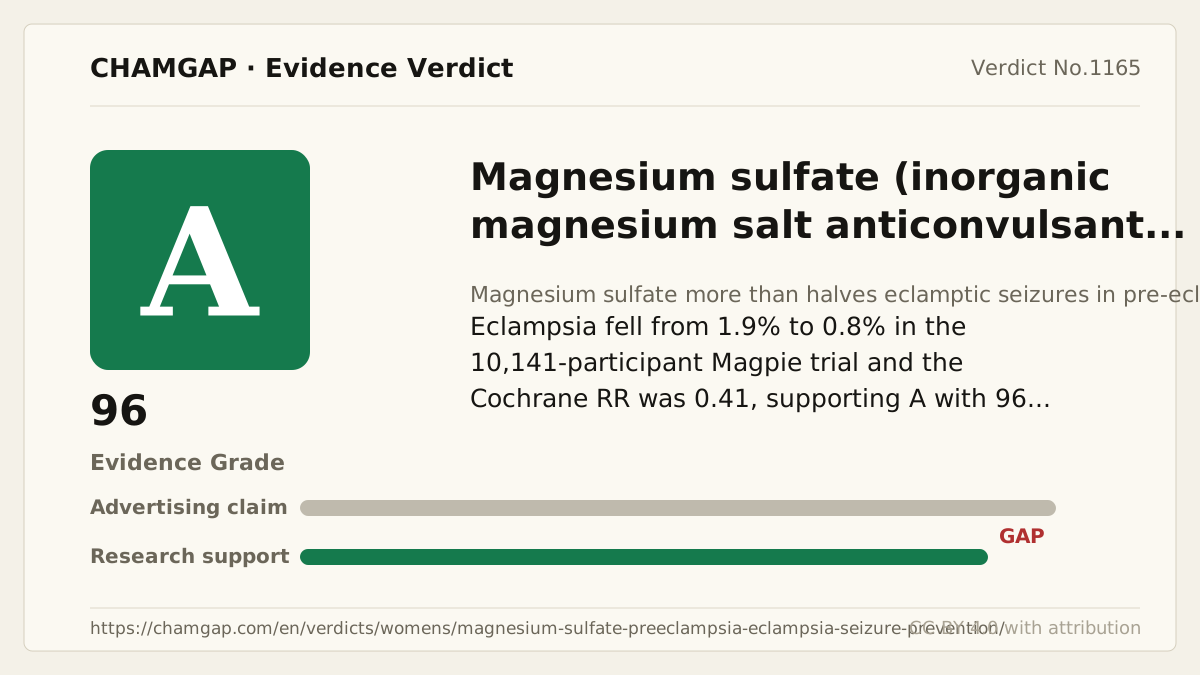
[Chamgap] Magnesium sulfate x prevention of eclamptic seizures in pre-eclampsia — Evidence Grade A·96. 3 cited sources checked. Source: https://chamgap.com/en/verdicts/womens/magnesium-sulfate-preeclampsia-eclampsia-seizure-prevention/ · CC BY 4.0CC BY 4.0 — free to use with attribution; do not distort grades, numbers, or verdict meaning.
What this document does and does not do
Chamgap is an information source. It reports what research has and has not confirmed; it does not tell readers what to take or buy. That decision belongs to readers and, when needed, medical or legal professionals. This verdict reflects literature available up to the search date and may change as new research appears. Nothing here is medical advice.