
Ursodeoxycholic acid,
does it really help with Reduction of adverse perinatal outcomes in intrahepatic cholestasis of pregnancy?
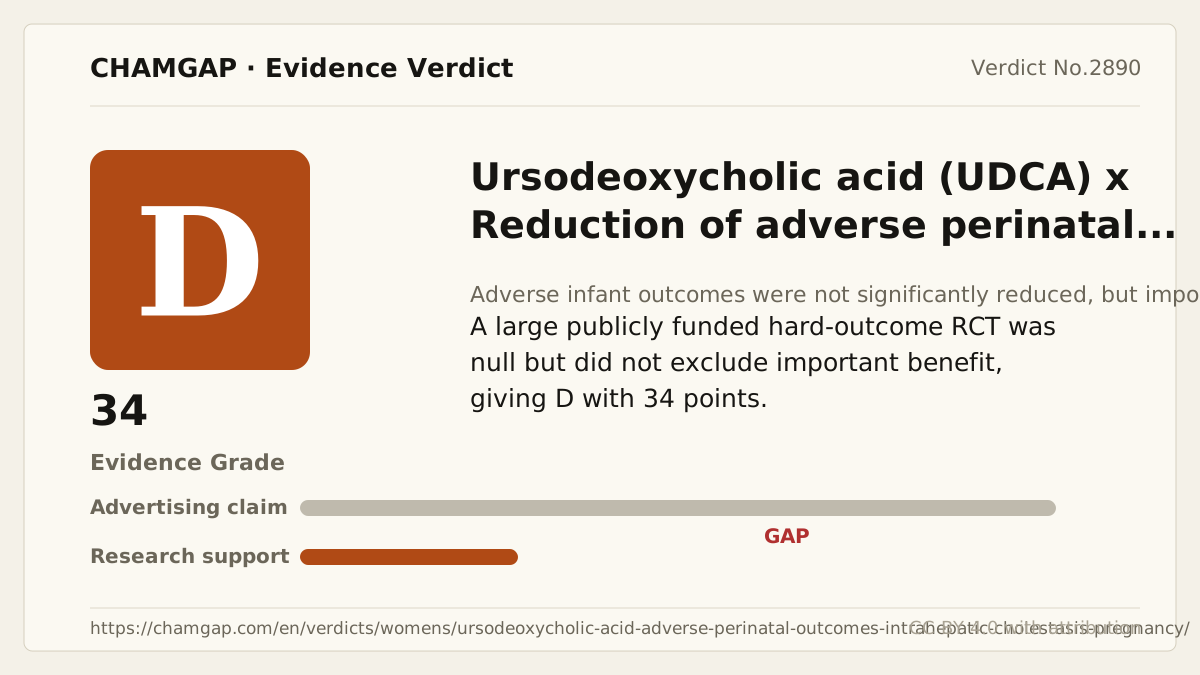
research showsGrade D. Perinatal death, preterm birth before 37 weeks, or neonatal-unit admission for at least 4 hours occurred in 74/322 (23%) versus 85/318 (27%), adjusted RR 0.85 (95% CI 0.62-1.15), absolute difference -4 points. The result was null, but the interval retains a potentially important 38% relative reduction.
ads claimUse of UDCA in other cholestatic diseases does not prove protection of infants in intrahepatic cholestasis of pregnancy.
Useful facts when choosing a product
- 605 women were randomized at 33 UK maternity units.
- Serious adverse events were 2 versus 6; none was considered treatment-related.
Chamgap Semantic Classification Code
Candidate index · review held
UNK.ursodeoxycholic-acid.UNK.adverse-perinatal-outcomes-in-intrahepatic-cholestasis-of-pregnancy.reduce.placeboUnknown > Ursodeoxycholic acid > Unknown > adverse perinatal outcomes in intrahepatic cholestasis of pregnancy > Reduction claim > Placebo
An automated migration candidate, not an issued permanent code; exact claim scope remains under review. This machine-generated migration candidate helps retrieval but is not a permanent assignment. The original verdict ID and URL remain authoritative.
What the research actually shows
Axis 6 B0 evidence ① Allocation concealment: "Randomisation was done via a secure web-based randomisation facility." ② Blinding: "women, clinicians, outcome assessors, and analysts were masked to allocation." ③ Analysis set and missingness: "All analyses were done according to the intention-to-treat principle"; one of 605 withdrew data consent. ④ Prespecified primary endpoint: registered death, preterm birth, or neonatal admission composite - consistent with ISRCTN91918806
Four gates: ① Defect: none. ② Listed item: none. ③ Evidence: secure central web allocation, full masking, ITT, registered endpoint. ④ Avoidability: apart from 1/605 (0.17%) consent withdrawal, no confirmed avoidable defect. Funded by the NIHR Efficacy and Mechanism Evaluation Programme.
Why this is classified as D (34)
A large public hard-outcome RCT was null, but its CI did not exclude important benefit, giving D with 34 points.
Counterpoint. A small secondary itch improvement cannot substitute for infant outcomes.
Rejudgment record. Source verified — Large public hard-outcome RCT with a confidence interval retaining important benefit
| Endpoint | H | Hard endpoint - actual events such as death |
| Replication | R1 | Single confirmatory trial |
| Independence | I2 | Decisive evidence is publicly or non-profit funded |
| Effect size | E0 | Null |
| Precision | C0 | The confidence interval leaves room for benefit |
Stored derived and displayed grades match; this is not a current recalculation or validity check (D).
Sub-claim grades by effect
This ingredient is marketed for several effects. A single overall grade blends strong and weak claims together, so each effect is graded separately here. The overall grade reflects the strongest disconfirming or core claim.
| Effect (sub-claim) | Grade | Basis |
|---|---|---|
| Reduced adverse perinatal composite | D | RR 0.85 (0.62-1.15) was null but did not exclude important benefit. |
| Maternal itch improvement | C | Secondary itch improved slightly by -5.7 mm. |
Cross-check — AI research and Codex final gate
Evidence Table
| Study | Design | Sample | Funding | Endpoint | Result | Weight |
|---|---|---|---|---|---|---|
| Chappell LC et al. 2019 PITCHES | 33-center double-blind placebo-controlled randomized trial | 605 randomized (305/300); 604 analyzed | Public NIHR Efficacy and Mechanism Evaluation Programme funding | Composite of perinatal death, birth before 37 weeks, or neonatal-unit admission for at least 4 hours | 74/322 (23%) versus 85/318 (27%), adjusted RR 0.85 (95% CI 0.62-1.15), absolute difference -4 points | Large publicly funded null hard-outcome trial |
Receipt — 1 References
All 1 cited sources were verified for existence at the original page (as of 2026-08-26).
Final verification and publication gate: Codex · Evidence date: 2026-08-26 · Corrections: none
Cite this verdict
[Chamgap] No Benefit of Ursodeoxycholic Acid for Adverse Perinatal Outcomes in Intrahepatic Cholestasis of Pregnancy — Evidence Grade D·34. 1 cited sources checked. Source: https://chamgap.com/en/verdicts/womens/ursodeoxycholic-acid-adverse-perinatal-outcomes-intrahepatic-cholestasis-pregnancy/ · CC BY 4.0CC BY 4.0 — free to use with attribution; do not distort grades, numbers, or verdict meaning.
What this document does and does not do
Chamgap is an information source. It reports what research has and has not confirmed; it does not tell readers what to take or buy. That decision belongs to readers and, when needed, medical or legal professionals. This verdict reflects literature available up to the search date and may change as new research appears. Nothing here is medical advice.