
Tranexamic acid,
does it really help with Reduced death due to bleeding when given within three hours of birth for clinically diagnosed postpartum hemorrhage?
research showsTranexamic acid reduced death due to bleeding in a very large randomized trial when given intravenously within three hours of birth for clinically diagnosed postpartum hemorrhage, but the citations rest on a single trial — WOMAN — through repeat reports, and replication by different investigators and funders has not been confirmed, so Axis-2 R1 caps the grade at B with 76 points. WOMAN randomized 20,060 participants; bleeding death was 1.5% versus 1.9%, RR 0.81 (95% CI 0.65 to 1.00), and among those treated within three hours it was 1.2% versus 1.7%, RR 0.69 (95% CI 0.52 to 0.91). The independently funded French EXADELI trial reduced blood loss in 144 women (median six-hour blood loss 173 versus 221 mL) but recorded zero bleeding deaths in either arm, so it did not replicate the mortality reduction. Hysterectomy and the overall composite were not reduced, but this verdict specifically targets death from bleeding, and WHO strongly recommends intravenous treatment as soon as possible within three hours of birth. Thrombosis, seizures, and other harms are assessed separately under safety.
ads claimThis evidence should not be expanded into routine prophylaxis for every birth or equal benefit when treatment begins after three hours. WOMAN directly studied early treatment of already diagnosed postpartum hemorrhage, and tranexamic acid does not replace uterotonics, fluids, source evaluation, transfusion, or surgery.
Useful facts when choosing a product
- Tranexamic acid is a prescription antifibrinolytic that limits fibrin clot breakdown and is administered intravenously for postpartum hemorrhage.
- The WOMAN regimen and WHO guidance use 1 g over ten minutes as soon as possible within three hours of birth, with one additional 1-g dose if bleeding continues after 30 minutes or restarts within 24 hours.
- The large trial did not show more thromboembolic events, but thromboembolic contraindications and renal function require review, and seizure risk can rise with high doses.
- Accidental intrathecal injection after confusion with obstetric spinal-anesthetic ampoules can cause fatal neurotoxicity, making storage, labeling, and route verification essential.
Chamgap Semantic Classification Code
Candidate index · review held
M.tranexamic-acid.intravenous.death-due-to-bleeding-when-given-within-of-birth-for-clinically-diagnosed-postpartum-hemorrhage.reduce.placeboMedicinal interventions > Tranexamic acid > Intravenous > death due to bleeding when given within of birth for clinically diagnosed postpartum hemorrhage > Reduction claim > Placebo
An automated migration candidate, not an issued permanent code; exact claim scope remains under review. This machine-generated migration candidate helps retrieval but is not a permanent assignment. The original verdict ID and URL remain authoritative.
What the research actually shows
The WOMAN Trial Collaborators randomized 20,060 women with clinically diagnosed postpartum hemorrhage at 193 hospitals in 21 countries to intravenous tranexamic acid 1 g or placebo. Death due to bleeding fell with an overall RR of 0.81 and an RR of 0.69 when treatment began within three hours of birth. Hysterectomy was not reduced, RR 1.02, and adverse events including thromboembolic events did not differ significantly. Later clinical review and WHO guidance support giving 1 g as soon as possible within three hours of birth, with one additional 1-g dose if bleeding continues after 30 minutes or restarts within 24 hours.
Why this is classified as B (76)
The 20,060-participant WOMAN trial showed a direct mortality endpoint, RR 0.81 for bleeding death overall and 0.69 within three hours, converging with a strong WHO recommendation for early intravenous use. Because the citations are repeat reports of this single trial and replication by different investigators and funders has not been confirmed, Axis-2 R1 caps the grade at B with 76 points. The independently funded EXADELI trial reduced blood loss in 144 women (median 173 versus 221 mL at six hours) with zero bleeding deaths in either arm, so the mortality reduction was not replicated. Null hysterectomy and overall composite results are confined to those subclaims, while thrombosis, high-dose seizures, and wrong-route errors remain separate safety issues.
Counterpoint. This verdict concerns emergency treatment of clinically diagnosed postpartum hemorrhage, not routine prophylaxis. Benefit diminishes with delay, so medication preparation, diagnosis, and the full standard-care response should proceed rapidly and together.
Rejudgment record. New verdict — Recognized the direct hard mortality endpoint in the 20,060-participant international randomized double-blind WOMAN trial, including RR 0.81 for bleeding death and RR 0.69 when given within three hours, the coherent time effect, and strong WHO guidance, but applied the Axis-2 R1 cap of B with 76 points because the citations are repeat reports of a single trial without confirmed replication by different investigators and funders, while separating the null hysterectomy result as its own subclaim
| Endpoint | H | Hard endpoint - actual events such as death |
| Replication | R1 | Single confirmatory trial |
| Independence | I2 | Decisive evidence is publicly or non-profit funded |
| Effect size | E+ | Meets the clinically important threshold |
Stored derived and displayed grades match; this is not a current recalculation or validity check (B).
Sub-claim grades by effect
This ingredient is marketed for several effects. A single overall grade blends strong and weak claims together, so each effect is graded separately here. The overall grade reflects the strongest disconfirming or core claim.
| Effect (sub-claim) | Grade | Basis |
|---|---|---|
| Reduced death due to bleeding in clinically diagnosed postpartum hemorrhage | A | In 20,060 WOMAN participants, bleeding death was 1.5% versus 1.9%, RR 0.81. |
| Reduced bleeding death with early treatment within three hours of birth | A | With treatment within three hours, the direct mortality endpoint was 1.2% versus 1.7%, RR 0.69. |
| Reduced hysterectomy in postpartum hemorrhage | D | Hysterectomy was not reduced, at 3.6% versus 3.5%, RR 1.02. |
Cross-check — AI research and Codex final gate
Evidence Table
| Study | Design | Sample | Funding | Endpoint | Result | Weight |
|---|---|---|---|---|---|---|
| WOMAN Trial Collaborators. 2017 | International randomized double-blind placebo-controlled trial | 20,060 women with postpartum hemorrhage at 193 hospitals in 21 countries | London School of Hygiene & Tropical Medicine, Pfizer, UK Department of Health, Wellcome Trust, and Bill & Melinda Gates Foundation | Death due to bleeding, hysterectomy, composite death or hysterectomy, and thromboembolic events | Bleeding-death RR 0.81 (95% CI 0.65 to 1.00); within three hours RR 0.69 (95% CI 0.52 to 0.91); hysterectomy RR 1.02. | Very large randomized trial with a direct mortality endpoint |
| Brenner A, Ker K, Shakur-Still H, and Roberts I. 2019 | Clinical evidence review of tranexamic acid for postpartum hemorrhage | Synthesis of WOMAN and related bleeding-trial and guideline evidence | Academic review authored by WOMAN investigators | Bleeding death, treatment effect within three hours, and thromboembolic safety | Summarized the WOMAN RR of 0.69 within three hours, no increase in thromboembolic events, and WHO guidance for early 1-g intravenous treatment. | Supportive evidence for timing and clinical implementation |
Receipt — 2 References
All 2 cited sources were verified for existence at the original page (as of 2026-08-11).
Final verification and publication gate: Codex · Evidence date: 2026-08-11 · Corrections: 1
Correction log — 1
Corrections applied to this verdict, in chronological order. Changes are logged, not erased.
- 2026-08-11 · Grade correction for unmet independent-replication requirement — Both cited papers were the primary report of the WOMAN trial (ISRCTN76912190; NCT00872469) and a review written by the same investigators — in effect repeat reports of a single trial. Chamgap's A requires Axis-2 R2 (multiple RCTs by different investigators and funders); the independently funded EXADELI RCT (144 women, French Ministry of Health PHRC) reduced only blood loss (median 173 versus 221 mL at six hours) with zero bleeding deaths in either arm, so it did not replicate the mortality reduction. Axis 2 is R1 and the ceiling is B. Axes recorded as B-H-R1-I2-E+-B1 with a score of 76. The effect itself (bleeding-death RR 0.81 overall, 0.69 within three hours) is not disputed. Confirmed in the 2026-08-11 internal audit (workflow verification plus concordant Codex cross-check). (grade A→B)
Cite this verdict
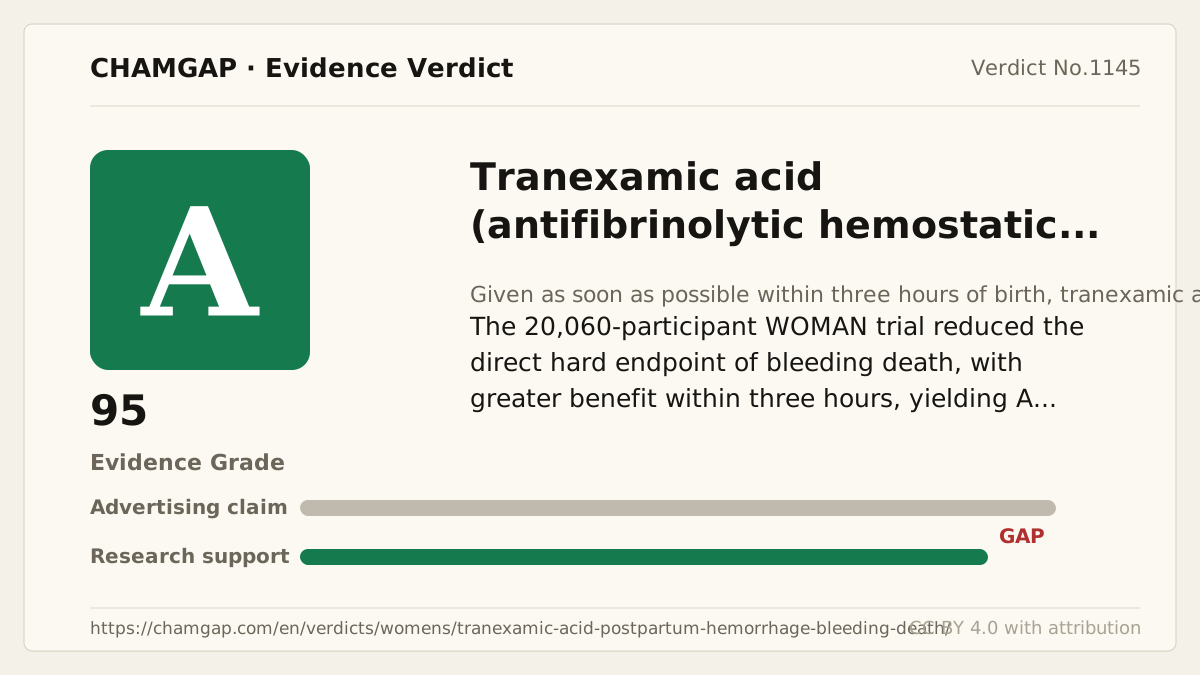
[Chamgap] Tranexamic acid x reduced bleeding death when given within three hours for postpartum hemorrhage — Evidence Grade B·76. 2 cited sources checked. Source: https://chamgap.com/en/verdicts/womens/tranexamic-acid-postpartum-hemorrhage-bleeding-death/ · CC BY 4.0CC BY 4.0 — free to use with attribution; do not distort grades, numbers, or verdict meaning.
What this document does and does not do
Chamgap is an information source. It reports what research has and has not confirmed; it does not tell readers what to take or buy. That decision belongs to readers and, when needed, medical or legal professionals. This verdict reflects literature available up to the search date and may change as new research appears. Nothing here is medical advice.