
Seven-day metronidazole,
does it really help with Reduced persistent infection or positive test of cure in women with trichomoniasis?
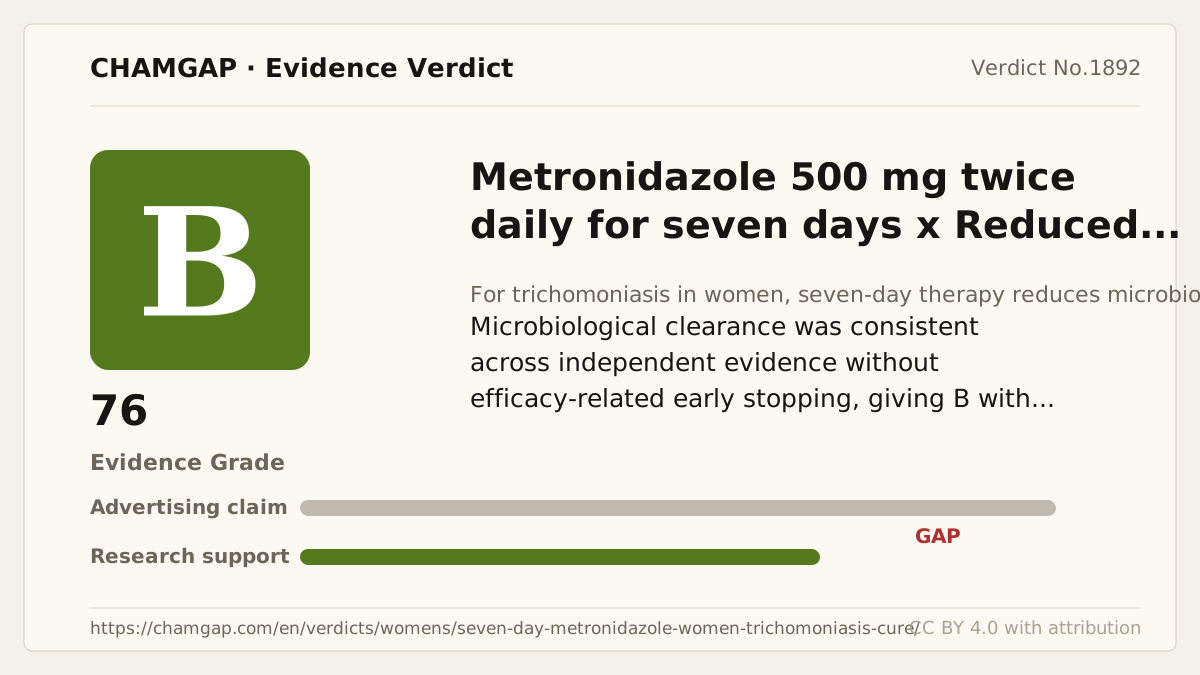
research showsThe grade is B. The trial randomized 623 women, 312 to seven-day therapy and 311 to a single dose, and 540 (86.7%) actually returned for four-week testing. In the multiply imputed all-randomized analysis, treatment failure was 34 of 312 (10.9%) versus 58 of 311 (18.6%), RR 0.55 (95% CI 0.34 to 0.70), an absolute difference of 7.7 percentage points and NNT 13. Enrollment ended for funding limits, not efficacy stopping, giving B with 76 points.
ads claimThe evidence compares seven days of 500 mg twice daily with a single 2-g dose in women with confirmed trichomoniasis. It does not support indiscriminate use for every vaginitis syndrome or prevention.
Useful facts when choosing a product
- The graded outcome is microbiological clearance after treatment in women.
- The pivotal comparison was a single 2-g dose versus 500 mg twice daily for seven days, not merely a comparison of equal total doses.
- Alcohol avoidance, drug interactions, pregnancy or lactation, and comorbidities should be reviewed with the prescriber; partner treatment and reinfection prevention also matter.
Chamgap Semantic Classification Code
Candidate index · review held
UNK.metronidazole-twice.UNK.persistent-infection-or-positive-test-of-cure-with-trichomoniasis.reduce.UNKUnknown > Metronidazole twice > Unknown > persistent infection or positive test of cure with trichomoniasis > Reduction claim > Unknown
An automated migration candidate, not an issued permanent code; exact claim scope remains under review. This machine-generated migration candidate helps retrieval but is not a permanent assignment. The original verdict ID and URL remain authoritative.
What the research actually shows
This NIH-supported multicenter trial assigned 623 women to seven-day therapy, 312, or single-dose therapy, 311. A total of 540 (86.7%) had an observed four-week test, while the primary analysis used multiple imputation for all 623 randomized participants. Failure was 34 of 312 (10.9%) versus 58 of 311 (18.6%), RR 0.55 (95% CI 0.34 to 0.70), absolute difference 7.7 percentage points, and NNT 13. Funding limits ended enrollment below the planned 1,664, but this was not efficacy-related early stopping. The primary endpoint was microbiological cure, not symptom resolution.
Why this is classified as B (76)
Clearance of infection is a direct treatment target and was replicated in a publicly funded randomized trial and prior clinical trials; funding-limited enrollment was not efficacy stopping, giving B with 76 points.
Counterpoint. About 11% still tested positive after the seven-day regimen, so cure is not guaranteed and adherence and reinfection require attention.
Rejudgment record. Cross-check applied — A publicly funded randomized trial and multiple earlier clinical trials consistently improved objective microbiological cure, and funding-limited enrollment was not efficacy-related early stopping
| Endpoint | P | Symptom or function itself is the target - including patient reports and performance tests |
| Replication | R2 | Independently replicated across trials |
| Independence | I2 | Decisive evidence is publicly or non-profit funded |
| Effect size | E+ | Meets the clinically important threshold |
Stored derived and displayed grades match; this is not a current recalculation or validity check (B).
Sub-claim grades by effect
This ingredient is marketed for several effects. A single overall grade blends strong and weak claims together, so each effect is graded separately here. The overall grade reflects the strongest disconfirming or core claim.
| Effect (sub-claim) | Grade | Basis |
|---|---|---|
| Reduced positive trichomoniasis test at four weeks | B | The primary endpoint succeeded in the 623-participant ITT population. |
| Reduced treatment failure versus single-dose therapy | B | The modern trial and six-trial meta-analysis point in the same direction. |
| Treatment benefit regardless of concomitant bacterial vaginosis | B | The pivotal trial found no significant interaction with bacterial vaginosis. |
Cross-check — AI research and Codex final gate
Evidence Table
| Study | Design | Sample | Funding | Endpoint | Result | Weight |
|---|---|---|---|---|---|---|
| Kissinger P et al. 2018 | Open-label randomized multicenter superiority trial | 623 randomized (312 seven-day/311 single-dose); actual primary ITT included all 623 | Public funding from the United States NIH and NIAID; no manufacturer support reported | Primary endpoint: positive culture or nucleic acid test four weeks after treatment completion | Observed four-week tests numbered 540 (86.7%); multiply imputed all-randomized analysis found 34/312 (10.9%) versus 58/311 (18.6%), RR 0.55 (95% CI 0.34 to 0.70), absolute difference 7.7 points, NNT 13. Enrollment ended for funding limits. | Pivotal modern publicly funded randomized trial |
| Howe K and Kissinger PJ. 2017 | Meta-analysis of clinical trials comparing single- and multidose metronidazole | Six clinical trials | No specific funding reported by the authors; not manufacturer-led | Trichomoniasis treatment failure | Single-dose therapy had higher failure, RR 1.87 (95% CI 1.23 to 2.82), P<0.01. | Independent synthesis supporting replication |
Receipt — 2 References
All 2 cited sources were verified for existence at the original page (as of 2026-07-24).
Final verification and publication gate: Codex · Evidence date: 2026-07-24 · Corrections: none
Cite this verdict
[Chamgap] Seven-day metronidazole x successful treatment of trichomoniasis in women — Evidence Grade B·76. 2 cited sources checked. Source: https://chamgap.com/en/verdicts/womens/seven-day-metronidazole-women-trichomoniasis-cure/ · CC BY 4.0CC BY 4.0 — free to use with attribution; do not distort grades, numbers, or verdict meaning.
What this document does and does not do
Chamgap is an information source. It reports what research has and has not confirmed; it does not tell readers what to take or buy. That decision belongs to readers and, when needed, medical or legal professionals. This verdict reflects literature available up to the search date and may change as new research appears. Nothing here is medical advice.