
Saffron,
does it really help with Relief of mood and physical symptoms of PMS or PMDD?
research showsSaffron is rated C despite a positive PMS and PMDD symptom signal. A 2020 trial randomized and analyzed 120 participants; its DRSP primary change was -22.59 with saffron and -15.30 with placebo (P=0.027). The between-group HAM-D result failed (P=0.080), however, and evidence remains concentrated in small, short Iranian trials, invoking rule ①-ⓒ.
ads claimEarly signals must not be marketed as an established replacement therapy or certain normalization of every symptom.
Useful facts when choosing a product
- Trials commonly used 15 mg twice daily.
- Culinary saffron and standardized capsules do not necessarily have matching composition.
- Persistent functional impairment warrants evaluation because PMS and PMDD differ in severity and diagnosis.
Chamgap Semantic Classification Code
Candidate index · review held
S.saffron.UNK.mood-and-physical-symptoms-of-pms-or-pmdd.relieve.MULTISupplements and nutraceuticals > Saffron > Unknown > mood and physical symptoms of PMS or PMDD > Symptom-relief claim > Multiple: primary unresolved
An automated migration candidate, not an issued permanent code; exact claim scope remains under review. This machine-generated migration candidate helps retrieval but is not a permanent assignment. The original verdict ID and URL remain authoritative.
What the research actually shows
Rajabi 2020 randomized 120 women with PMDD across three groups for two menstrual cycles; the DRSP primary endpoint succeeded while the Hamilton between-group result failed. Agha-Hosseini 2008 reported symptom responses in a 50-person, two-cycle placebo-controlled PMS trial. Both were small short Iranian studies.
Why this is classified as C (52)
The direct symptom primary endpoint succeeded, but inconsistent scales and small, short, Iranian evidence invoke rule ①-ⓒ and support C with 52 points.
Counterpoint. A short-term adjunct may be plausible, but equivalence to standard therapy and prevention of recurrence are unproven.
Rejudgment record. Cross-check applied — DRSP is a direct patient-symptom endpoint and the primary analysis was positive, but another scale failed and the small short single-country evidence invokes the rule ①-ⓒ ceiling of C
Sub-claim grades by effect
This ingredient is marketed for several effects. A single overall grade blends strong and weak claims together, so each effect is graded separately here. The overall grade reflects the strongest disconfirming or core claim.
| Effect (sub-claim) | Grade | Basis |
|---|---|---|
| Improvement of overall daily PMDD symptoms | C | The DRSP primary endpoint was positive in a small single-country trial. |
| Improvement of mood symptoms in PMS | C | Small-trial signals exist, but results differ across scales. |
| Improvement of physical symptoms in PMS | C | Direct symptom signals exist without independent large replication. |
Cross-check — AI research and Codex final gate
Evidence Table
| Study | Design | Sample | Funding | Endpoint | Result | Weight |
|---|---|---|---|---|---|---|
| Rajabi F et al. 2020 | Randomized three-arm placebo- and active-controlled trial | 120 randomized; 120 reportedly analyzed (40 per group) | Study from Isfahan University of Medical Sciences; Novin Saffron supplied the study product | Primary DRSP symptom score | DRSP change -22.59 versus -15.30, success (P=0.027); HAM-D between-group comparison failed (P=0.080). | Key direct symptom evidence |
| Agha-Hosseini M et al. 2008 | Randomized double-blind placebo-controlled trial | 50 randomized; 47 completed and were analyzed | No external manufacturer funding clearly reported; Iranian academic study | Daily Symptom Report total PMS symptoms and Hamilton depression score | Symptom response after two menstrual cycles favored saffron over placebo. | Small replication evidence |
Receipt — 2 References
All 2 cited sources were verified for existence at the original page (as of 2026-07-24).
Final verification and publication gate: Codex · Evidence date: 2026-07-24 · Corrections: none
Cite this verdict
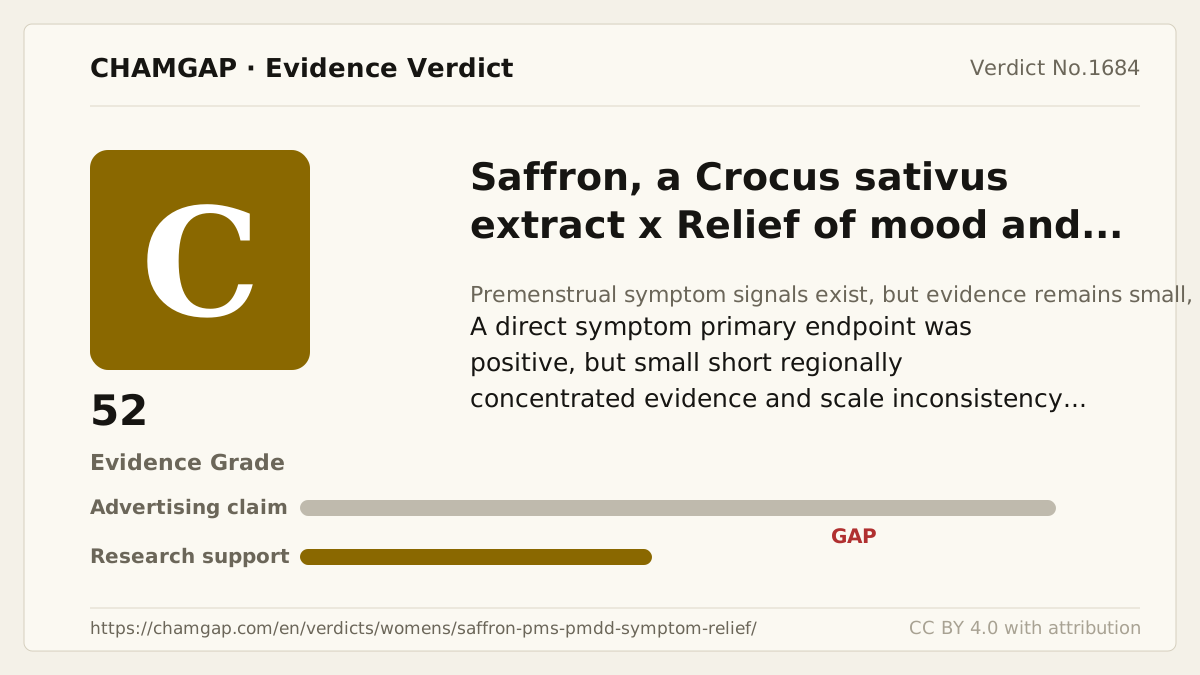
[Chamgap] Saffron x relief of PMS and PMDD symptoms — Evidence Grade C·52. 2 cited sources checked. Source: https://chamgap.com/en/verdicts/womens/saffron-pms-pmdd-symptom-relief/ · CC BY 4.0CC BY 4.0 — free to use with attribution; do not distort grades, numbers, or verdict meaning.
What this document does and does not do
Chamgap is an information source. It reports what research has and has not confirmed; it does not tell readers what to take or buy. That decision belongs to readers and, when needed, medical or legal professionals. This verdict reflects literature available up to the search date and may change as new research appears. Nothing here is medical advice.