
Long-term rotating night shift,
does it really help with Increased incidence of invasive breast cancer?
research showsThe grade is D with 34 points. The broad claim that night-shift work increases breast cancer cannot be supported by sparse subcategories. In the larger NHS cohort, at least 30 years gave HR 0.95 (95% CI 0.77 to 1.17), trend P=.63, a null result. The apparently positive values came from younger NHS II: baseline exposure of at least 20 years gave HR 2.15 (1.23 to 3.73; 13 cases), and updated cumulative exposure gave 1.40 (1.00 to 1.97; 35 cases), with nonsignificant trend tests of P=.23 and P=.74.
ads claimThis observed work history does not quantify the preventive effect of leaving night work.
Useful facts when choosing a product
- Exposure required at least three nights per month plus rotating day or evening work.
- NHS and NHS II included 193,075 women and 9,541 invasive cancers over 24 years.
- NHS II partly updated exposure; NHS relied on baseline long-term history.
Chamgap Semantic Classification Code
Candidate index · review held
UNK.long-term-rotating-night-shift-history.UNK.incidence-of-invasive-breast-cancer.increase.UNKUnknown > Long-term rotating night-shift history > Unknown > incidence of invasive breast cancer > Increase claim > Unknown
An automated migration candidate, not an issued permanent code; exact claim scope remains under review. This machine-generated migration candidate helps retrieval but is not a permanent assignment. The original verdict ID and URL remain authoritative.
What the research actually shows
Wegrzyn et al. followed 78,516 NHS and 114,559 NHS II participants through 2012 and 2013. Rotating night work meant at least three nights per month plus day or evening shifts and was self-reported in years. NHS used baseline history; NHS II had some updates. In NHS, at least 30 years gave HR 0.95 (0.77 to 1.17), trend P=.63. In NHS II, baseline exposure of at least 20 years gave HR 2.15 (1.23 to 3.73; 13 cases), trend P=.23, while updated cumulative exposure gave HR 1.40 (1.00 to 1.97; 35 cases), trend P=.74. An early-cancer exclusion sensitivity analysis was not verified. IARC classification was not used as a grading basis. Verdict 2244 is C with 54 points and uses overlapping NHS-network data, so it was not double-counted as independent replication.
Why this is classified as D (34)
The broad claim was null in the larger cohort, while positive values came from sparse 13-case and 35-case subcategories with nonsignificant trends and wide intervals, giving D with 34 points.
Counterpoint. Ill workers leaving shifts may bias long-duration risk downward, and no early-event exclusion was verified.
Rejudgment record. Cross-check applied — Duration-specific hazard ratios, case counts, trend tests, exposure updating, and shared NHS research network
| Endpoint | H | Hard endpoint - actual events such as death |
| Replication | R1 | Single confirmatory trial |
| Independence | I2 | Decisive evidence is publicly or non-profit funded |
| Effect size | E0 | Null |
| Precision | C0 | The confidence interval leaves room for benefit |
Stored derived and displayed grades match; this is not a current recalculation or validity check (D).
Sub-claim grades by effect
This ingredient is marketed for several effects. A single overall grade blends strong and weak claims together, so each effect is graded separately here. The overall grade reflects the strongest disconfirming or core claim.
| Effect (sub-claim) | Grade | Basis |
|---|---|---|
| Breast-cancer increase after at least 20 years of rotating night work in younger adulthood | C | NHS II signaled risk, but exposed cases were sparse and trend tests were null. |
| Increased breast cancer in all long-term night workers | D | The large NHS result at 30 years or more was HR 0.95. |
Cross-check — AI research and Codex final gate
Evidence Table
| Study | Design | Sample | Funding | Endpoint | Result | Weight |
|---|---|---|---|---|---|---|
| Wegrzyn LR et al. AJE 2017 | Two prospective cohorts from the same research network | 78,516 NHS plus 114,559 NHS II participants; 9,541 cancers | Public NIH and NCI funding | Invasive breast cancer over 24 years | NHS at least 30 years HR 0.95 (0.77-1.17); NHS II baseline at least 20 years 2.15 (1.23-3.73; 13 cases), updated 1.40 (1.00-1.97; 35 cases) | Core but inconsistent observational evidence |
Receipt — 1 References
All 1 cited sources were verified for existence at the original page (as of 2026-08-05).
Final verification and publication gate: Codex · Evidence date: 2026-08-05 · Corrections: none
Cite this verdict
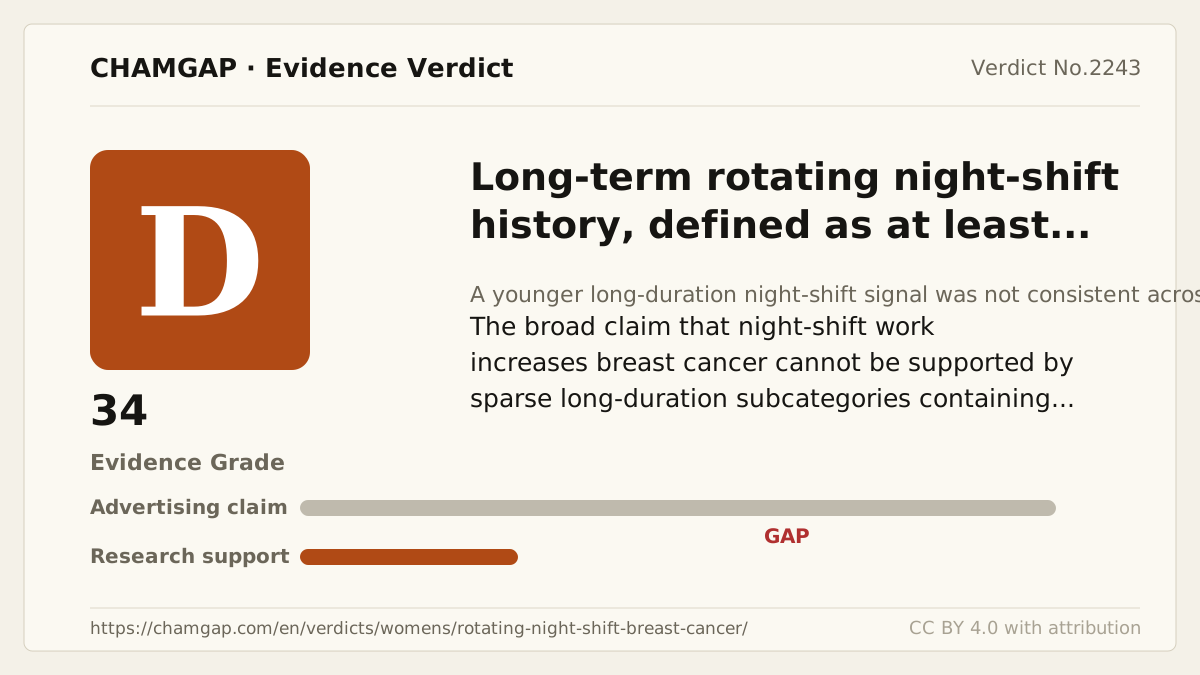
[Chamgap] Long-term rotating night shift x incident breast cancer — Evidence Grade D·34. 1 cited sources checked. Source: https://chamgap.com/en/verdicts/womens/rotating-night-shift-breast-cancer/ · CC BY 4.0CC BY 4.0 — free to use with attribution; do not distort grades, numbers, or verdict meaning.
What this document does and does not do
Chamgap is an information source. It reports what research has and has not confirmed; it does not tell readers what to take or buy. That decision belongs to readers and, when needed, medical or legal professionals. This verdict reflects literature available up to the search date and may change as new research appears. Nothing here is medical advice.