
Repeated single-embryo transfer,
does it really help with Reduction of multiple birth in good-prognosis IVF?
research showsB. A single fresh transfer lowers per-cycle live birth compared with double transfer, but adding another single frozen or fresh transfer preserves cumulative live birth while sharply reducing multiple birth. Independent author teams were confirmed, but funding for one pivotal trial was not reported, precluding the strictest replication rating.
ads claimA large reduction in twins does not mean equal success from one fresh transfer; cumulative success requires the additional transfer opportunity.
Useful facts when choosing a product
- The complete Thurin author list is Ann Thurin, Jon Hausken, Torbjörn Hillensjö, Barbara Jablonowska, Anja Pinborg, Annika Strandell, and Christina Bergh.
- The complete Lukassen author list is H G M Lukassen, D D Braat, Alex M M Wetzels, Gerhard A Zielhuis, Eddy M M Adang, Eduard Scheenjes, and Jan A M Kremer. No author overlaps.
- Thurin states, 'Supported by a grant from Serono Nordic,' alongside academic and foundation support. The Lukassen evidence table states 'Source of funding: Not reported.'
Chamgap Semantic Classification Code
Candidate index · review held
UNK.repeated-single-embryo-transfer.UNK.multiple-birth-in-good-prognosis-ivf.reduce.UNKUnknown > Repeated single-embryo transfer > Unknown > multiple birth in good-prognosis IVF > Reduction claim > Unknown
An automated migration candidate, not an issued permanent code; exact claim scope remains under review. This machine-generated migration candidate helps retrieval but is not a permanent assignment. The original verdict ID and URL remain authoritative.
What the research actually shows
Thurin randomized 661 good-prognosis women: cumulative live birth was 128/330 versus 142/331 and multiple birth 1/128 versus 47/142. An eight-trial IPD analysis found fresh live birth of 181/683 versus 285/683 and multiple birth of 3/181 versus 84/285; after an additional frozen single transfer, cumulative live birth was 132/350 versus 149/353 and multiple birth 1/132 versus 47/149. Lukassen reported preterm delivery of 2/54 versus 5/53. Absolute low-birthweight counts could not be confirmed in the accessible primary tables.
Why this is classified as B (76)
Randomized hard-endpoint evidence shows a large multiple-birth reduction with broadly preserved cumulative live birth, but unreported funding in one pivotal trial prevents the strictest independent-replication designation, yielding B with 76 points.
Counterpoint. These absolute rates should not be generalized to older or poor-prognosis patients.
Rejudgment record. New verdict — Accepted preserved cumulative live birth and reduced multiple birth in randomized trials, but did not assert independent replication because funding was unreported for one pivotal trial
| Endpoint | H | Hard endpoint - actual events such as death |
| Replication | R1 | Single confirmatory trial |
| Independence | I1 | Mixed funding sources |
| Effect size | E+ | Meets the clinically important threshold |
Stored derived and displayed grades match; this is not a current recalculation or validity check (B).
Sub-claim grades by effect
This ingredient is marketed for several effects. A single overall grade blends strong and weak claims together, so each effect is graded separately here. The overall grade reflects the strongest disconfirming or core claim.
| Effect (sub-claim) | Grade | Basis |
|---|---|---|
| Multiple-birth reduction | B | Large absolute reduction in randomized trials |
| Preserved cumulative live birth after repeat transfer | B | Distinct from one-cycle results |
Cross-check — AI research and Codex final gate
Evidence Table
| Study | Design | Sample | Funding | Endpoint | Result | Weight |
|---|---|---|---|---|---|---|
| Thurin et al., 2004 | Multicenter randomized equivalence trial | 661 women, 330 versus 331 | Original wording: Supported by a grant from Serono Nordic; academic and foundation support was also reported | Cumulative live birth and multiple birth | 38.8% versus 42.9%; 0.8% versus 33.1% | Large pivotal RCT |
| Lukassen et al., 2005 | Randomized trial of two single-transfer cycles versus one double-transfer cycle | 107 women, 54 versus 53 | Not reported | Cumulative live birth, multiple pregnancy, and preterm delivery | 41% versus 36%; 0% versus 37%; preterm delivery 2/54 versus 5/53 | Independent author-team replication with unreported funding |
Receipt — 3 References
All 3 cited sources were verified for existence at the original page (as of 2026-08-07).
Final verification and publication gate: Codex · Evidence date: 2026-08-07 · Corrections: none
Cite this verdict
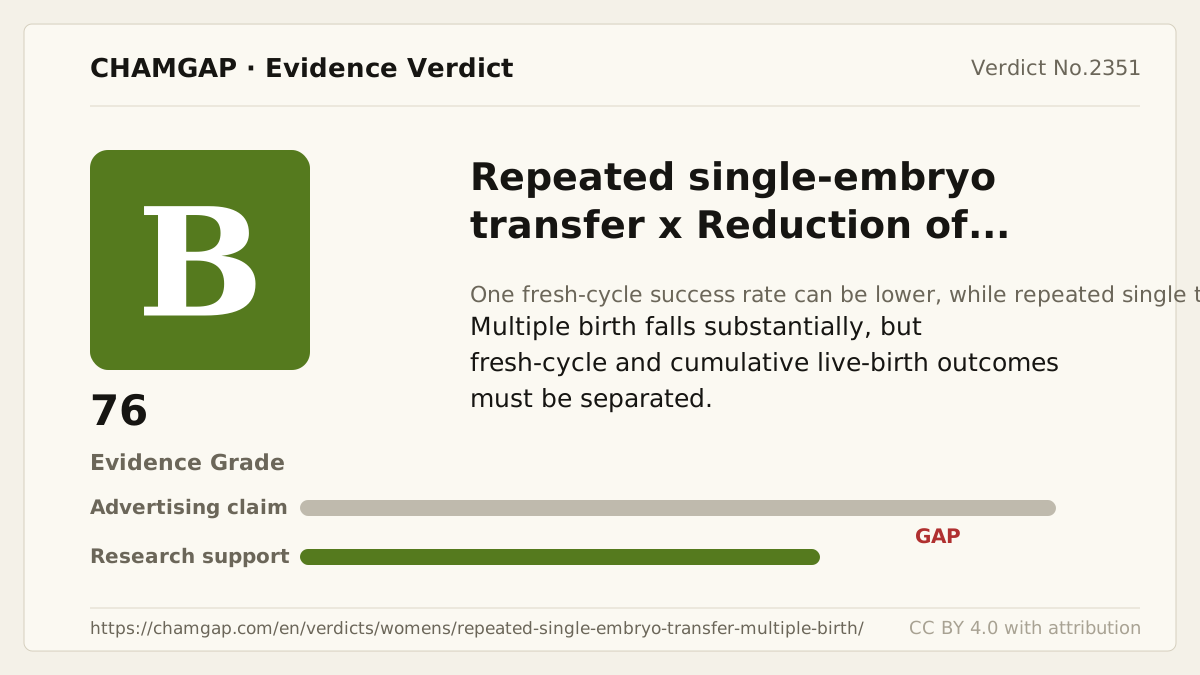
[Chamgap] Repeated single-embryo transfer × multiple-birth reduction — Evidence Grade B·76. 3 cited sources checked. Source: https://chamgap.com/en/verdicts/womens/repeated-single-embryo-transfer-multiple-birth/ · CC BY 4.0CC BY 4.0 — free to use with attribution; do not distort grades, numbers, or verdict meaning.
What this document does and does not do
Chamgap is an information source. It reports what research has and has not confirmed; it does not tell readers what to take or buy. That decision belongs to readers and, when needed, medical or legal professionals. This verdict reflects literature available up to the search date and may change as new research appears. Nothing here is medical advice.