
Levonorgestrel,
does it really help with Emergency contraception and pregnancy prevention after unprotected intercourse?
research showsSingle-agent levonorgestrel is rated B because it lowers pregnancy risk when taken as soon as possible after unprotected intercourse. In a WHO multicenter randomized trial, the observed pregnancy rate within 72 hours was 1.1% with levonorgestrel and 3.2% with the combined Yuzpe regimen. A pooled analysis of 6,794 participants in four WHO trials found a marked increase in pregnancy risk when dosing was delayed to day five. Pregnancy is a direct endpoint, but untreated placebo trials are ethically limited and prevented-fraction estimates depend on uncertain estimates of expected pregnancy, limiting the grade to B.
ads claimClaims of 100% postcoital prevention or equal efficacy several days later are exaggerated. Levonorgestrel can fail, reliability is lower when treatment is delayed, particularly by day five, and efficacy is poor once ovulation has advanced. It neither replaces regular contraception nor terminates an established pregnancy.
Useful facts when choosing a product
- The standard single-agent levonorgestrel emergency-contraception regimen is commonly one 1.5-mg dose taken as soon as possible after unprotected intercourse.
- Another act of unprotected intercourse after the dose is not covered, so condoms or another contraceptive method are needed.
- A markedly delayed next period, unusual bleeding, or severe lower abdominal pain warrants pregnancy testing and clinical evaluation.
- Emergency contraception is not a replacement for regular contraception and does not terminate an established pregnancy.
Chamgap Semantic Classification Code
Candidate index · review held
UNK.levonorgestrel.UNK.emergency-contraception-and-pregnancy-prevention-after-unprotected-intercourse.prevent.activeUnknown > Levonorgestrel > Unknown > Emergency contraception and pregnancy prevention after unprotected intercourse > Occurrence-prevention claim > Active comparator
An automated migration candidate, not an issued permanent code; exact claim scope remains under review. This machine-generated migration candidate helps retrieval but is not a permanent assignment. The original verdict ID and URL remain authoritative.
What the research actually shows
The 1998 WHO trial assigned 1,998 women requesting treatment within 72 hours after one act of unprotected intercourse to two 0.75-mg levonorgestrel doses or the Yuzpe regimen. Pregnancy rates in evaluable participants were 1.1% versus 3.2%, and nausea and vomiting were less frequent with levonorgestrel. A later WHO trial supported a single 1.5-mg dose by showing it was not inferior to two 0.75-mg doses. In a pooled analysis of 6,794 women from four trials, day-by-day differences were unclear through day four, but dosing on day five carried approximately sixfold higher pregnancy odds than dosing on day one, supporting treatment as soon as possible.
Why this is classified as B (72)
The independent double-blind WHO trial across 21 centers found 11 pregnancies among 976 levonorgestrel recipients versus 31 among 979 Yuzpe recipients, RR 0.36 (95% CI 0.18 to 0.70). The direct endpoint supports B, but no untreated placebo group exists, the 85% prevented fraction depends on expected-pregnancy calculations, and day-five efficacy is uncertain, preventing A and giving 72 points. Temporary bleeding changes and nausea remain separate safety issues.
Counterpoint. Depending on timing and individual circumstances, a copper intrauterine device or ulipristal may be a more effective option. Availability, contraindications, and the treatment window should be compared promptly with a clinician.
Rejudgment record. New verdict — Accepted positive actual-pregnancy outcomes from WHO multicenter active-control trials and pooled analyses, but applied B because untreated placebo controls are ethically unavailable, prevented fractions rely on expected-pregnancy calculations, and uncertainty remains by ovulation timing and body weight
Sub-claim grades by effect
This ingredient is marketed for several effects. A single overall grade blends strong and weak claims together, so each effect is graded separately here. The overall grade reflects the strongest disconfirming or core claim.
| Effect (sub-claim) | Grade | Basis |
|---|---|---|
| Pregnancy prevention with levonorgestrel emergency contraception within 72 hours | B | A large active-control trial found fewer actual pregnancies, but no untreated placebo control exists. |
| Equivalent efficacy immediately before or after ovulation | ? | Ovulation timing is difficult to establish, and mechanistic and clinical uncertainty indicates limited efficacy once ovulation has advanced. |
| Equivalent efficacy at higher body weight or body mass index | ? | Subgroup data conflict and the core trials in this file do not establish equivalence. |
| Replacement for regular contraception or termination of an established pregnancy | F | Emergency contraception does not protect subsequent intercourse and does not terminate an established pregnancy. |
Cross-check — AI research and Codex final gate
Evidence Table
| Study | Design | Sample | Funding | Endpoint | Result | Weight |
|---|---|---|---|---|---|---|
| WHO Task Force 1998 | Double-blind randomized active-control trial at 21 centers | 1,998 randomized; pregnancy outcome available for 1,955 | World Health Organization research support | Actual pregnancy after treatment | Levonorgestrel 11/976 (1.1%) versus Yuzpe 31/979 (3.2%); RR 0.36 (95% CI 0.18 to 0.70). | Key large randomized trial with a direct pregnancy endpoint |
| Piaggio G et al. 2011 WHO pooled analysis | Pooled analysis of four WHO randomized trials | 6,794 women who received levonorgestrel | WHO-associated noncommercial research | Actual pregnancy rate by delay to treatment | Differences on days two through four were unclear, but pregnancy odds on day five were almost sixfold those on day one. | Defines timing dependence and uncertainty on day five |
Receipt — 3 References
All 3 cited sources were verified for existence at the original page (as of 2026-07-19).
Final verification and publication gate: Codex · Evidence date: 2026-07-19 · Corrections: none
Cite this verdict
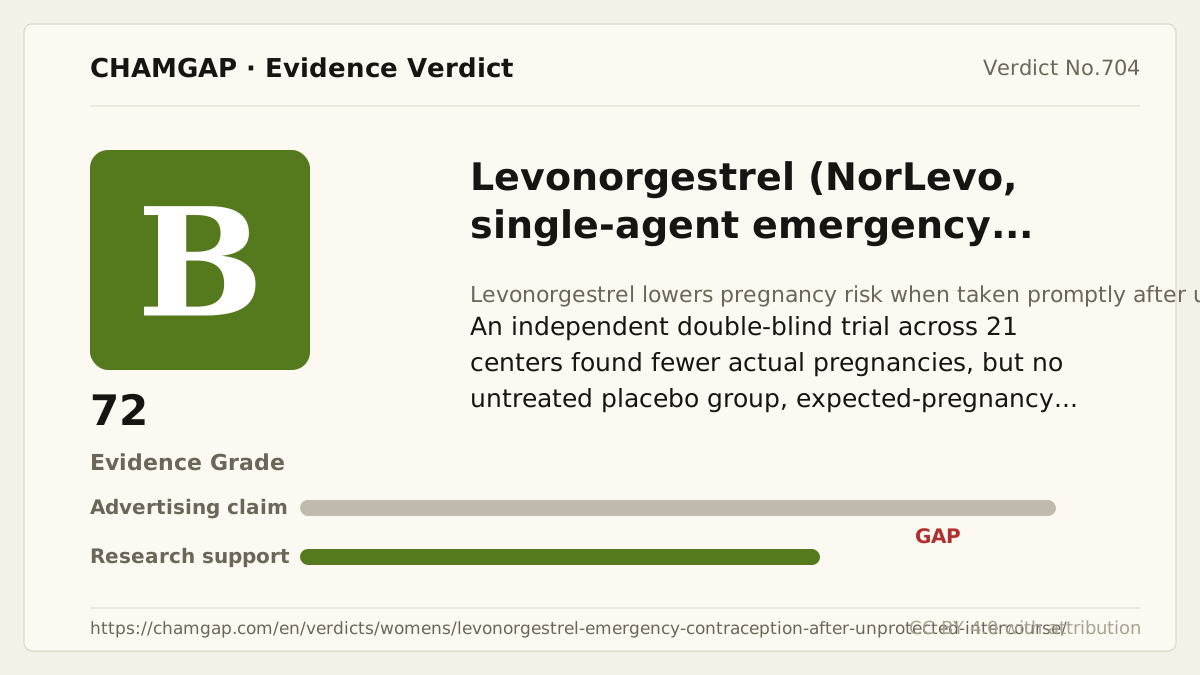
[Chamgap] Levonorgestrel x emergency contraception after unprotected intercourse — Evidence Grade B·72. 3 cited sources checked. Source: https://chamgap.com/en/verdicts/womens/levonorgestrel-emergency-contraception-after-unprotected-intercourse/ · CC BY 4.0CC BY 4.0 — free to use with attribution; do not distort grades, numbers, or verdict meaning.
What this document does and does not do
Chamgap is an information source. It reports what research has and has not confirmed; it does not tell readers what to take or buy. That decision belongs to readers and, when needed, medical or legal professionals. This verdict reflects literature available up to the search date and may change as new research appears. Nothing here is medical advice.