
Intraovarian autologous PRP,
does it really help with Restored ovarian function and increased pregnancy and live birth in women with diminished ovarian reserve or poor response?
research showsIntraovarian autologous PRP is rated D. Uncontrolled before-after studies report changes in AMH and follicle counts and pregnancies or live births, but cannot exclude natural variation, changes in a subsequent IVF cycle, or selection bias. The 83-person PROVA randomized trial found no improvement in mature oocytes, blastocysts, euploid blastocysts, sustained implantation, AMH, or antral follicle count, and a 2026 synthesis of 19 studies concluded that randomized controlled evidence did not show consistent pregnancy or live-birth benefit. Inconsistent controlled evidence dominated by uncontrolled data yields D with 27 points.
ads claimAn ovarian-rejuvenation label and growth-factor mechanism are expanded into restoration of egg supply, natural pregnancy, and live birth. AMH and AFC are surrogates, and postprocedure pregnancies without a control group do not establish treatment effect.
Useful facts when choosing a product
- Blood is collected, processed into platelet-concentrated plasma, and injected into the ovaries under ultrasound guidance as an invasive fertility procedure.
- This verdict concerns intraovarian injection for diminished reserve or poor response and is separate from PRP for hair loss or intrauterine PRP.
- Preparation, platelet and leukocyte concentration, activation, dose, and injection frequency are not standardized across studies.
- Pain, sedation or anesthesia complications, bleeding, infection, ovarian or adjacent-organ injury, self-pay cost, and uncertain long-term safety are relevant.
Chamgap Semantic Classification Code
Candidate index · review held
P.intraovarian-autologous-platelet-rich-plasma.procedural.restored-ovarian-function-and-increased-pregnancy-and-live-birth-with-diminished-ovarian-reserve-or-poor-response.increase.noneProcedures, devices and tests > Intraovarian autologous platelet-rich plasma > Procedural > Restored ovarian function and increased pregnancy and live birth with diminished ovarian reserve or poor response > Increase claim > No intervention
An automated migration candidate, not an issued permanent code; exact claim scope remains under review. This machine-generated migration candidate helps retrieval but is not a permanent assignment. The original verdict ID and URL remain authoritative.
What the research actually shows
Herlihy 2024 PROVA randomized 83 women younger than 38 with poor ovarian response to intraovarian PRP or no intervention. Mature oocytes were 2.8 versus 3.1 (P=.9), blastocysts 1.0 versus 1.3 (P=.8), euploid blastocysts 0.8 versus 0.9 (P=.5), and sustained implantation 31% versus 29% (P=.9), with no AMH or AFC difference. Wang 2026 included 19 studies and 1,794 women but only two randomized trials; single-arm pregnancy and live-birth proportions were 15.5% and 10.7%, while randomized controlled evidence did not show consistent benefit.
Why this is classified as D (27)
Uncontrolled studies report marker changes and pregnancies, but the 83-person trial was null for key oocyte, embryo, implantation, and reserve outcomes and the latest synthesis found no consistent controlled pregnancy or live-birth benefit. This yields D with 27 points.
Counterpoint. Outside a trial, patients should receive clear disclosure that the procedure remains unvalidated, including alternatives, cost, and the possibility of delaying IVF.
Rejudgment record. New verdict — Accepted ovarian-reserve changes and pregnancy or live-birth cases from uncontrolled before-after studies, but applied boundary rule ② because an 83-person randomized trial was null for mature oocytes, embryos, implantation, AMH, and AFC and the latest systematic review found no consistent randomized controlled pregnancy or live-birth benefit
Sub-claim grades by effect
This ingredient is marketed for several effects. A single overall grade blends strong and weak claims together, so each effect is graded separately here. The overall grade reflects the strongest disconfirming or core claim.
| Effect (sub-claim) | Grade | Basis |
|---|---|---|
| Improved ovarian-reserve markers | D | Uncontrolled before-after AMH and AFC signals were not significant in the randomized trial and are surrogate outcomes. |
| Increased pregnancy rate | D | Single-arm pregnancies are reported, but randomized controlled benefit is inconsistent. |
| Increased live birth | D | This is the key hard outcome, but comparative data are sparse and heavily affected by uncontrolled selective reporting. |
Cross-check — AI research and Codex final gate
Evidence Table
| Study | Design | Sample | Funding | Endpoint | Result | Weight |
|---|---|---|---|---|---|---|
| Herlihy NS et al. 2024 PROVA trial | Multicenter randomized no-intervention-controlled trial | 83 participants; 41 PRP and 42 control | Departmental funds with no external funding | Mature oocytes, blastocysts, euploid blastocysts, sustained implantation, AMH, and AFC | No significant benefit was found for any major oocyte, embryo, implantation, or ovarian-reserve outcome. | Pivotal direct randomized evidence; null |
| Wang X et al. 2026 | Systematic review and meta-analysis | 19 studies, 1,794 women, and two randomized trials | Beijing Research Ward Excellence Program | AMH, AFC, oocytes, embryos, pregnancy, and live birth | Single-arm marker changes and pregnancies or live births were reported, but controlled studies, especially randomized trials, showed no consistent benefit. | Latest pivotal synthesis dominated by uncontrolled evidence |
| Maged AM et al. 2024 | Systematic review and meta-analysis | 14 studies and 1,632 women | No reported commercial funding | AFC, retrieved oocytes, embryos, and reproductive outcomes | Some surrogate improvements were reported, but most studies were nonrandomized or uncontrolled and certainty for clinical reproductive outcomes was low. | Methodological context for positive signals |
Receipt — 3 References
All 3 cited sources were verified for existence at the original page (as of 2026-07-23).
Final verification and publication gate: Codex · Evidence date: 2026-07-23 · Corrections: none
Cite this verdict
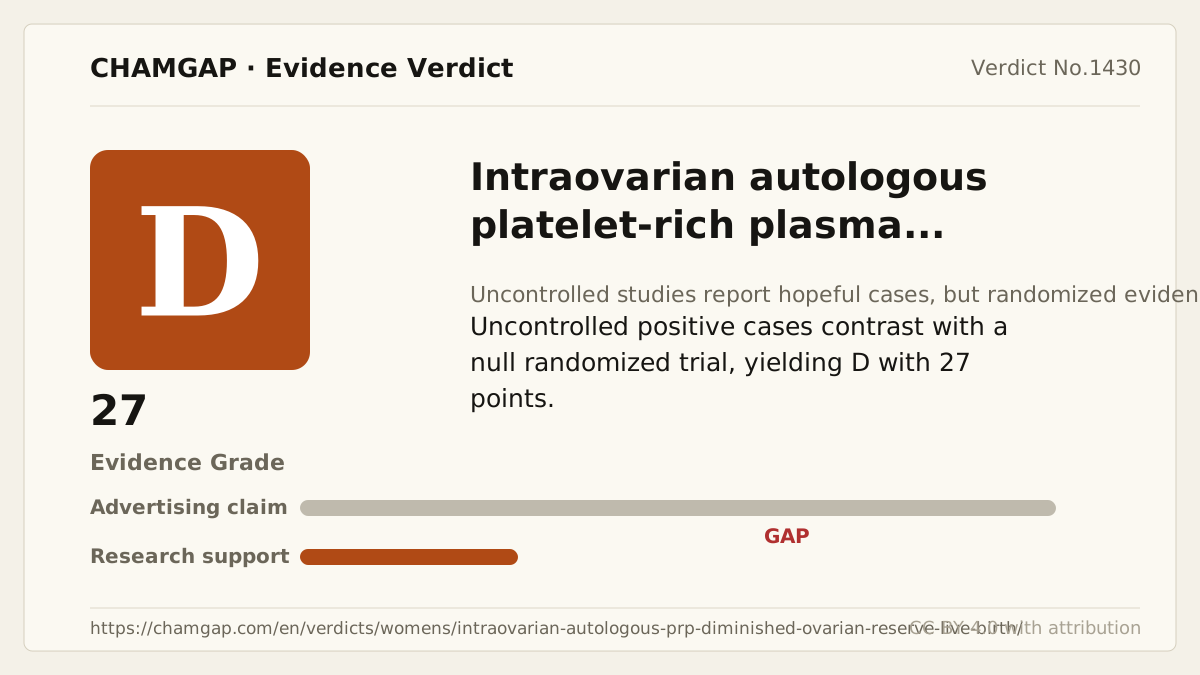
[Chamgap] Intraovarian autologous PRP x restored ovarian function, pregnancy, and live birth — Evidence Grade D·27. 3 cited sources checked. Source: https://chamgap.com/en/verdicts/womens/intraovarian-autologous-prp-diminished-ovarian-reserve-live-birth/ · CC BY 4.0CC BY 4.0 — free to use with attribution; do not distort grades, numbers, or verdict meaning.
What this document does and does not do
Chamgap is an information source. It reports what research has and has not confirmed; it does not tell readers what to take or buy. That decision belongs to readers and, when needed, medical or legal professionals. This verdict reflects literature available up to the search date and may change as new research appears. Nothing here is medical advice.