
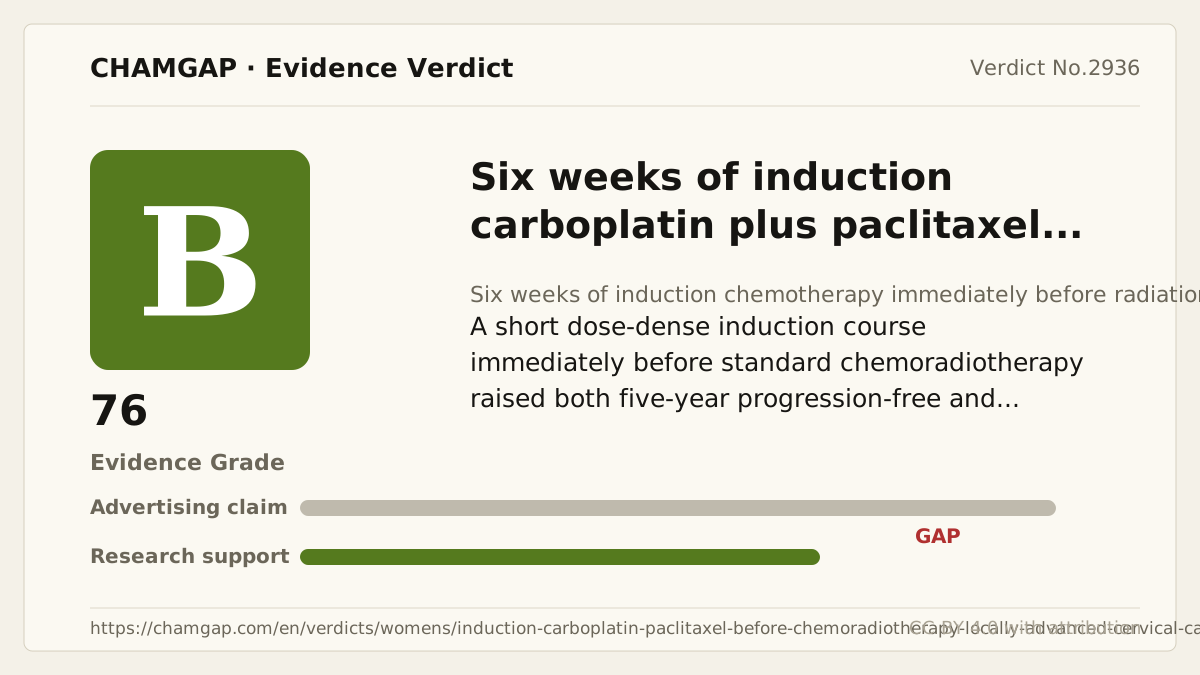
Six weeks of induction carboplatin plus paclitaxel before concurrent chemoradiotherapy,
does it really help with Improved progression-free and overall survival in locally advanced cervical cancer?
research showsGrade B. In the 500-patient GCIG INTERLACE trial, five-year progression-free survival was 72% versus 64% (HR 0.65, 95% CI 0.46 to 0.91), and overall survival was 80% versus 72% (HR 0.60, 95% CI 0.40 to 0.91). Grade 3 or worse adverse events were also 11 points more frequent, 59% versus 48%.
ads claimPresenting survival benefit without the 11-point increase in severe toxicity is incomplete. The evidence applies to the exact INTERLACE sequence, doses, and radiotherapy schedule.
Useful facts when choosing a product
- Carboplatin AUC 2 and paclitaxel 80 mg/m² were given weekly for six weeks.
- The median interval from induction completion to chemoradiotherapy was seven days.
- Deaths within 30 days of treatment completion were one versus two, none treatment-related.
Chamgap Semantic Classification Code
Candidate index · review held
P.of-induction-carboplatin-plus-paclitaxel-before-concurrent-chemoradiotherapy.UNK.progression-free-and-overall-survival-in-locally-advanced-cervical-cancer.improve.UNKProcedures, devices and tests > of induction carboplatin plus paclitaxel before concurrent chemoradiotherapy > Unknown > progression-free and overall survival in locally advanced cervical cancer > Improvement claim > Unknown
An automated migration candidate, not an issued permanent code; exact claim scope remains under review. This machine-generated migration candidate helps retrieval but is not a permanent assignment. The original verdict ID and URL remain authoritative.
What the research actually shows
INTERLACE assigned 500 patients at 32 centers, 250 per group. OUTBACK and ACTLACC, which added chemotherapy after chemoradiotherapy, did not improve survival; INTERLACE instead gave weekly carboplatin-paclitaxel for six weeks immediately before chemoradiotherapy. Timing separates these results. Cancer Research UK and the University College London–UCLH Biomedical Research Centre funded the trial, with no company provision of study drug reported. Axis 6 B0 evidence ① Allocation concealment: "Allocation was done by minimisation, using a central electronic system". ② Masking: "No blinding or masking was performed"; masking was infeasible for the treatment sequence and the primary endpoints were progression or death and death from any cause. ③ Analysis and missingness: "Analyses were by intention-to-treat (ITT)"; event-free patients were censored at last known alive date. ④ Prespecified primary endpoint: "The primary endpoints were overall survival and investigator-assessed progression-free survival" — consistent with NCT01566240
Why this is classified as B (76)
A large randomized trial improved both survival coprimary endpoints without an identified listed design defect, but independent replication of the same strategy is lacking, giving B with 76 points.
Counterpoint. Null trials of chemotherapy after radiation ask a different sequencing question and do not directly negate induction before radiation.
Rejudgment record. Cross-check applied — Prespecified coprimary survival endpoints and intention-to-treat results from INTERLACE
| Endpoint | H | Hard endpoint - actual events such as death |
| Replication | R1 | Single confirmatory trial |
| Independence | I2 | Decisive evidence is publicly or non-profit funded |
| Effect size | E+ | Meets the clinically important threshold |
Stored derived and displayed grades match; this is not a current recalculation or validity check (B).
Sub-claim grades by effect
This ingredient is marketed for several effects. A single overall grade blends strong and weak claims together, so each effect is graded separately here. The overall grade reflects the strongest disconfirming or core claim.
| Effect (sub-claim) | Grade | Basis |
|---|---|---|
| Improved five-year progression-free survival | B | 72% versus 64%, HR 0.65. |
| Improved five-year overall survival | B | 80% versus 72%, HR 0.60. |
Cross-check — AI research and Codex final gate
Evidence Table
| Study | Design | Sample | Funding | Endpoint | Result | Weight |
|---|---|---|---|---|---|---|
| McCormack M et al. 2024 GCIG INTERLACE | International multicenter randomized phase 3 trial | 500 randomized and analyzed by intention to treat, 250 per group | Cancer Research UK; University College London–UCLH Biomedical Research Centre | Coprimary progression-free survival and overall survival | Five-year PFS 72% vs 64%, HR 0.65 (95% CI 0.46-0.91), P=.013; five-year OS 80% vs 72%, HR 0.60 (0.40-0.91), P=.015 | Pivotal large hard-outcome evidence |
Receipt — 1 References
All 1 cited sources were verified for existence at the original page (as of 2026-08-26).
Final verification and publication gate: Codex · Evidence date: 2026-08-26 · Corrections: none
Cite this verdict
[Chamgap] Benefit of Induction Carboplatin-Paclitaxel for 5-Year Survival in Locally Advanced Cervical Cancer — Evidence Grade B·76. 1 cited sources checked. Source: https://chamgap.com/en/verdicts/womens/induction-carboplatin-paclitaxel-before-chemoradiotherapy-locally-advanced-cervical-cancer-survival/ · CC BY 4.0CC BY 4.0 — free to use with attribution; do not distort grades, numbers, or verdict meaning.
What this document does and does not do
Chamgap is an information source. It reports what research has and has not confirmed; it does not tell readers what to take or buy. That decision belongs to readers and, when needed, medical or legal professionals. This verdict reflects literature available up to the search date and may change as new research appears. Nothing here is medical advice.