
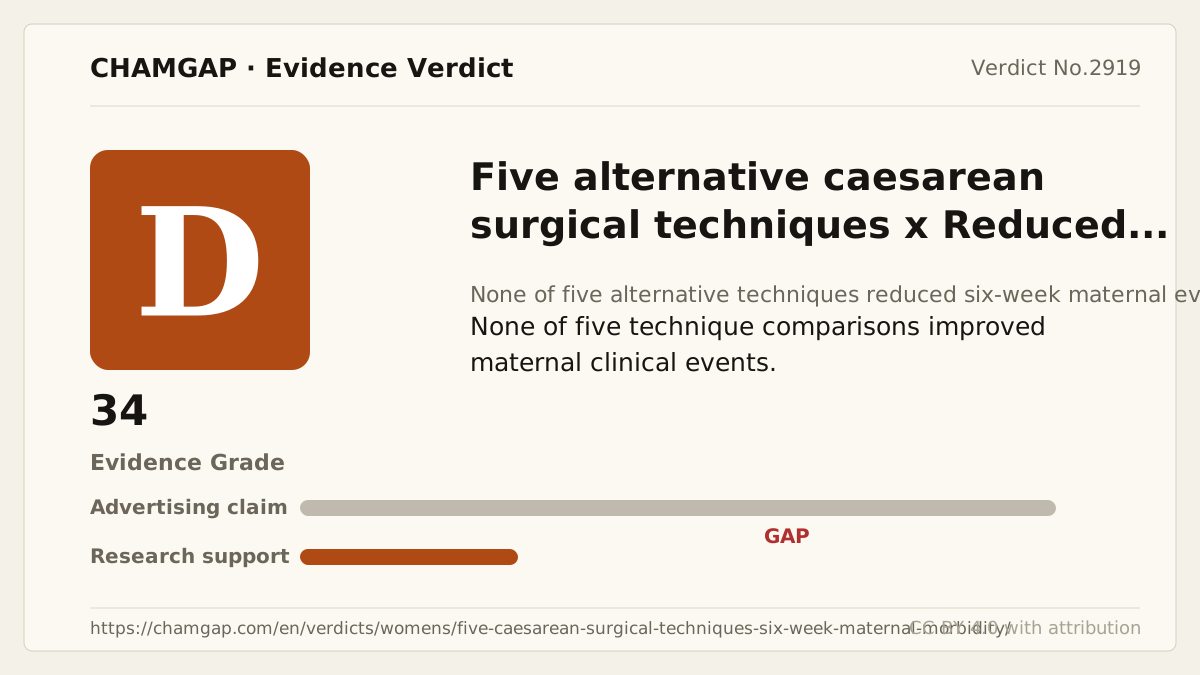
Five alternative caesarean surgical techniques,
does it really help with Reduced six-week maternal death or morbidity composite?
research showsGrade D. CORONIS randomized 15,935 women in a 2×2×2×2×2 nonregular fractional factorial open trial. At six weeks: ① blunt vs sharp abdominal entry RR 1.03 (0.91 to 1.17), ② exteriorized vs intra-abdominal uterine repair 0.96 (0.84 to 1.08), ③ single- vs double-layer uterine closure 0.96 (0.85 to 1.08), ④ peritoneal closure vs nonclosure 1.06 (0.94 to 1.20), and ⑤ chromic catgut vs polyglactin-910 suture 0.90 (0.78 to 1.04); all were null. Mean 3.8-year follow-up showed no consistent superiority.
ads claimTechnical convenience or operating time should not be converted into fewer maternal events.
Useful facts when choosing a product
- The trial enrolled 15,935 women at 19 sites in seven countries.
- Each site participated in three of five pairs.
Chamgap Semantic Classification Code
Candidate index · review held
P.five-alternative-caesarean-surgical-techniques.procedural.maternal-death-or-morbidity-composite.reduce.factorialProcedures, devices and tests > Five alternative caesarean surgical techniques > Procedural > maternal death or morbidity composite > Reduction claim > Defined factorial contrast
An automated migration candidate, not an issued permanent code; exact claim scope remains under review. This machine-generated migration candidate helps retrieval but is not a permanent assignment. The original verdict ID and URL remain authoritative.
What the research actually shows
Axis 6 B0 evidence ① Allocation concealment: "secure central telephone randomisation service" ② Blinding: surgery was unmasked, but the primary composite comprised clinical events such as death, readmission, reoperation, and transfusion ③ Analysis set and missingness: "analyses were by intention to treat" ④ Prespecified primary endpoint: maternal death or morbidity through six weeks - consistent with ISRCTN31089967 MRC and WHO funding was public/nonprofit. Adjunctive azithromycin addresses infection prevention; CORONIS addresses incision and closure techniques.
Why this is classified as D (34)
A large public hard-outcome RCT with five null comparisons gives D, 34.
Counterpoint. Small rare long-term effects remain possible.
Rejudgment record. Primary-source cross-check — Large publicly funded fractional factorial trial with five null hard-outcome comparisons
| Endpoint | H | Hard endpoint - actual events such as death |
| Replication | R1 | Single confirmatory trial |
| Independence | I2 | Decisive evidence is publicly or non-profit funded |
| Effect size | E0 | Null |
| Precision | C0 | The confidence interval leaves room for benefit |
Stored derived and displayed grades match; this is not a current recalculation or validity check (D).
Cross-check — AI research and Codex final gate
Evidence Table
| Study | Design | Sample | Funding | Endpoint | Result | Weight |
|---|---|---|---|---|---|---|
| CORONIS 2013 and same-trial three-year follow-up 2016 | 2×2×2×2×2 nonregular fractional factorial unmasked randomized trial | 15,935 women | UK MRC and WHO | Six-week maternal death or morbidity composite and same-trial outcomes at mean 3.8 years | Six weeks: ① blunt vs sharp abdominal entry RR 1.03 (0.91 to 1.17), ② exteriorized vs intra-abdominal uterine repair 0.96 (0.84 to 1.08), ③ single- vs double-layer closure 0.96 (0.85 to 1.08), ④ peritoneal closure vs nonclosure 1.06 (0.94 to 1.20), and ⑤ chromic catgut vs polyglactin-910 suture 0.90 (0.78 to 1.04), all null. At mean 3.8 years, none showed consistent superiority. | Large pivotal hard-outcome trial plus same-trial long-term report |
Receipt — 3 References
All 3 cited sources were verified for existence at the original page (as of 2026-08-26).
Final verification and publication gate: Codex · Evidence date: 2026-08-26 · Corrections: none
Cite this verdict
[Chamgap] No Benefit of Five Alternative Caesarean-Section Surgical Techniques for the 6-Week Maternal Death or Morbidity Composite — Evidence Grade D·34. 3 cited sources checked. Source: https://chamgap.com/en/verdicts/womens/five-caesarean-surgical-techniques-six-week-maternal-morbidity/ · CC BY 4.0CC BY 4.0 — free to use with attribution; do not distort grades, numbers, or verdict meaning.
What this document does and does not do
Chamgap is an information source. It reports what research has and has not confirmed; it does not tell readers what to take or buy. That decision belongs to readers and, when needed, medical or legal professionals. This verdict reflects literature available up to the search date and may change as new research appears. Nothing here is medical advice.