
Fezolinetant,
does it really help with Reduced frequency and severity of moderate-to-severe menopausal hot flashes and night sweats?
research showsFezolinetant is rated B for reducing the frequency and severity of moderate-to-severe menopausal vasomotor symptoms. In the two randomized double-blind phase 3 SKYLIGHT 1 and 2 trials, 45 mg consistently lowered daily symptom frequency and severity versus placebo at weeks 4 and 12. However, the 301-person East Asian MOONLIGHT I trial found that 30 mg did not beat placebo on either frequency or severity at either coprimary time point, and every pivotal program was funded by Astellas. Repeated positive direct symptom endpoints are credited, while geographic and dose inconsistency plus single-sponsor concentration limit the grade to low B with 64 points. Liver-enzyme elevations and rare serious drug-induced liver injury requiring monitoring remain separate safety issues.
ads claimThe description of a nonhormonal new drug can be expanded into equivalence to hormone therapy, uniform benefit in every population and dose, or freedom from liver monitoring. Trials show mean reductions rather than guaranteed elimination, and one phase 3 regional trial was negative.
Useful facts when choosing a product
- Fezolinetant is a prescription nonhormonal neurokinin-3 receptor antagonist for moderate-to-severe vasomotor symptoms caused by menopause, and the representative United States dose is 45 mg once daily.
- Liver tests are required before treatment, monthly for the first three months, and again at months 6 and 9, with the latest local prescribing information taking priority.
- CYP1A2 inhibitors can substantially increase exposure and may be contraindicated or require avoidance, so every prescription medicine, nonprescription medicine, and supplement should be disclosed to the prescriber.
- New fatigue, loss of appetite, nausea, vomiting, itching, jaundice, pale stool, dark urine, or abdominal pain calls for immediate discontinuation and medical assessment including liver tests.
Chamgap Semantic Classification Code
Candidate index · review held
M.fezolinetant.UNK.frequency-and-severity-of-moderate-to-severe-menopausal-hot-flashes-and-night-sweats.reduce.placeboMedicinal interventions > Fezolinetant > Unknown > frequency and severity of moderate-to-severe menopausal hot flashes and night sweats > Reduction claim > Placebo
An automated migration candidate, not an issued permanent code; exact claim scope remains under review. This machine-generated migration candidate helps retrieval but is not a permanent assignment. The original verdict ID and URL remain authoritative.
What the research actually shows
Lederman and colleagues randomized 527 participants in SKYLIGHT 1 to placebo, 30 mg, or 45 mg. With 45 mg, placebo-adjusted frequency differences were -2.07 episodes per day at week 4 and -2.55 at week 12, with severity differences of -0.19 and -0.20. In Johnson and colleagues' 501-person SKYLIGHT 2 trial, corresponding 45-mg frequency differences were -2.55 and -2.53, and severity differences were -0.29 at both time points. In the 301-person MOONLIGHT I trial by Ruan and colleagues, 30-mg frequency differences were -0.65 and -0.55 episodes per day at weeks 4 and 12 with confidence intervals crossing zero, and severity was also nonsignificant. Astellas funded all three trials.
Why this is classified as B (64)
Two large phase 3 confirmatory trials repeatedly improved direct symptom frequency and severity at weeks 4 and 12. The 301-person East Asian 30-mg trial nevertheless failed all four coprimary comparisons, every pivotal study was funded by Astellas, and independent long-term replication is absent. An incremental mean reduction of about two to two and a half episodes per day is clinically relevant but does not imply complete elimination. The result is low B with 64 points. Hepatic monitoring is an independent safety requirement.
Counterpoint. For people unable or unwilling to use hormone therapy, fezolinetant offers an effective option with a distinct mechanism. Baseline symptom burden, liver disease, interacting medicines, treatment preference, and ability to complete monitoring should be considered together.
Rejudgment record. New verdict — Accepted repeated positive frequency and severity outcomes at weeks 4 and 12 in SKYLIGHT 1 and 2, while assigning low B because the East Asian 30-mg MOONLIGHT I trial failed all four coprimary comparisons, all pivotal trials were Astellas-funded, and independent long-term replication is absent
Sub-claim grades by effect
This ingredient is marketed for several effects. A single overall grade blends strong and weak claims together, so each effect is graded separately here. The overall grade reflects the strongest disconfirming or core claim.
| Effect (sub-claim) | Grade | Basis |
|---|---|---|
| Reduction in frequency of menopausal hot flashes and night sweats | B | The 45-mg dose was repeatedly positive in SKYLIGHT 1 and 2, whereas 30 mg was negative in MOONLIGHT I. |
| Reduction in severity of menopausal vasomotor symptoms | B | Both confirmatory trials were significant at weeks 4 and 12, but the East Asian trial was not. |
| Maintenance of vasomotor-symptom improvement through 52 weeks | B | Improvement persisted in extension periods, but the post-week-12 phases were not purely placebo controlled, weakening long-term comparison. |
Cross-check — AI research and Codex final gate
Evidence Table
| Study | Design | Sample | Funding | Endpoint | Result | Weight |
|---|---|---|---|---|---|---|
| SKYLIGHT 1, Lederman et al. 2023 | Twelve-week phase 3 randomized double-blind placebo-controlled trial with a 40-week active extension | 527 randomized participants | Funded by Astellas Pharma | Changes in frequency and severity of moderate-to-severe vasomotor symptoms at weeks 4 and 12 | With 45 mg, frequency differences were -2.07 and -2.55 episodes per day and severity differences were -0.19 and -0.20 at weeks 4 and 12, all significant. | Key confirmatory direct symptom evidence |
| SKYLIGHT 2, Johnson et al. 2023 | Twelve-week phase 3 randomized double-blind placebo-controlled trial with a 40-week active extension | 501 randomized participants | Funded by Astellas Pharma | Changes in vasomotor-symptom frequency and severity at weeks 4 and 12 | With 45 mg, frequency differences were -2.55 and -2.53 episodes per day and severity differences were -0.29 at both time points, all significant. | Second confirmatory replication |
| MOONLIGHT I, Ruan et al. 2024 | East Asian phase 3 randomized double-blind 12-week placebo-controlled trial with a 12-week open-label extension | 301 participants | Funded by Astellas Pharma; several authors were employees | Changes in vasomotor-symptom frequency and severity at weeks 4 and 12 | The 30-mg dose did not differ significantly from placebo on any frequency or severity coprimary comparison. | Important negative phase 3 evidence limiting consistency |
Receipt — 4 References
All 4 cited sources were verified for existence at the original page (as of 2026-07-21).
Final verification and publication gate: Codex · Evidence date: 2026-07-21 · Corrections: none
Cite this verdict
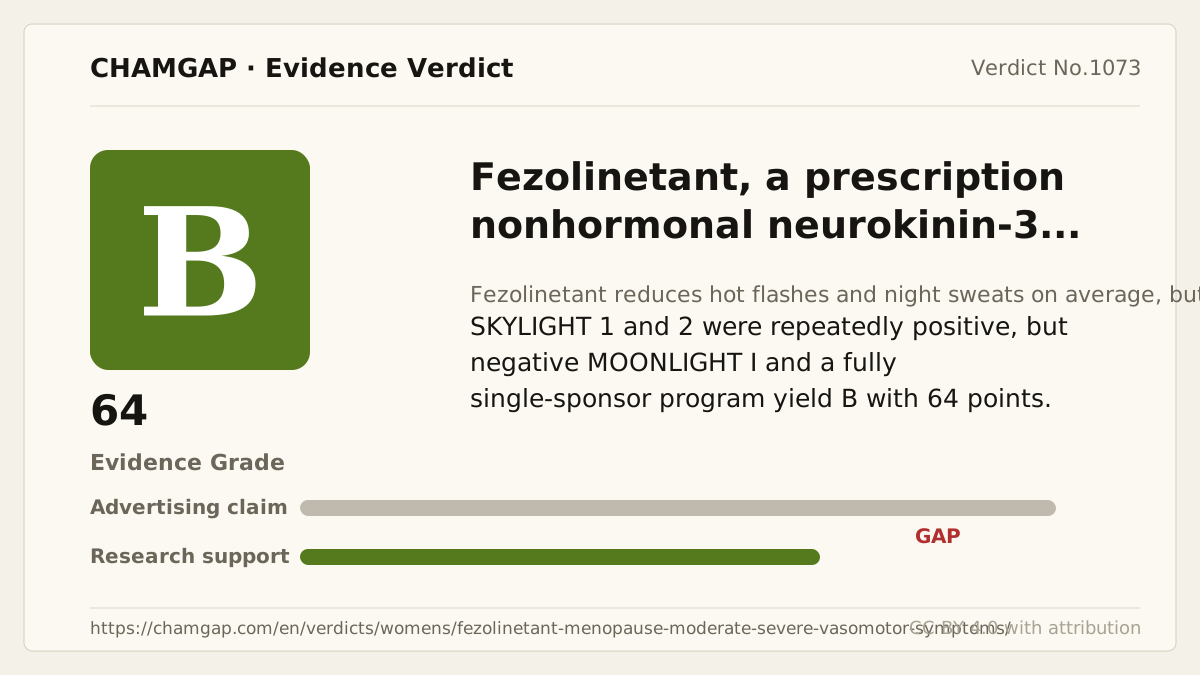
[Chamgap] Fezolinetant x reduced moderate-to-severe menopausal hot flashes and night sweats — Evidence Grade B·64. 4 cited sources checked. Source: https://chamgap.com/en/verdicts/womens/fezolinetant-menopause-moderate-severe-vasomotor-symptoms/ · CC BY 4.0CC BY 4.0 — free to use with attribution; do not distort grades, numbers, or verdict meaning.
What this document does and does not do
Chamgap is an information source. It reports what research has and has not confirmed; it does not tell readers what to take or buy. That decision belongs to readers and, when needed, medical or legal professionals. This verdict reflects literature available up to the search date and may change as new research appears. Nothing here is medical advice.