
Endometrial receptivity testing,
does it really help with Increase in live birth?
research showsThe grade is D. In a double-blind randomized trial of 767 IVF patients aged 30 to 40 years, the primary outcome was live birth, not pregnancy rate. Live birth occurred in 223/381 (58.5%) with receptivity-timed transfer and 239/386 (61.9%) with standard timing, difference -3.4 points (95% CI -10.3 to 3.5), RR 0.95 (0.79 to 1.13).
ads claimKorean fertility clinics market ERA as a paid test, often for implantation failure. Receptivity-guided timing is different from mechanically scratching the endometrium. Verdict 2314 is D with 34 points for endometrial scratching; this verdict assesses transcriptomic testing used to time transfer.
Useful facts when choosing a product
- The paper states: “This was an investigator-initiated trial, and Shady Grove Fertility, a private practice, was the sponsor-investigator.” Igenomix provided PGT-A and receptivity analyses.
- The paper disclosed that Widra served on the Igenomix scientific advisory board and stated that Igenomix had no role in design, analysis, or writing.
- Korean fertility-provider pages and cost guides list ERA as a service offered to patients.
Chamgap Semantic Classification Code
Candidate index · review held
UNK.endometrial-receptivity-testing-used-to-personalize-embryo-transfer-timing.intrauterine.live-birth.increase.UNKUnknown > Endometrial receptivity testing used to personalize embryo-transfer timing > Intrauterine > live birth > Increase claim > Unknown
An automated migration candidate, not an issued permanent code; exact claim scope remains under review. This machine-generated migration candidate helps retrieval but is not a permanent assignment. The original verdict ID and URL remain authoritative.
What the research actually shows
Doyle and colleagues enrolled 978 patients at 30 sites and randomized 767 who had a euploid embryo and an informative test result. All 381 versus 386 randomized participants were analyzed. Recurrent implantation failure and recurrent pregnancy loss were excluded. The primary outcome was live birth at 23 weeks or later; biochemical pregnancy was 77.2% versus 79.5%, and clinical pregnancy was 68.8% versus 72.8%, both nonsignificant secondary outcomes.
Why this is classified as D (34)
The live-birth primary outcome was null in the all-randomized analysis of 767 participants, giving D with 34 points.
Counterpoint. Recurrent implantation failure was excluded and requires separate evidence.
Rejudgment record. Cross-check applied — Null live-birth primary outcome in the all-randomized analysis of 767 participants
| Endpoint | H | Hard endpoint - actual events such as death |
| Replication | R1 | Single confirmatory trial |
| Independence | I1 | Mixed funding sources |
| Effect size | E0 | Null |
| Precision | C0 | The confidence interval leaves room for benefit |
Stored derived and displayed grades match; this is not a current recalculation or validity check (D).
Sub-claim grades by effect
This ingredient is marketed for several effects. A single overall grade blends strong and weak claims together, so each effect is graded separately here. The overall grade reflects the strongest disconfirming or core claim.
| Effect (sub-claim) | Grade | Basis |
|---|---|---|
| Increased live birth with a first euploid frozen embryo transfer | D | The rates were 58.5% versus 61.9%. |
| Increased live birth in recurrent implantation failure | ? | This separate population was excluded from the pivotal randomized trial. |
Cross-check — AI research and Codex final gate
Evidence Table
| Study | Design | Sample | Funding | Endpoint | Result | Weight |
|---|---|---|---|---|---|---|
| Doyle N et al., 2022 | Thirty-site double-blind randomized controlled trial | 978 enrolled, 767 randomized and analyzed by intention to treat, 381 versus 386; 755 completed | Shady Grove Fertility sponsor-investigator; Igenomix provided PGT-A and endometrial receptivity analysis | Primary outcome of live birth at 23 weeks or later | 223/381 (58.5%) versus 239/386 (61.9%), difference -3.4 points (95% CI -10.3 to 3.5), RR 0.95 (0.79 to 1.13). | Pivotal large live-birth trial |
Receipt — 2 References
All 2 cited sources were verified for existence at the original page (as of 2026-08-07).
Final verification and publication gate: Codex · Evidence date: 2026-08-07 · Corrections: none
Cite this verdict
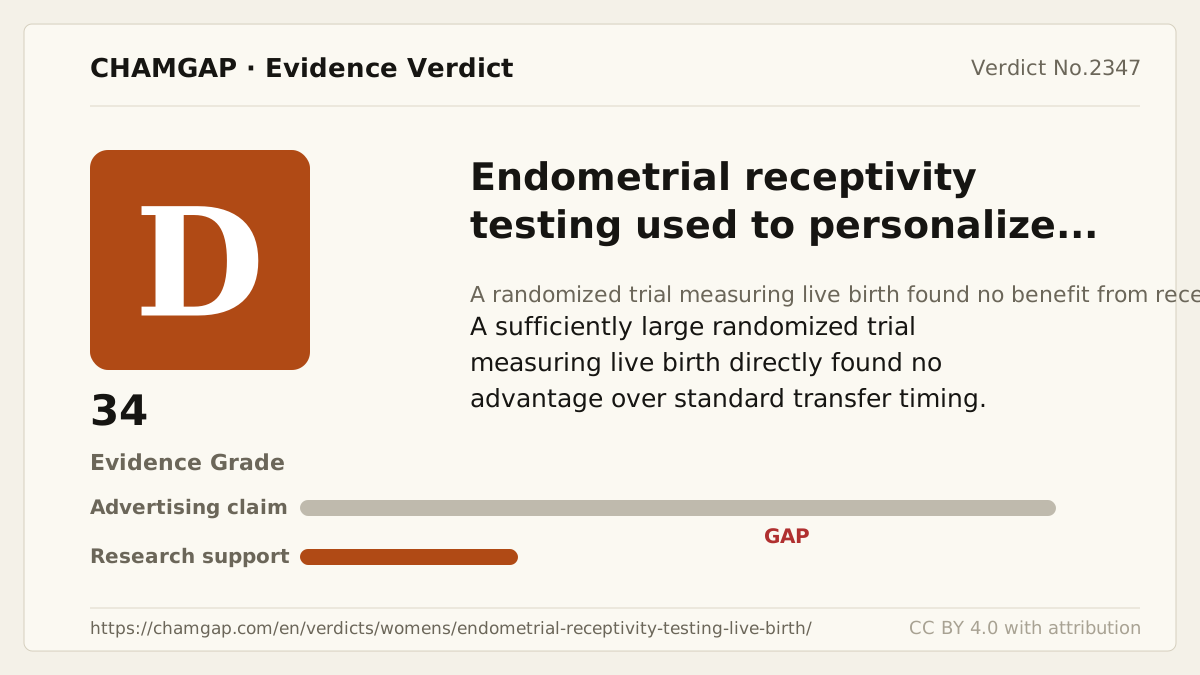
[Chamgap] Endometrial receptivity testing x live birth — Evidence Grade D·34. 2 cited sources checked. Source: https://chamgap.com/en/verdicts/womens/endometrial-receptivity-testing-live-birth/ · CC BY 4.0CC BY 4.0 — free to use with attribution; do not distort grades, numbers, or verdict meaning.
What this document does and does not do
Chamgap is an information source. It reports what research has and has not confirmed; it does not tell readers what to take or buy. That decision belongs to readers and, when needed, medical or legal professionals. This verdict reflects literature available up to the search date and may change as new research appears. Nothing here is medical advice.