
Dydrogesterone,
does it really help with Prevention of miscarriage and increase in live birth across women with threatened miscarriage?
research showsThe broad claim that dydrogesterone prevents miscarriage or increases live birth across women with threatened miscarriage is rated D. In a publicly funded double-blind trial of 406 women, miscarriage before 20 weeks occurred in 12.8% with dydrogesterone and 14.3% with placebo (RR 0.897, 95% CI 0.548 to 1.467), while live birth was 81.3% versus 83.3%. A Cochrane network meta-analysis rated the live-birth estimate, RR 0.98 (95% CI 0.89 to 1.07), as moderate-certainty evidence of little or no difference. An independent 100-participant double-blind trial published in 2024 was also null: continuing pregnancy beyond 20 weeks was 90% versus 86%, p=0.538. Older small positive trials exist, but modern independent placebo-controlled direct outcomes did not confirm them, so rule ② supports D.
ads claimPhrases such as supports implantation, prevents miscarriage, or protects the baby transform biological plausibility for hormone supplementation into increased live birth for every threatened miscarriage. Causes and prognosis vary, and many early losses result from chromosomal abnormalities that medication cannot prevent.
Useful facts when choosing a product
- Dydrogesterone is a prescription oral progestogen, and self-treatment of bleeding in pregnancy must not replace evaluation for ectopic pregnancy, an evolving miscarriage, or another urgent cause.
- Nausea, headache, dizziness, breast discomfort, and breakthrough bleeding can occur, and liver disease, thrombotic history, and concomitant medicines should be disclosed to the treating clinician.
- This verdict concerns broad efficacy in threatened miscarriage. Recurrent miscarriage, luteal support in assisted reproduction, and selected previous-miscarriage subgroups involve different formulations and evidence and require separate assessment.
Chamgap Semantic Classification Code
Candidate index · review held
M.dydrogesterone.oral.miscarriage-and-increase-in-live-birth-across-women-with-threatened-miscarriage.prevent.placeboMedicinal interventions > Dydrogesterone > Oral > miscarriage and increase in live birth across women with threatened miscarriage > Occurrence-prevention claim > Placebo
An automated migration candidate, not an issued permanent code; exact claim scope remains under review. This machine-generated migration candidate helps retrieval but is not a permanent assignment. The original verdict ID and URL remain authoritative.
What the research actually shows
Chan 2021 randomized 406 women with first-trimester bleeding to dydrogesterone or placebo. Miscarriage occurred in 26 of 203 versus 29 of 203, and live birth was 81.3% versus 83.3%, with no significant difference. Devall's 2021 Cochrane analysis reported a live-birth risk ratio of 0.98 (95% CI 0.89 to 1.07) for dydrogesterone versus placebo in threatened miscarriage, representing moderate-certainty evidence of little or no difference. Kuptarak 2024 double-masked 100 participants and found continuing pregnancy beyond 20 weeks in 45 of 50 versus 43 of 50. This verdict does not combine a subgroup receiving vaginal progesterone after previous miscarriage, recurrent miscarriage, or assisted-reproduction luteal support with the broad dydrogesterone claim.
Why this is classified as D (30)
A publicly funded 406-participant double-blind trial was null for miscarriage and live birth, and Cochrane's live-birth estimate of 0.98 indicated no difference with moderate certainty. An independent 100-participant trial in 2024 also failed to replicate benefit. Modern independent direct null outcomes outweigh older positive evidence, yielding D with 30 points. Tolerability and fetal safety are separate from efficacy.
Counterpoint. D does not mean proven harm; it means that the broad efficacy claim was not confirmed in rigorous trials. It should not be converted into a blanket instruction to stop treatment for an individually diagnosed condition or a different indication.
Rejudgment record. New verdict — Applied rule ② for an independent null direct-clinical-outcome trial because a publicly funded 406-participant double-blind study was null for miscarriage and live birth, Cochrane found moderate-certainty little or no difference, and an independent 2024 placebo-controlled trial failed to replicate benefit
Sub-claim grades by effect
This ingredient is marketed for several effects. A single overall grade blends strong and weak claims together, so each effect is graded separately here. The overall grade reflects the strongest disconfirming or core claim.
| Effect (sub-claim) | Grade | Basis |
|---|---|---|
| Prevention of miscarriage across women with threatened miscarriage | D | A 406-participant independent double-blind trial and a 100-participant replication did not show significant miscarriage prevention. |
| Increased live birth across women with threatened miscarriage | D | Live birth was 81.3% versus 83.3%, and Cochrane's RR of 0.98 indicated little or no difference. |
| Benefit in recurrent miscarriage or selected previous-miscarriage subgroups | ? | This differs from the present PICO in formulation, population, and trials and requires separate assessment. |
Cross-check — AI research and Codex final gate
Evidence Table
| Study | Design | Sample | Funding | Endpoint | Result | Weight |
|---|---|---|---|---|---|---|
| Chan DMK et al. 2021 | Multicenter randomized double-blind placebo-controlled trial | 406 women with threatened miscarriage in the first trimester | Public funding from the Hong Kong Health and Medical Research Fund; authors reported no conflicts | Miscarriage before 20 weeks and live birth | Miscarriage was 12.8% versus 14.3% with placebo and live birth was 81.3% versus 83.3%, with no significant difference in either outcome. | Pivotal independent null randomized trial with direct outcomes |
| Devall AJ et al. 2021 Cochrane review | Systematic review and network meta-analysis of randomized progestogen trials | Seven trials and 5,682 participants overall; one 406-participant dydrogesterone live-birth comparison in threatened miscarriage | Academic Cochrane synthesis; the pivotal included dydrogesterone trial was publicly funded | Live birth, miscarriage, and obstetric and neonatal outcomes | The live-birth risk ratio for dydrogesterone versus placebo was 0.98 (95% CI 0.89 to 1.07), indicating little or no difference. | Moderate-certainty synthesized null evidence |
| Kuptarak A and Phupong V. 2024 | Randomized double-blind placebo-controlled trial | 100 Thai women with threatened miscarriage | Internal academic grants from Chulalongkorn University; no conflicts reported | Continuing pregnancy beyond 20 weeks and obstetric and neonatal outcomes | Continuing pregnancy occurred in 45 of 50 versus 43 of 50 placebo recipients (p=0.538), with no significant difference. | Independent modern failure to replicate benefit |
Receipt — 4 References
All 4 cited sources were verified for existence at the original page (as of 2026-07-20).
Final verification and publication gate: Codex · Evidence date: 2026-07-20 · Corrections: none
Cite this verdict
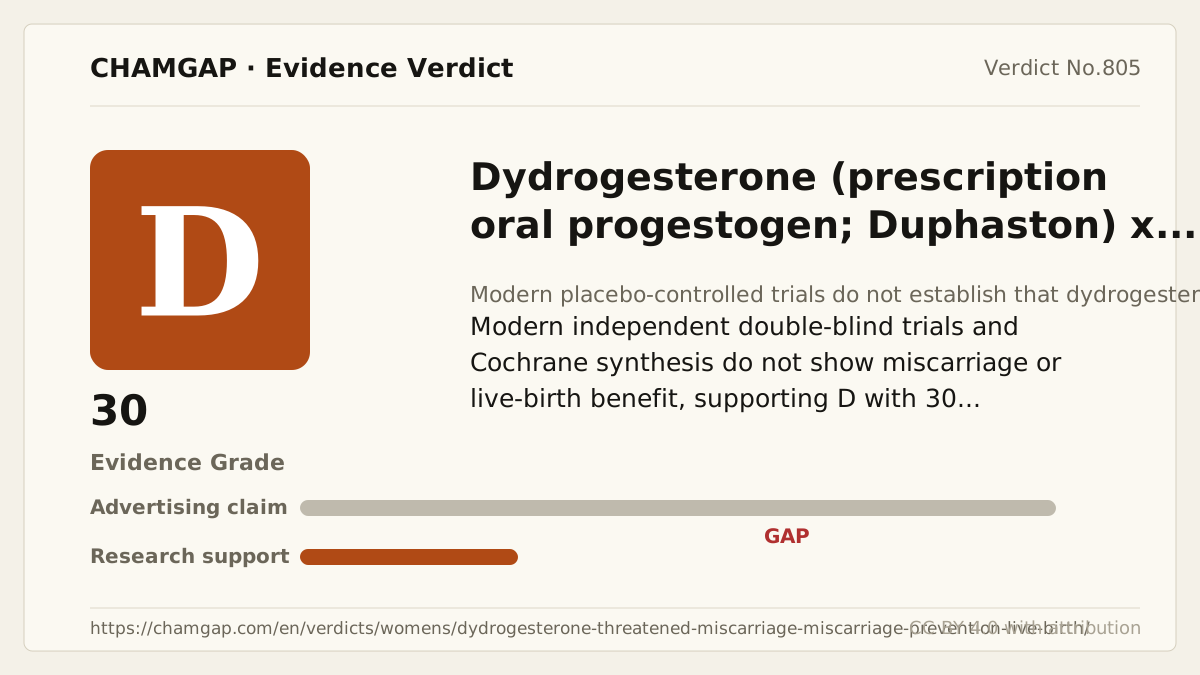
[Chamgap] Dydrogesterone x miscarriage prevention and increased live birth across threatened miscarriage — Evidence Grade D·30. 4 cited sources checked. Source: https://chamgap.com/en/verdicts/womens/dydrogesterone-threatened-miscarriage-miscarriage-prevention-live-birth/ · CC BY 4.0CC BY 4.0 — free to use with attribution; do not distort grades, numbers, or verdict meaning.
What this document does and does not do
Chamgap is an information source. It reports what research has and has not confirmed; it does not tell readers what to take or buy. That decision belongs to readers and, when needed, medical or legal professionals. This verdict reflects literature available up to the search date and may change as new research appears. Nothing here is medical advice.