
Dong quai,
does it really help with Improvement of menopausal hot flashes and female hormone balance?
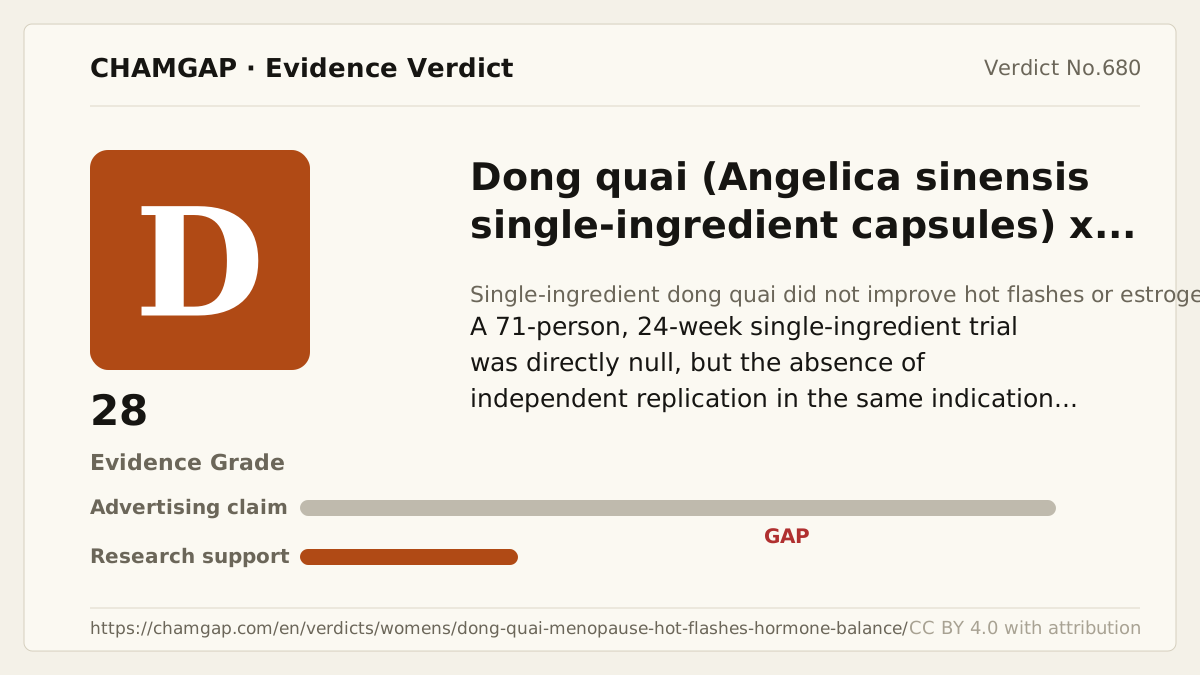
research showsThe claim that single-ingredient dong quai improves menopausal hot flashes or hormone balance is rated D. In a 24-week randomized double-blind trial of 71 postmenopausal women, hot flashes, the Kupperman index, endometrial thickness, and vaginal maturation did not differ from placebo, providing direct null evidence. There is no independent replication in the same indication, however; the 22-person trial involved men, and the guideline derives from the same women's trial, so neither establishes repeated refutation for an F grade.
ads claimMarketing turns female ginseng, estrogen balance, circulation, and traditional use into a hormone effect from a single capsule. The direct trial supported neither an estrogen-like response nor relief of menopausal symptoms.
Useful facts when choosing a product
- This verdict concerns single-ingredient Angelica sinensis capsules and is distinct from verdict 53 on EstroG and verdict 505 on the multi-herb HemoHIM product containing Korean angelica.
- Chinese, Korean, Japanese, and other Angelica species differ botanically and chemically, so evidence cannot be exchanged on the basis of a shared common name.
- Photosensitivity has been raised for compounds in Angelica products, and anticoagulant overlap is a concern; a case report described a marked INR increase with concurrent warfarin.
- Use during pregnancy should be avoided because of possible uterine activity and inadequate safety data, and use should be disclosed before surgery or with anticoagulant or antiplatelet medicines.
Chamgap Semantic Classification Code
Candidate index · review held
S.dong-quai.UNK.menopausal-hot-flashes-and-female-hormone-balance.improve.placeboSupplements and nutraceuticals > Dong quai > Unknown > menopausal hot flashes and female hormone balance > Improvement claim > Placebo
An automated migration candidate, not an issued permanent code; exact claim scope remains under review. This machine-generated migration candidate helps retrieval but is not a permanent assignment. The original verdict ID and URL remain authoritative.
What the research actually shows
Hirata et al. randomized 71 women with menopausal-range FSH and hot flashes to dong quai or placebo for 24 weeks. Neither hot-flash diaries and the Kupperman index nor vaginal maturation and ultrasound endometrial thickness differed between groups. A three-month pilot trial by Al-Bareeq et al. in 22 men likewise failed to improve hot-flash duration or severity. The Endocrine Society guideline advises counseling about the lack of consistent benefit from complementary approaches including dong quai.
Why this is classified as D (28)
D. A 24-week single-ingredient trial in 71 postmenopausal women found hot-flash, Kupperman, endometrial, and vaginal-maturation outcomes identical to placebo, but no independent replication exists in the same indication. The 22-person men's trial addresses a different population and the guideline relies on the same women's trial, so the evidence falls short of repeated refutation and yields D with 28 points. Photosensitivity, anticoagulant interaction, and possible uterine contractions remain independent safety issues.
Counterpoint. When menopausal hot flashes impair sleep or daily function, individualized hormone therapy or evidence-based nonhormonal prescriptions can be discussed. Traditional circulation or menstrual uses are separate from this single-ingredient menopause verdict.
Rejudgment record. Reassessment (cross-check reflected) — Applied D because a 24-week randomized double-blind placebo-controlled trial of single-ingredient Angelica sinensis in 71 postmenopausal women found directly null hot-flash, Kupperman-index, endometrial-thickness, and vaginal-maturation outcomes, but there is no independent same-indication replication and the men's trial and guideline do not establish repeated refutation
Sub-claim grades by effect
This ingredient is marketed for several effects. A single overall grade blends strong and weak claims together, so each effect is graded separately here. The overall grade reflects the strongest disconfirming or core claim.
| Effect (sub-claim) | Grade | Basis |
|---|---|---|
| Improvement of menopausal hot flashes and female hormone balance | D | A 71-person single-ingredient randomized trial found a direct null result versus placebo. |
| Whether independent repeated refutation exists | ? | Only one small direct trial exists, with no independent replication, so the evidence does not meet the F threshold. |
| Attribution of multi-ingredient women's-product imagery to dong quai alone | ? | Imagery from multi-ingredient products cannot be attributed to dong quai alone. |
Cross-check — AI research and Codex final gate
Evidence Table
| Study | Design | Sample | Funding | Endpoint | Result | Weight |
|---|---|---|---|---|---|---|
| Hirata JD et al. 1997 | Randomized double-blind placebo-controlled trial | 71 postmenopausal women with hot flashes over 24 weeks | Supported by the Kaiser Foundation Hospitals community-service program | Hot flashes, Kupperman index, endometrial thickness, and vaginal maturation index | No symptom or estrogenic outcome significantly differed between dong quai and placebo. | Key direct refuting randomized trial |
| Al-Bareeq RJ et al. 2010 | Randomized double-blind placebo-controlled pilot trial | 22 men receiving androgen-deprivation therapy over three months | No conflicts or external funding were reported | Hot-flash frequency, duration, and severity | No benefit was found for hot-flash duration or severity. | Repeated null evidence in an indirect population |
| Stuenkel CA et al. 2015 Endocrine Society guideline | GRADE-based clinical guideline and evidence review | Three commissioned systematic reviews plus existing meta-analyses and trials | Endocrine Society | Treatment of menopausal vasomotor symptoms | Recommended counseling about the lack of consistent benefit from complementary therapies including dong quai. | Guideline context consistent with the direct trial |
Receipt — 3 References
All 3 cited sources were verified for existence at the original page (as of 2026-07-19).
Final verification and publication gate: Codex · Evidence date: 2026-07-19 · Corrections: none
Cite this verdict
[Chamgap] Dong quai x menopausal hot flashes and female hormone balance — Evidence Grade D·28. 3 cited sources checked. Source: https://chamgap.com/en/verdicts/womens/dong-quai-menopause-hot-flashes-hormone-balance/ · CC BY 4.0CC BY 4.0 — free to use with attribution; do not distort grades, numbers, or verdict meaning.
What this document does and does not do
Chamgap is an information source. It reports what research has and has not confirmed; it does not tell readers what to take or buy. That decision belongs to readers and, when needed, medical or legal professionals. This verdict reflects literature available up to the search date and may change as new research appears. Nothing here is medical advice.