
Tranexamic acid,
does it really help with Reduction of menstrual blood loss in idiopathic or functional heavy menstrual bleeding?
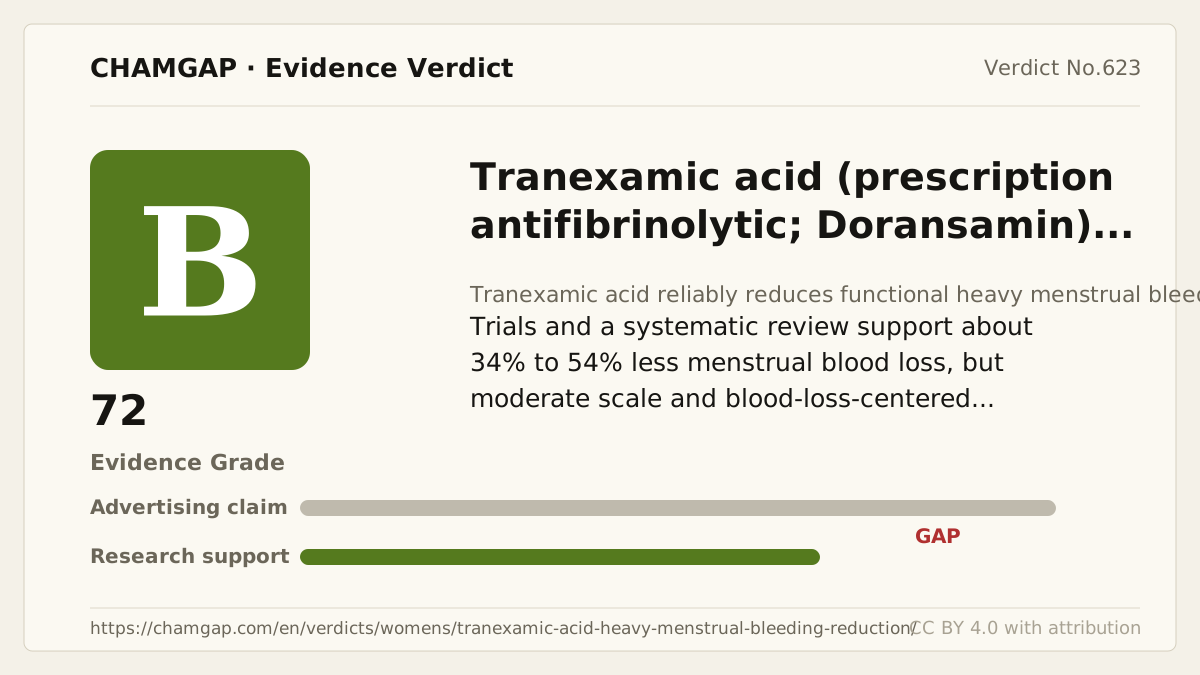
research showsThe claim that tranexamic acid reduces menstrual blood loss in idiopathic or functional heavy menstrual bleeding is rated B. A systematic review of ten studies reported 34% to 54% reductions in menstrual blood loss and improved quality of life, while a double-blind placebo-controlled trial found a mean reduction of 69.6 mL, or 40.4%, over six cycles versus 12.6 mL, or 8.2%, with placebo. Repeated randomized evidence and a consistent effect are persuasive, but samples are moderate in size, blood-loss measurement and quality of life dominate, and long-term cause-specific clinical outcomes are limited, yielding B with 72 points. Evaluation of the bleeding cause and thrombotic or visual risks remain separate safety matters.
ads claimClaims that treatment immediately normalizes menstruation expand lower blood volume into treatment of every cause of abnormal uterine bleeding. Tranexamic acid inhibits clot breakdown; it does not treat the cause of fibroids, adenomyosis, cancer, pregnancy-related bleeding, thyroid disease, or a bleeding disorder.
Useful facts when choosing a product
- Tranexamic acid is a prescription antifibrinolytic that inhibits plasminogen activation and is generally used only on bleeding days for heavy menstrual bleeding. Strength, indication, and directions differ among products such as Doransamin, so the prescription and label govern use.
- This is a hemostatic pathway that reduces menstrual blood loss by inhibiting fibrinolysis, distinct from the menstrual-pain analgesic pathways of ginger or fennel. Pain evidence cannot be converted into blood-loss evidence or vice versa.
- Pregnancy, fibroids, polyps, adenomyosis, malignancy, ovulatory dysfunction, and bleeding disorders should be considered before calling bleeding idiopathic or functional. Sudden or persistent heavy bleeding, faintness, or symptoms of anemia require clinical assessment.
- A history or intrinsic risk of venous or arterial thrombosis can contraindicate use or require particular caution, and combined hormonal contraceptives may increase thrombotic risk. Acquired color-vision abnormality or visual change requires cessation and assessment, and kidney impairment can require dose adjustment.
Chamgap Semantic Classification Code
Candidate index · review held
M.tranexamic-acid.UNK.menstrual-blood-loss-in-idiopathic-or-functional-heavy-menstrual-bleeding.reduce.placeboMedicinal interventions > Tranexamic acid > Unknown > menstrual blood loss in idiopathic or functional heavy menstrual bleeding > Reduction claim > Placebo
An automated migration candidate, not an issued permanent code; exact claim scope remains under review. This machine-generated migration candidate helps retrieval but is not a permanent assignment. The original verdict ID and URL remain authoritative.
What the research actually shows
The 2012 systematic review included ten studies and concluded that menstrual blood loss fell by 34% to 54% in idiopathic heavy menstrual bleeding with improved quality-of-life measures. A 2010 trial randomized adult women with objectively measured blood loss of at least 80 mL per cycle to tranexamic acid 3.9 g per day or placebo for up to six cycles. The modified intention-to-treat analysis included 115 tranexamic-acid and 72 placebo participants, with mean reductions of 69.6 mL and 12.6 mL. Neither short trials nor product labeling are large enough to prove absence of thrombotic risk, so history and concomitant medicines require separate review.
Why this is classified as B (72)
A systematic review and placebo-controlled trial consistently support approximately 34% to 54% lower menstrual blood loss and improved quality of life. Moderate trial scale, blood-loss and patient-report emphasis, limited long-term anemia, surgery, and cause-specific outcomes, and little independent large-trial replication yield B with 72 points. Thrombotic and visual risk and evaluation of the bleeding cause remain separate safety issues.
Counterpoint. For appropriately diagnosed functional heavy menstrual bleeding, a nonhormonal treatment used only on bleeding days can be practically valuable. Repeated use without diagnosis can delay evaluation of a serious underlying cause.
Rejudgment record. New verdict — Accepted the 34% to 54% menstrual-blood-loss reduction in a ten-study systematic review and the 40.4% reduction plus quality-of-life improvement in a placebo-controlled trial, while assigning B for moderate scale, blood-loss and patient-report emphasis, industry support in the formulation trial, and limited long-term cause-specific outcomes
Sub-claim grades by effect
This ingredient is marketed for several effects. A single overall grade blends strong and weak claims together, so each effect is graded separately here. The overall grade reflects the strongest disconfirming or core claim.
| Effect (sub-claim) | Grade | Basis |
|---|---|---|
| Reduction of menstrual blood loss in idiopathic or functional heavy menstrual bleeding | B | A systematic review and placebo-controlled trial consistently support an approximately 34% to 54% reduction. |
| Improved quality of life related to heavy menstrual bleeding | B | Validated patient-reported measures improved, although long-term functional evidence is limited. |
| Evaluation of bleeding causes and thrombotic risk | B | This is a diagnostic and safety boundary separate from efficacy; underlying causes, thrombosis history, and concomitant contraception require review. |
Cross-check — AI research and Codex final gate
Evidence Table
| Study | Design | Sample | Funding | Endpoint | Result | Weight |
|---|---|---|---|---|---|---|
| Naoulou and Tsai 2012 | Systematic review of tranexamic acid for heavy menstrual bleeding | Ten eligible studies | Academic review; funding varied across source trials | Menstrual blood loss, quality of life, and adverse events | Menstrual blood loss fell by 34% to 54% in idiopathic menorrhagia, with improved quality of life | Principal efficacy synthesis |
| Lukes EW et al. 2010 | Multicenter randomized double-blind placebo-controlled trial | 187 in the modified intention-to-treat analysis; 115 tranexamic acid and 72 placebo | Formulation trial supported by Xanodyne Pharmaceuticals and Ferring Pharmaceuticals | Menstrual blood loss and health-related quality of life across six cycles | Mean reduction of 69.6 mL or 40.4% versus 12.6 mL or 8.2% with placebo | Direct placebo-controlled confirmation |
Receipt — 3 References
All 3 cited sources were verified for existence at the original page (as of 2026-07-19).
Final verification and publication gate: Codex · Evidence date: 2026-07-19 · Corrections: none
Cite this verdict
[Chamgap] Tranexamic acid x reduced blood loss in idiopathic or functional heavy menstrual bleeding — Evidence Grade B·72. 3 cited sources checked. Source: https://chamgap.com/en/verdicts/womens/tranexamic-acid-heavy-menstrual-bleeding-reduction/ · CC BY 4.0CC BY 4.0 — free to use with attribution; do not distort grades, numbers, or verdict meaning.
What this document does and does not do
Chamgap is an information source. It reports what research has and has not confirmed; it does not tell readers what to take or buy. That decision belongs to readers and, when needed, medical or legal professionals. This verdict reflects literature available up to the search date and may change as new research appears. Nothing here is medical advice.