
Domperidone,
does it really help with Increased milk volume and successful breastfeeding in postpartum women with low milk supply?
research showsDomperidone is rated C because a short-term increase in postpartum milk volume has been reproduced. A 2019 meta-analysis of five randomized trials and 239 women found 93.97 mL more expressed milk per day than placebo, and the 90-participant EMPOWER trial found more mothers responding after 14 days, although the absolute gain was modest. In a 2023 trial of 366 women after cesarean delivery, exclusive breastfeeding was higher at seven days, but the six-month primary outcome and the three-month result were not significant. Milk volume and early feeding signals are not extended to durable success or infant growth; cardiac harms are handled separately under safety.
ads claimPromotion can turn a rise in expressed milk into claims that milk will surge and breastfeeding must succeed. The evidence mainly addresses short-term volume and early feeding rates in selected women after lactation support.
Useful facts when choosing a product
- Domperidone is a dopamine D2-antagonist gastroprokinetic, and use to increase postpartum milk supply is off label rather than an approved gastrointestinal indication.
- Trials commonly used 10 mg three times daily for seven to fourteen days, but this is not a basis for self-starting or dose escalation; prescribing and follow-up are required.
- Latch, feeding and pumping frequency, breast emptying, postpartum hemorrhage, thyroid disease, medicines, and other reversible causes of low supply should be assessed first.
- QT prolongation, ventricular arrhythmia, and sudden cardiac death have been reported, and risk can rise with higher doses, cardiac disease, electrolyte disturbance, QT-prolonging medicines, or strong CYP3A4 inhibitors.
Chamgap Semantic Classification Code
Candidate index · review held
X.domperidone.behavioral.milk-volume-and-successful-breastfeeding-in-postpartum-women-with-low-milk-supply.increase.placeboBehaviors, exposures and policies > Domperidone > Behavioral delivery > milk volume and successful breastfeeding in postpartum women with low milk supply > Increase claim > Placebo
An automated migration candidate, not an issued permanent code; exact claim scope remains under review. This machine-generated migration candidate helps retrieval but is not a permanent assignment. The original verdict ID and URL remain authoritative.
What the research actually shows
Taylor 2019 pooled five randomized trials and 239 women and found a mean 93.97-mL/day increase in expressed milk versus placebo (95% CI 71.12 to 116.83). In the 90-participant EMPOWER trial, 77.8% versus 57.8% reached at least a 50% increase by day 14 (OR 2.56, 95% CI 1.02 to 6.25), but the absolute gain was modest. In Archana 2023, 366 women after cesarean delivery received counseling plus domperidone or placebo; exclusive breastfeeding was 96.17% versus 85.79% at seven days, while the prespecified six-month primary outcome and the three-month result were not significant. A cardiovascular meta-analysis linked general domperidone use to sudden cardiac death or ventricular arrhythmia, although absolute risk in young postpartum women remains uncertain.
Why this is classified as C (48)
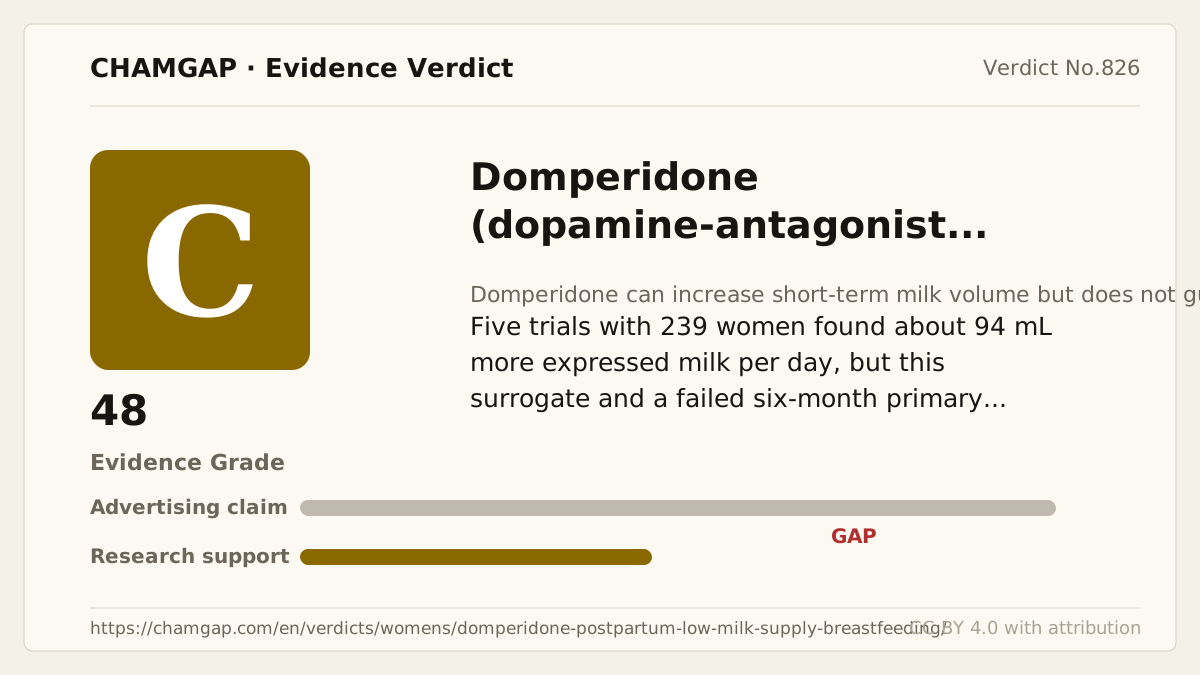
Five randomized trials with 239 women found about 94 mL more expressed milk per day, but milk volume is a surrogate and the six-month exclusive-breastfeeding primary outcome in a 366-pair trial was negative. Uncertain durable benefit gives C with 48 points; QT and arrhythmia risk remains separate under safety.
Counterpoint. After skilled lactation support and correction of reversible causes, clinicians may consider a short monitored trial for selected women with persistent low supply. Palpitations, fainting, or severe dizziness require prompt medical care.
Rejudgment record. New verdict — Accepted about 94 mL more expressed milk per day across five randomized trials and 239 women, but applied lower C for surrogate dependence, limited samples, and failure of the six-month exclusive-breastfeeding primary outcome in the 366-pair trial, with QT risk separated under safety
Sub-claim grades by effect
This ingredient is marketed for several effects. A single overall grade blends strong and weak claims together, so each effect is graded separately here. The overall grade reflects the strongest disconfirming or core claim.
| Effect (sub-claim) | Grade | Basis |
|---|---|---|
| Short-term increase in milk volume among postpartum women with low supply | C | Expressed volume is positive across several small randomized trials, but it is a surrogate and the absolute gain is limited. |
| Increased exclusive breastfeeding at seven days | C | One single-center randomized trial of 366 participants was positive, providing limited direct clinical-outcome evidence. |
| Durable exclusive breastfeeding success at three to six months | D | The six-month primary outcome and the three-month result were not statistically significant. |
| Improved infant growth | ? | No reproducible efficacy evidence for improved infant growth could be established in the verified literature. |
Cross-check — AI research and Codex final gate
Evidence Table
| Study | Design | Sample | Funding | Endpoint | Result | Weight |
|---|---|---|---|---|---|---|
| Taylor A et al. 2019 | Systematic review and meta-analysis of randomized placebo-controlled trials | Five randomized trials and 239 women in the meta-analysis | Funding was not adequately identified in the PubMed abstract and varied across primary trials | Change from baseline in daily expressed human-milk volume | Mean increase of 93.97 mL/day versus placebo (95% CI 71.12 to 116.83). | Key positive synthesis for a surrogate endpoint |
| Asztalos EV et al. EMPOWER 2017 | Multicenter randomized double-blind placebo-controlled trial | 90 mothers of very preterm infants | Sponsored by Sunnybrook Health Sciences Centre; specific funding was inadequately identified in the verified material | Proportion with at least a 50% milk-volume increase at day 14 | 77.8% versus 57.8%, OR 2.56 (95% CI 1.02 to 6.25); the absolute gain was modest. | Direct randomized evidence, but a short-term surrogate |
| Archana A et al. 2023 | Single-center randomized double-blind placebo-controlled trial | 366 mother-infant pairs after cesarean delivery | Academic institutional study; specific funding was not identified in the PubMed abstract | Six-month exclusive-breastfeeding primary outcome and shorter-term rates | Seven days favored domperidone, but three- and six-month results were not significant. | Key evidence showing failure of the long-term primary endpoint |
| Ou LB et al. 2021 | Systematic review and meta-analysis of observational studies | Eight studies and 480,395 participants | Specific funding was not identified in the PubMed abstract | Sudden cardiac death or ventricular arrhythmia | Adjusted OR 1.69 versus nonuse (95% CI 1.46 to 1.95). | Safety-only evidence |
Receipt — 4 References
All 4 cited sources were verified for existence at the original page (as of 2026-07-20).
Final verification and publication gate: Codex · Evidence date: 2026-07-20 · Corrections: none
Cite this verdict
[Chamgap] Domperidone x increased postpartum milk volume and successful breastfeeding — Evidence Grade C·48. 4 cited sources checked. Source: https://chamgap.com/en/verdicts/womens/domperidone-postpartum-low-milk-supply-breastfeeding/ · CC BY 4.0CC BY 4.0 — free to use with attribution; do not distort grades, numbers, or verdict meaning.
What this document does and does not do
Chamgap is an information source. It reports what research has and has not confirmed; it does not tell readers what to take or buy. That decision belongs to readers and, when needed, medical or legal professionals. This verdict reflects literature available up to the search date and may change as new research appears. Nothing here is medical advice.