
Cervical pessary,
does it really help with Prevention of preterm birth in singleton pregnancy with a short cervix?
research showsA cervical pessary has not consistently prevented preterm birth in singleton pregnancies with a short cervix, earning D with 24 points. TOPS analyzed 542 participants and found RR 1.00 (95% CI 0.83 to 1.20) for delivery before 37 weeks or fetal death. A meta-analysis of three trials and 1,412 participants was also null, RR 0.71 (0.21 to 2.43). Results are repeatedly null, but the confidence interval cannot exclude substantial benefit, so the grade is D rather than F.
ads claimA mechanical story about supporting the cervix can be presented as proven prevention. Large trials did not confirm lower preterm birth or fetal death.
Useful facts when choosing a product
- It is a silicone device inserted around the cervix by a clinician and removed later in pregnancy.
- In TOPS, 98.9% also received vaginal progesterone, testing the pessary as an addition to usual management.
- Evidence differs by cervical length, prior preterm birth, and number of fetuses.
Chamgap Semantic Classification Code
Candidate index · review held
P.cervical-pessary.device.preterm-birth-in-singleton-pregnancy-with-a-short-cervix.prevent.UNKProcedures, devices and tests > Cervical pessary > Device delivered > preterm birth in singleton pregnancy with a short cervix > Occurrence-prevention claim > Unknown
An automated migration candidate, not an issued permanent code; exact claim scope remains under review. This machine-generated migration candidate helps retrieval but is not a permanent assignment. The original verdict ID and URL remain authoritative.
What the research actually shows
Hoffman and colleagues randomized 544 participants in TOPS and analyzed 542; delivery before 37 weeks or fetal death was 45.5% versus 45.6%, RR 1.00 (95% CI 0.83 to 1.20). A meta-analysis of three trials and 1,412 participants was also null, RR 0.71 (0.21 to 2.43). The repeated null findings do not exclude substantial benefit because the confidence interval is wide, supporting D rather than F.
Why this is classified as D (24)
TOPS RR 1.00 (0.83 to 1.20) and the three-trial, 1,412-participant meta-analysis RR 0.71 (0.21 to 2.43) were repeatedly null, but substantial benefit remains possible, supporting D with 24 points rather than F.
Counterpoint. An obstetric specialist should choose established prevention according to individual risk; a pessary should not be substituted independently.
Rejudgment record. Cross-check applied — Applied repeated null results from TOPS and the three-trial meta-analysis but retained D rather than F because the confidence intervals cannot exclude substantial benefit
Sub-claim grades by effect
This ingredient is marketed for several effects. A single overall grade blends strong and weak claims together, so each effect is graded separately here. The overall grade reflects the strongest disconfirming or core claim.
| Effect (sub-claim) | Grade | Basis |
|---|---|---|
| Prevention of delivery before 37 weeks or fetal death | D | The actual 542-person TOPS analysis was null with RR 1.00. |
| Prevention of spontaneous birth before 34 weeks | D | The primary endpoint failed in the large 932-person analysis. |
| Reduction in composite neonatal morbidity | D | Large trials did not establish a consistent reduction. |
Cross-check — AI research and Codex final gate
Evidence Table
| Study | Design | Sample | Funding | Endpoint | Result | Weight |
|---|---|---|---|---|---|---|
| Hoffman MK et al. 2023 TOPS | Multicenter open-label randomized usual-care-controlled trial | 544 randomized; actual primary analysis 542 | Public funding from the United States NICHD | Delivery or fetal death before 37 weeks | 45.5% versus 45.6%, RR 1.00; primary endpoint failed. | Newest key public negative trial |
| Nicolaides KH et al. 2016 | Multicenter open-label randomized expectant-management-controlled trial | 935 randomized; actual intention-to-treat analysis 932 | Funded by the Fetal Medicine Foundation; the manufacturer had no role in design or analysis | Spontaneous birth before 34 weeks | 12.0% versus 10.8%, OR 1.12, P=0.57; primary endpoint failed. | Independent large negative trial |
Receipt — 2 References
All 2 cited sources were verified for existence at the original page (as of 2026-07-24).
Final verification and publication gate: Codex · Evidence date: 2026-07-24 · Corrections: none
Cite this verdict
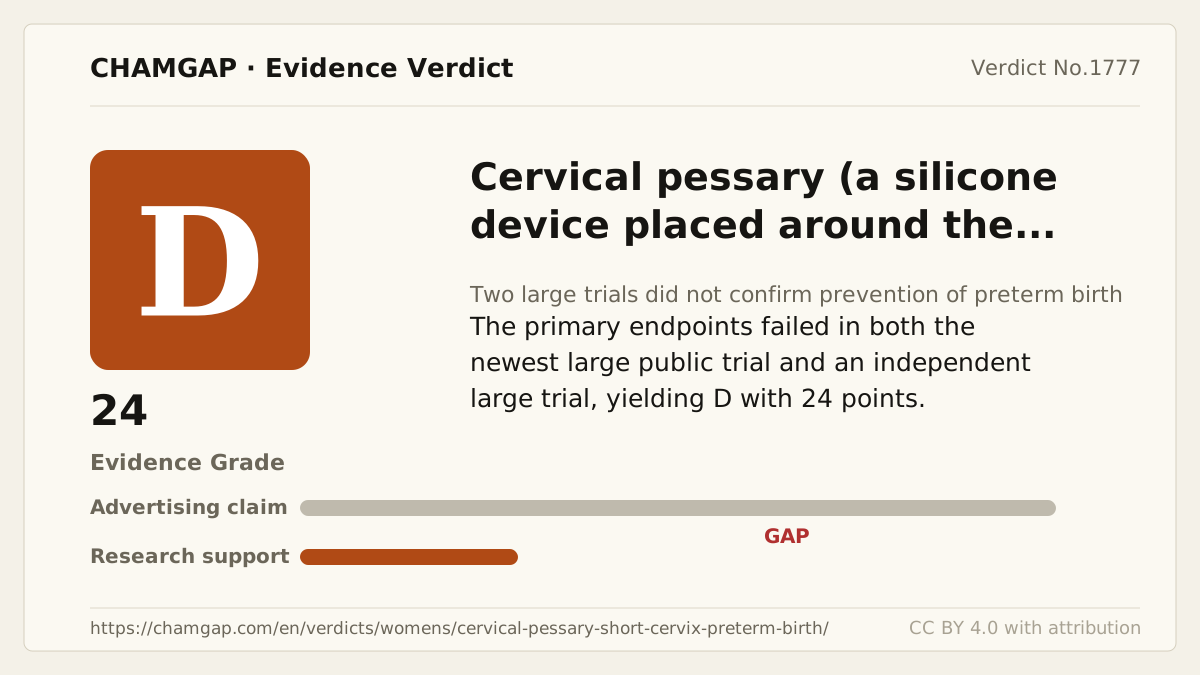
[Chamgap] Cervical pessary x prevention of preterm birth with a short cervix — Evidence Grade D·24. 2 cited sources checked. Source: https://chamgap.com/en/verdicts/womens/cervical-pessary-short-cervix-preterm-birth/ · CC BY 4.0CC BY 4.0 — free to use with attribution; do not distort grades, numbers, or verdict meaning.
What this document does and does not do
Chamgap is an information source. It reports what research has and has not confirmed; it does not tell readers what to take or buy. That decision belongs to readers and, when needed, medical or legal professionals. This verdict reflects literature available up to the search date and may change as new research appears. Nothing here is medical advice.