
Aspirin 300 mg,
does it really help with Reduced recurrence and death after standard treatment for high-risk nonmetastatic HER2-negative breast cancer?
research showsAspirin 300 mg is rated F because it did not reduce recurrence or death after standard treatment for high-risk nonmetastatic HER2-negative breast cancer. The largely publicly funded phase 3 A011502 trial randomized 3,020 participants but stopped at the first interim analysis after crossing the futility boundary. There were 141 invasive disease-free survival events with aspirin and 112 with placebo, yielding an HR of 1.27 (95% CI 0.99 to 1.63; P=.06), with no benefit and a numerically unfavorable direction. However, the confidence interval narrowly included 1, so harm was not statistically established. Overall survival was also unimproved, with an HR of 1.19 (95% CI 0.82 to 1.72). The large confirmatory trial reversed the positive observational expectation, but the distinction from established harm places the verdict at the top of the F band, F with 17 points.
ads claimMarketing or online claims may turn an anti-inflammatory mechanism and favorable observational associations into proven prevention of cancer recurrence. In this indication, the large phase 3 trial designed to test that hypothesis stopped for futility and events were numerically more frequent with aspirin.
Useful facts when choosing a product
- A011502 used aspirin 300 mg by mouth once daily, which is not the same dose or indication as commonly used low-dose cardiovascular prevention.
- Participants had high-risk nonmetastatic ERBB2-negative breast cancer after standard local therapy and chemotherapy. The result does not automatically apply to another cancer or an acute vascular indication.
- There is no basis to start aspirin to improve breast cancer recurrence or survival. A separate cardiovascular indication should be assessed on its own benefits and risks.
- Aspirin can cause gastrointestinal or intracranial bleeding, ulcers, bruising, and drug interactions. Anticoagulant use and a history of bleeding require particular clinical review.
Chamgap Semantic Classification Code
Candidate index · review held
S.aspirin-oral-tablet.oral.recurrence-and-death-after-standard-treatment-for-high-risk-nonmetastatic-her2-negative-breast-cancer.reduce.MULTISupplements and nutraceuticals > Aspirin oral tablet > Oral > recurrence and death after standard treatment for high-risk nonmetastatic HER2-negative breast cancer > Reduction claim > Multiple: primary unresolved
An automated migration candidate, not an issued permanent code; exact claim scope remains under review. This machine-generated migration candidate helps retrieval but is not a permanent assignment. The original verdict ID and URL remain authoritative.
What the research actually shows
A011502 was a double-blind placebo-controlled phase 3 trial conducted at 534 sites in the United States and Canada. It enrolled patients with high-risk stage II or III ERBB2-negative disease after completion of local treatment and chemotherapy; endocrine therapy could continue. At the first interim analysis, 253 invasive disease-free survival events had occurred among 3,020 randomized participants and the trial stopped for futility. Earlier observational meta-analyses reported an association between postdiagnostic aspirin use and lower breast-cancer-specific mortality, but heterogeneity, selection bias, and healthy-user confounding were substantial concerns. This finding is separate from aspirin use in acute stroke under 1581, PI3K-mutated colorectal cancer under 1592, and the different aspirin indication under 1441. Failure in this indication does not decide cardiovascular or other cancer indications.
Why this is classified as F (17)
Observational studies had suggested a survival benefit, but a 3,020-participant randomized phase 3 confirmatory trial stopped for futility at its first interim analysis. Invasive disease-free survival at HR 1.27 and overall survival at HR 1.19 showed no benefit and point estimates favored harm. Because the invasive disease-free survival confidence interval of 0.99 to 1.63 narrowly included 1, harm was not statistically established, placing this confirmatory reversal at the top of the F band, F with 17 points.
Counterpoint. Patients already taking aspirin for an evidence-based indication such as prevention after myocardial infarction or stroke should not stop it solely because of this verdict. The absence of breast cancer adjuvant benefit and the need for aspirin in another indication require separate clinical decisions.
Rejudgment record. Cross-check applied — Applied F because a large phase 3 randomized placebo-controlled confirmatory trial directly tested and reversed the positive observational expectation, stopped at its prespecified futility boundary, and produced point estimates favoring harm for both invasive disease-free and overall survival
Sub-claim grades by effect
This ingredient is marketed for several effects. A single overall grade blends strong and weak claims together, so each effect is graded separately here. The overall grade reflects the strongest disconfirming or core claim.
| Effect (sub-claim) | Grade | Basis |
|---|---|---|
| Reduced breast cancer recurrence after standard treatment | F | Invasive disease-free survival was HR 1.27 with no benefit and numerically more events, but the confidence interval narrowly included 1, so harm was not statistically established. |
| Improved overall survival after standard treatment | F | Overall survival was HR 1.19 (95% CI 0.82 to 1.72), with no reduction in death. |
| Improved invasive disease-free survival | F | The primary endpoint crossed the futility boundary and stopped the trial early, reversing the positive observational expectation. |
Cross-check — AI research and Codex final gate
Evidence Table
| Study | Design | Sample | Funding | Endpoint | Result | Weight |
|---|---|---|---|---|---|---|
| Chen WY et al. 2024, Alliance A011502 | Multicenter randomized double-blind placebo-controlled phase 3 trial | 3,020 participants at 534 sites in the United States and Canada | Primarily public funding from the United States Department of Defense and NCI; Bayer provided study drug without a design or analysis role | Primary invasive disease-free survival and key secondary overall survival | The trial stopped for futility at the first interim analysis. Invasive disease-free survival was HR 1.27 (95% CI 0.99 to 1.63) and overall survival was HR 1.19 (95% CI 0.82 to 1.72), with no benefit. | Decisive large confirmatory reversal evidence |
| Baker A and Kartsonaki C. 2024 | Systematic review and meta-analysis of observational studies | 24 papers and 149,860 patients with breast cancer | Academic research based on observational rather than randomized evidence | Associations of prediagnostic and postdiagnostic aspirin use with breast-cancer-specific mortality, all-cause mortality, and recurrence | Postdiagnostic use was associated with breast-cancer-specific mortality at HR 0.79, but recurrence at HR 0.89 was null; selection bias and high heterogeneity precluded causal conclusions. | Pre-reversal observational expectation and confounding limitations |
Receipt — 2 References
All 2 cited sources were verified for existence at the original page (as of 2026-07-24).
Final verification and publication gate: Codex · Evidence date: 2026-07-24 · Corrections: none
Cite this verdict
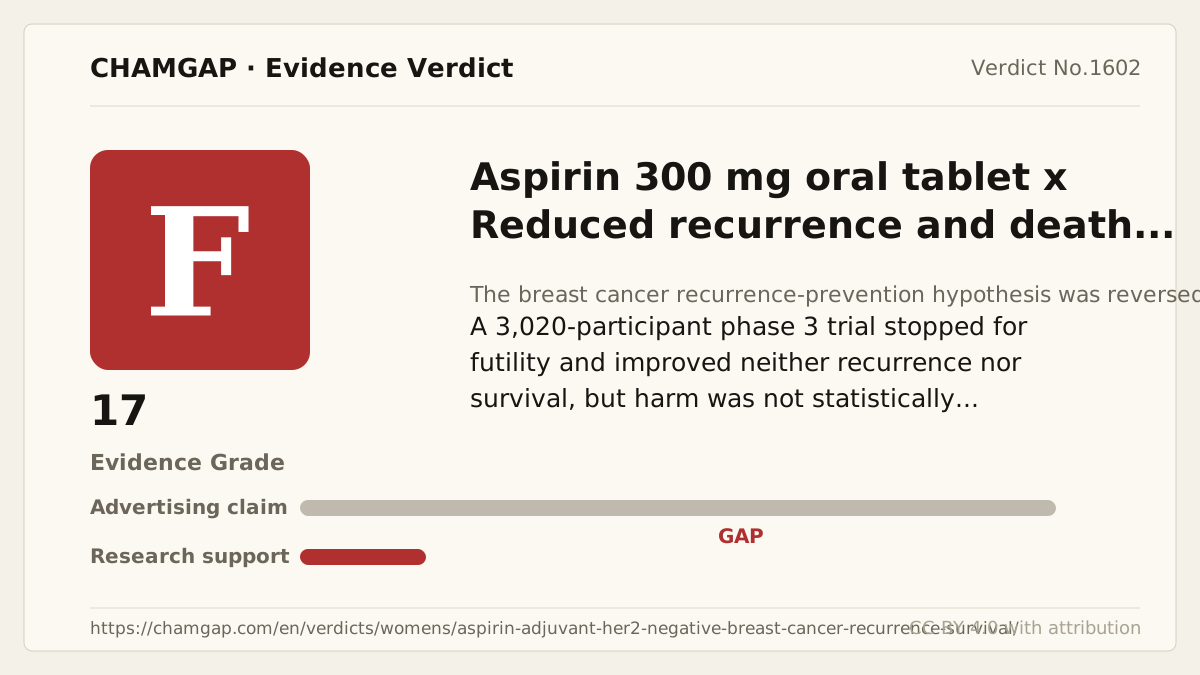
[Chamgap] Aspirin 300 mg x reduced recurrence and death in high-risk HER2-negative breast cancer — Evidence Grade F·17. 2 cited sources checked. Source: https://chamgap.com/en/verdicts/womens/aspirin-adjuvant-her2-negative-breast-cancer-recurrence-survival/ · CC BY 4.0CC BY 4.0 — free to use with attribution; do not distort grades, numbers, or verdict meaning.
What this document does and does not do
Chamgap is an information source. It reports what research has and has not confirmed; it does not tell readers what to take or buy. That decision belongs to readers and, when needed, medical or legal professionals. This verdict reflects literature available up to the search date and may change as new research appears. Nothing here is medical advice.