
Wide local excision for melanoma,
does it really help with Prevention of locoregional recurrence and melanoma death with a wider margin versus 1 cm for trunk or limb melanoma at least 2 mm thick by Breslow depth?
research showsA margin wider than 1 cm is rated B for trunk or limb melanoma at least 2 mm thick by Breslow depth. A 900-participant UK MRC-related randomized trial showed more locoregional recurrence with a 1 cm margin than with 3 cm, and long-term follow-up found 194 versus 165 melanoma deaths, with an HR of 1.24 against the 1 cm group. The mortality result was nominally borderline in long-term follow-up, the UK-only sensitivity analysis crossed one, and overall survival did not differ. The trial also did not directly compare the current 2 cm margin with 3 cm, preventing an A grade.
ads claimWide excision can be simplified into a claim that the widest possible margin certainly prevents recurrence and death. The evidence specifically shows that 1 cm is inadequate for trunk or limb melanoma at least 2 mm thick; it does not show that 3 cm is superior to the current 2 cm approach.
Useful facts when choosing a product
- Wide local excision removes additional skin and subcutaneous tissue around the diagnostic-excision scar using a clinical margin selected by tumor thickness.
- This verdict is based on a trial comparing 1 cm and 3 cm margins for primary trunk or limb cutaneous melanoma at least 2 mm thick by Breslow depth.
- The 2 cm margin commonly used in modern guidelines was not a direct comparator, so the result must not be interpreted as proof that 3 cm is superior to 2 cm.
- A wider excision can increase wound complications, infection, seroma, sensory change, scarring, and the need for skin graft or flap reconstruction.
Chamgap Semantic Classification Code
Candidate index · review held
P.wide-local-excision.procedural.locoregional-recurrence-and-melanoma-death-with-a-wider-margin.prevent.UNKProcedures, devices and tests > Wide local excision > Procedural > locoregional recurrence and melanoma death with a wider margin > Occurrence-prevention claim > Unknown
An automated migration candidate, not an issued permanent code; exact claim scope remains under review. This machine-generated migration candidate helps retrieval but is not a permanent assignment. The original verdict ID and URL remain authoritative.
What the research actually shows
The UK Melanoma Study Group and collaborators randomized 900 patients with primary cutaneous melanoma at least 2 mm thick on the trunk or limbs to an additional 1 cm or 3 cm margin after initial excision. At a median of five years, locoregional relapse was significantly more frequent with 1 cm and overall survival did not differ. At a median of 8.8 years, melanoma-specific death was nominally higher with 1 cm, but all-cause survival remained nonsignificant and a country-restricted sensitivity analysis retained uncertainty. Surgical complications occurred in 8% with 1 cm and 15% with 3 cm.
Why this is classified as B (66)
A 900-participant randomized trial directly favored the wider margin for the clinical cancer outcome of locoregional recurrence. Long-term melanoma-specific mortality was nominally significant, but a borderline confidence interval, sensitivity-analysis uncertainty, no overall-survival difference, and no direct 2 cm comparison yield B with 66 points.
Counterpoint. The appropriate margin balances tumor thickness, anatomical site, function, reconstruction burden, and pathology. This verdict concerns wide excision for invasive melanoma, not Mohs surgery or imiquimod for basal-cell carcinoma.
Rejudgment record. Cross-check applied — Accepted reduced locoregional recurrence in the 900-participant randomized comparison of 1 cm versus 3 cm and treated the long-term melanoma-specific mortality signal as supportive, while applying a ceiling for borderline robustness, sensitivity-analysis uncertainty, no overall-survival difference, and no direct comparison with the current 2 cm margin. At cross-check the score was lowered to 66 for the borderline melanoma-specific mortality (HR 1.24, 1.01-1.53) and the null overall survival (grade B retained).
Sub-claim grades by effect
This ingredient is marketed for several effects. A single overall grade blends strong and weak claims together, so each effect is graded separately here. The overall grade reflects the strongest disconfirming or core claim.
| Effect (sub-claim) | Grade | Basis |
|---|---|---|
| Prevention of locoregional recurrence with a wider margin versus 1 cm | B | The 900-participant randomized trial found significantly greater recurrence risk with the 1 cm margin. |
| Prevention of melanoma-specific death with a 3 cm margin versus 1 cm | C | The long-term HR was 1.24 with p=0.041, but sensitivity-analysis uncertainty and no overall-survival difference make the result borderline. |
| Prevention of recurrence or death with a 3 cm margin versus 2 cm | C | The pivotal UK trial did not directly compare 2 cm, so incremental benefit cannot be established. |
Cross-check — AI research and Codex final gate
Evidence Table
| Study | Design | Sample | Funding | Endpoint | Result | Weight |
|---|---|---|---|---|---|---|
| Thomas JM et al. 2004 | Open randomized trial of 1 cm versus 3 cm margins at 59 hospitals | 900 participants | United Kingdom public, cancer-research, and surgical academic support | Locoregional recurrence and overall survival | The 1 cm group had more locoregional recurrence, with adjusted HR 1.34, while overall survival did not significantly differ. | Pivotal direct randomized evidence for locoregional recurrence |
| Hayes AJ et al. 2016 | Long-term survival follow-up of the original randomized trial | 900 originally randomized participants with median follow-up of 8.8 years | Cancer Research UK and United Kingdom public and charitable support | Melanoma-specific survival and overall survival | Melanoma deaths numbered 194 with 1 cm versus 165 with 3 cm, HR 1.24, while the all-cause mortality HR of 1.14 was not significant. | Mortality signal with borderline robustness |
Receipt — 2 References
All 2 cited sources were verified for existence at the original page (as of 2026-07-23).
Final verification and publication gate: Codex · Evidence date: 2026-07-23 · Corrections: none
Cite this verdict
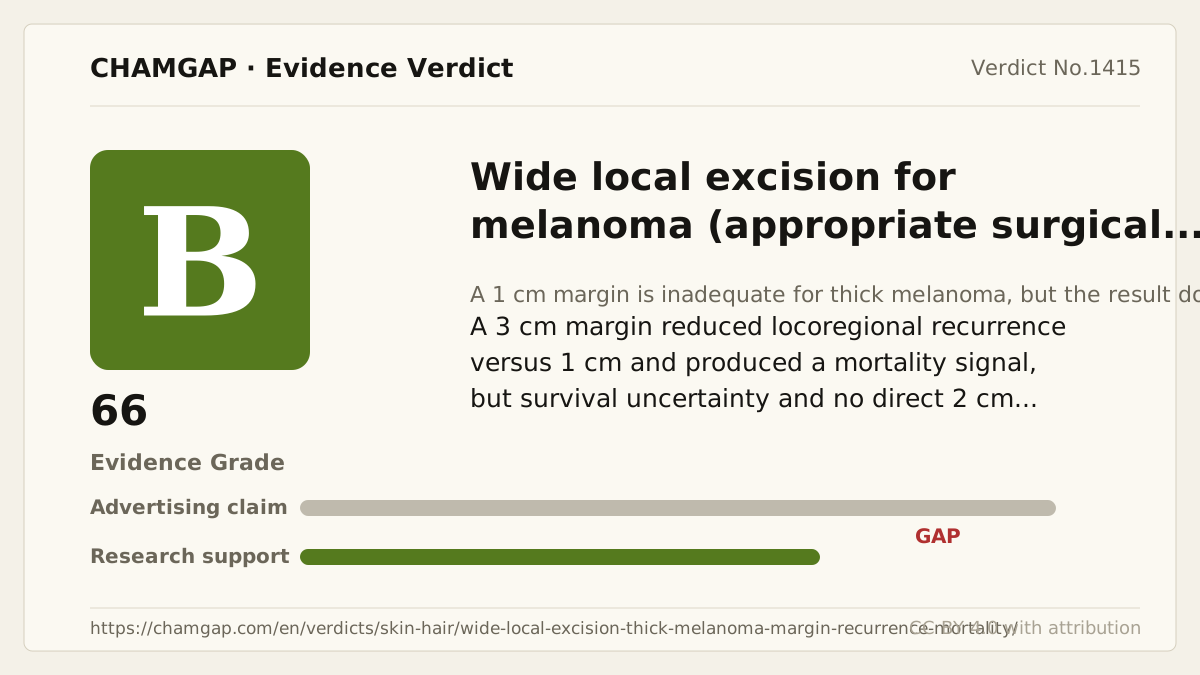
[Chamgap] Wide local excision for melanoma x prevention of locoregional recurrence in thick melanoma — Evidence Grade B·66. 2 cited sources checked. Source: https://chamgap.com/en/verdicts/skin-hair/wide-local-excision-thick-melanoma-margin-recurrence-mortality/ · CC BY 4.0CC BY 4.0 — free to use with attribution; do not distort grades, numbers, or verdict meaning.
What this document does and does not do
Chamgap is an information source. It reports what research has and has not confirmed; it does not tell readers what to take or buy. That decision belongs to readers and, when needed, medical or legal professionals. This verdict reflects literature available up to the search date and may change as new research appears. Nothing here is medical advice.