
Early endovenous ablation,
does it really help with Faster complete healing of venous leg ulcers?
research showsThe grade is A. Complete healing is an actual closure of the skin defect, and blinded photographic review in EVRA found faster healing. After 450 participants were randomized, median healing was 56 days (95% CI 49 to 66) versus 82 days (69 to 92), HR 1.38 (1.13 to 1.68), P=0.001. Independent VUERT pointed the same way, and Cochrane pooled HR 1.41 (1.36 to 1.47), heterogeneity 0%, with high certainty, giving A with 86 points.
ads claimThis does not show that vein procedures heal every chronic wound. It applies to venous ulcers with confirmed superficial reflux in people able to receive compression therapy.
Useful facts when choosing a product
- EVRA delivered early endovenous treatment within two weeks of randomization.
- The deferred group could receive ablation after healing or after six months if unhealed.
- The trial allowed more than one thermal or nonthermal endovenous closure technique.
Chamgap Semantic Classification Code
Candidate index · review held
UNK.early-endovenous-ablation-added-to-compression.intravenous.faster-complete-healing-of-venous-leg-ulcers.improve.addonUnknown > Early endovenous ablation added to compression > Intravenous > Faster complete healing of venous leg ulcers > Improvement claim > Added intervention on common background care
An automated migration candidate, not an issued permanent code; exact claim scope remains under review. This machine-generated migration candidate helps retrieval but is not a permanent assignment. The original verdict ID and URL remain authoritative.
What the research actually shows
The U.K. NIHR-funded EVRA trial randomized 450 participants, 224 to early and 226 to deferred ablation. Two ulcers had already healed before randomization and did not contribute to the survival analysis, so not all 450 contributed healing-time data. Median healing was 56 days (49 to 66) versus 82 days (69 to 92), HR 1.38 (1.13 to 1.68), P=0.001; healing at 24 weeks was 85.6% versus 76.3%. The independent Brazilian single-center VUERT trial randomized 56, 27 versus 29; median healing was 68 versus 77 days and healing velocity favored ablation, P=0.049, while healing rates themselves were not significant. Author lists did not overlap.
Why this is classified as A (86)
A large publicly funded trial accelerated blinded-confirmed actual healing, a nonoverlapping independent trial pointed the same way, and pooled certainty was high, giving A with 86 points.
Counterpoint. Complete healing is supported, but reduced one-year recurrence remains uncertain.
Rejudgment record. Cross-check applied — A large publicly funded trial accelerated blinded-photograph-confirmed complete healing, with nonoverlapping independent replication and high-certainty synthesis
| Endpoint | H | Hard endpoint - actual events such as death |
| Replication | R2 | Independently replicated across trials |
| Independence | I2 | Decisive evidence is publicly or non-profit funded |
| Effect size | E+ | Meets the clinically important threshold |
Stored derived and displayed grades match; this is not a current recalculation or validity check (A).
Sub-claim grades by effect
This ingredient is marketed for several effects. A single overall grade blends strong and weak claims together, so each effect is graded separately here. The overall grade reflects the strongest disconfirming or core claim.
| Effect (sub-claim) | Grade | Basis |
|---|---|---|
| Shorter time to complete venous leg-ulcer healing | A | EVRA medians were 56 versus 82 days, and the pooled HR was 1.41. |
| Reduced ulcer recurrence at one year | D | The pooled RR was 0.29 with a very wide 95% CI of 0.03 to 2.48. |
Cross-check — AI research and Codex final gate
Evidence Table
| Study | Design | Sample | Funding | Endpoint | Result | Weight |
|---|---|---|---|---|---|---|
| Gohel MS et al. 2018 EVRA | 20-center open randomized trial with blinded healing assessment | 450 randomized, 224 versus 226; two healed before randomization did not contribute to survival analysis | U.K. NIHR Health Technology Assessment Programme | Time to complete ulcer healing | HR 1.38 (95% CI 1.13 to 1.68), P=0.001; median 56 days (49 to 66) versus 82 days (69 to 92); 24-week healing 85.6% versus 76.3% | Pivotal large publicly funded evidence |
| Puggina J et al. 2021 VUERT | Single-center open-label randomized trial | 56 randomized and analyzed, 27 versus 29 | No commercial trial funding identified in the report | Healing at 6, 12, and 24 weeks and recurrence at 12 months | Healing rates did not differ significantly; healing velocity favored ablation (P=0.049) | Small independent evidence in the same direction |
Receipt — 3 References
All 3 cited sources were verified for existence at the original page (as of 2026-08-11).
Final verification and publication gate: Codex · Evidence date: 2026-08-11 · Corrections: none
Cite this verdict
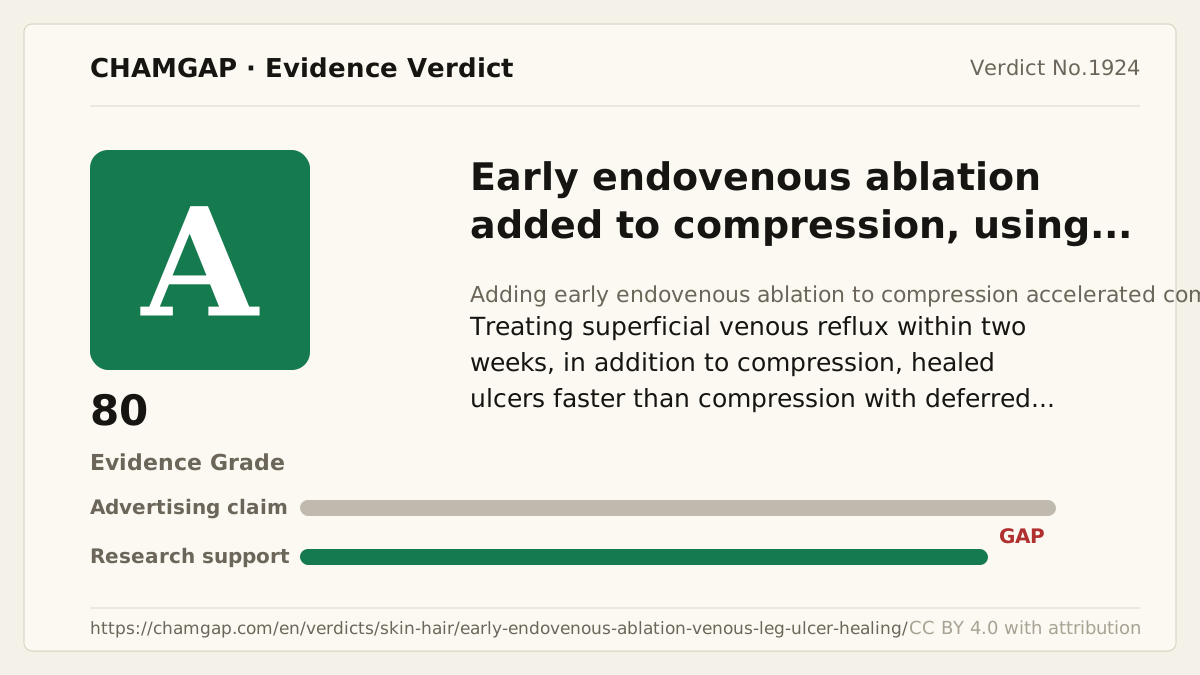
[Chamgap] Early endovenous ablation x faster venous leg-ulcer healing — Evidence Grade A·86. 3 cited sources checked. Source: https://chamgap.com/en/verdicts/skin-hair/early-endovenous-ablation-venous-leg-ulcer-healing/ · CC BY 4.0CC BY 4.0 — free to use with attribution; do not distort grades, numbers, or verdict meaning.
What this document does and does not do
Chamgap is an information source. It reports what research has and has not confirmed; it does not tell readers what to take or buy. That decision belongs to readers and, when needed, medical or legal professionals. This verdict reflects literature available up to the search date and may change as new research appears. Nothing here is medical advice.