
Multilayer compression bandaging,
does it really help with Faster complete healing of venous leg ulcers?
research showsMultilayer compression bandaging is rated A because it accelerates complete healing of venous leg ulcers. Morrell 1998 randomized 233 participants and analyzed all of them by intention to treat; the primary clinical endpoint, time to complete healing, succeeded (log-rank P=.03; 12-week healing 34% versus 24%). Shi 2021, Cochrane 2021(7):CD013397, compared compression with no compression in 14 randomized trials and 1,391 participants: complete healing in eight trials and 1,120 participants had RR 1.77 (1.41 to 2.21), I-squared=65%, while time to healing had HR 2.17 (1.52 to 3.10), I-squared=59%. Unmasked procedures, variation among bandage types, and moderate heterogeneity limit the score to the bottom of A, 80 points.
ads claimMarketing can omit bandage type, operator skill, wound care, and arterial assessment and imply that compression heals any leg wound. The evidence applies to properly delivered compression for venous leg ulcers.
Useful facts when choosing a product
- Multilayer systems combine padding and compression layers to provide therapeutic graduated pressure.
- The venous cause and arterial circulation should be assessed before treatment, and trained clinicians should select pressure and wound care.
- Worsening pain, pallor, cyanosis, coldness, or numbness requires prompt assessment for excessive pressure or arterial compromise.
Chamgap Semantic Classification Code
Candidate index · review held
M.multilayer-compression-bandaging.intravenous.faster-complete-healing-of-venous-leg-ulcers.improve.UNKMedicinal interventions > Multilayer compression bandaging > Intravenous > Faster complete healing of venous leg ulcers > Improvement claim > Unknown
An automated migration candidate, not an issued permanent code; exact claim scope remains under review. This machine-generated migration candidate helps retrieval but is not a permanent assignment. The original verdict ID and URL remain authoritative.
What the research actually shows
Morrell and colleagues randomized 233 people with venous leg ulcers to weekly four-layer bandaging in a specialist clinic, 120 participants, or usual district-nurse home care, 113 participants. The actual primary analysis was intention to treat in all 233 participants, and the primary endpoint of time to complete healing succeeded with log-rank P=.03; complete healing at 12 weeks was 34% versus 24%. Shi 2021, Cochrane 2021(7):CD013397, included 14 randomized trials and 1,391 participants comparing compression with no compression. Eight trials with 1,120 participants gave RR 1.77 (95% CI 1.41 to 2.21), I-squared=65%, for complete healing; five trials with 733 participants gave HR 2.17 (1.52 to 3.10), I-squared=59%, for time to healing. The heterogeneity values differ and are reported separately. The separate verdict 1357, which is D with 34 points, concerns graduated compression stockings for leg fatigue, while verdict 1494, which is A with 90 points, concerns medical intermittent pneumatic compression for DVT prevention. Both purposes differ entirely from ulcer healing, and neither evidence base was reused.
Why this is classified as A (80)
Success on a direct complete-healing primary endpoint in a 233-participant intention-to-treat trial and replication across 14 trials and 1,391 participants support A with 80 points. Unmasked procedures, variation among bandage types, moderate heterogeneity, and the specialist-clinic bundle prevent a higher score.
Counterpoint. With proper selection and skilled application, compression is a core treatment that increases both the probability and speed of healing.
Rejudgment record. Cross-check applied — A publicly funded intention-to-treat trial succeeded on the direct complete-healing primary endpoint and a 14-trial meta-analysis replicated it; unmasked procedures, variation among bandage types, and moderate heterogeneity limit the score to 80
Sub-claim grades by effect
This ingredient is marketed for several effects. A single overall grade blends strong and weak claims together, so each effect is graded separately here. The overall grade reflects the strongest disconfirming or core claim.
| Effect (sub-claim) | Grade | Basis |
|---|---|---|
| Increased complete healing within 12 months | A | Eight randomized trials with 1,120 participants were repeatedly positive, with RR 1.77. |
| Shorter time to complete healing | A | Both the pivotal intention-to-treat trial and the five-trial synthesis were positive. |
| Reduction in ulcer-related pain | B | The Cochrane review suggests improvement, but evidence is less extensive than for healing. |
Cross-check — AI research and Codex final gate
Evidence Table
| Study | Design | Sample | Funding | Endpoint | Result | Weight |
|---|---|---|---|---|---|---|
| Morrell CJ et al. 1998 | Randomized controlled trial with one-year follow-up | 233 randomized, 120/113; actual primary intention-to-treat analysis 233 | Public funding from the former Trent Regional Health Authority | Primary: time to complete ulcer healing | Primary endpoint succeeded; log-rank P=.03, with 12-week healing of 34% versus 24%. | Pivotal randomized trial with a direct clinical endpoint |
| Shi C et al. 2021 | Cochrane systematic review and meta-analysis, compression versus no compression | 14 randomized trials and 1,391 participants; complete-healing analysis in 8 trials and 1,120 participants | NIHR Cochrane Infrastructure and University of Manchester support; not manufacturer-led | Complete healing and time to healing | Complete healing RR 1.77 (1.41 to 2.21), I-squared=65%; time-to-healing HR 2.17 (1.52 to 3.10), I-squared=59%. | Independent replicated synthesis |
| O'Brien JF et al. 2003 | Pragmatic randomized controlled trial with 12-week follow-up in an Irish community setting | 200 randomized, 100/100; intention-to-treat analysis | Educational grant from Smith & Nephew, a compression-product manufacturer, per the Shi 2021 Cochrane characteristics table; a different funder from Morrell's public funding | Time to healing and cost per leg healed | Three-month healing was 54% versus 34%; four-layer bandaging healed ulcers significantly earlier (P=0.006) and reduced cost per leg healed (P=0.040). | Independent replication by a different country, team, and funder, with the manufacturer educational grant disclosed |
Receipt — 3 References
All 3 cited sources were verified for existence at the original page (as of 2026-08-11).
Final verification and publication gate: Codex · Evidence date: 2026-08-11 · Corrections: none
Cite this verdict
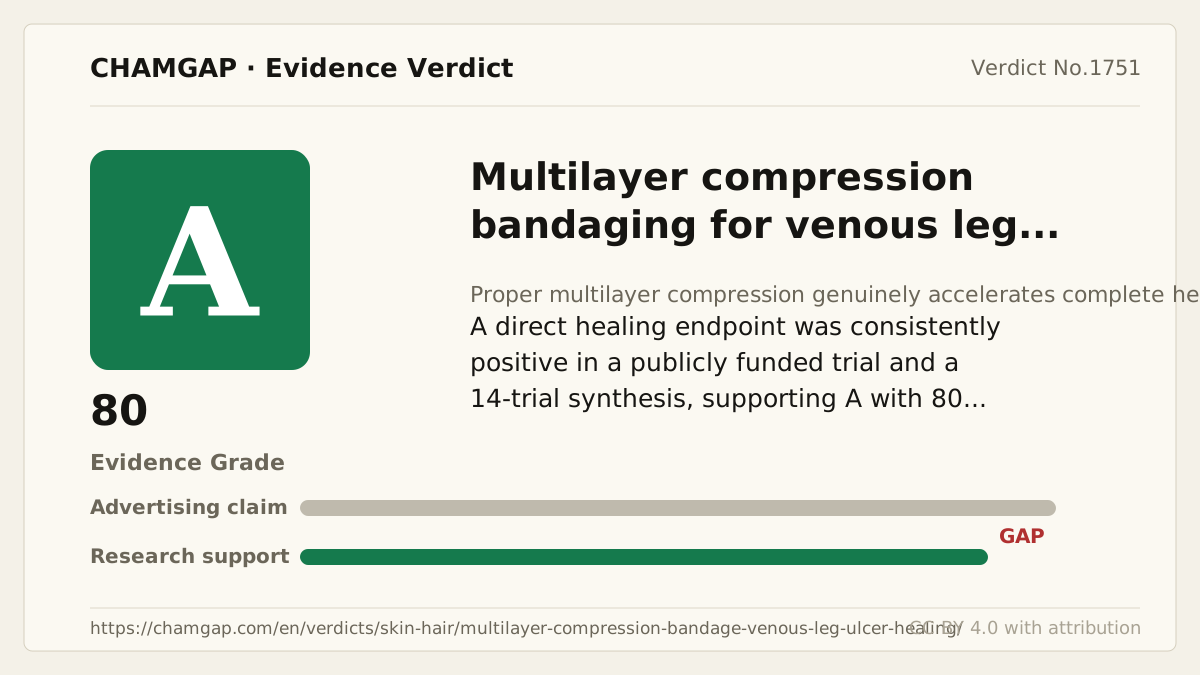
[Chamgap] Multilayer compression bandaging x complete venous leg-ulcer healing — Evidence Grade A·80. 3 cited sources checked. Source: https://chamgap.com/en/verdicts/skin-hair/multilayer-compression-bandage-venous-leg-ulcer-healing/ · CC BY 4.0CC BY 4.0 — free to use with attribution; do not distort grades, numbers, or verdict meaning.
What this document does and does not do
Chamgap is an information source. It reports what research has and has not confirmed; it does not tell readers what to take or buy. That decision belongs to readers and, when needed, medical or legal professionals. This verdict reflects literature available up to the search date and may change as new research appears. Nothing here is medical advice.