
Topical adapalene,
does it really help with Reduction of inflammatory and noninflammatory lesions in mild-to-moderate acne?
research showsB. Topical adapalene repeatedly reduces inflammatory and noninflammatory lesion counts in mild-to-moderate acne. Two vehicle-controlled trials totaling 2,141 participants significantly improved 12-week lesion counts and investigator global assessment, and a 200-participant Japanese trial reported a 63.2% versus 36.9% median reduction in total lesions. Lesion counts are direct, objective clinical endpoints, and the trials are consistently positive. However, the pivotal evidence is concentrated in the Galderma formulation-development program, falling short of the independent large hard-outcome evidence required for A and supporting upper B with 79 points. This verdict does not establish monotherapy for severe nodulocystic disease. Early irritation, dryness, erythema, sun-exposure precautions, and avoidance during pregnancy remain separate safety issues.
ads claimMarketing can expand the evidence into a claim that adapalene alone treats every form of acne or works immediately without irritation. The strong evidence actually concerns reduction of comedonal and inflammatory lesions in mild-to-moderate acne after consistent treatment for roughly eight to twelve weeks, not monotherapy for severe nodulocystic disease, scars, or instant irritation-free results.
Useful facts when choosing a product
- Adapalene is generally applied as a thin layer once daily to the entire clean, fully dry acne-prone area; available strengths and nonprescription or prescription status vary by country and product.
- Benefit develops over weeks rather than after one or two applications, so use should be continued according to the specific label or prescription before response is judged.
- Dryness, stinging, erythema, and scaling are common early effects. Avoiding harsh cleansers and duplicate retinoids, using moisturizer, and protecting skin from ultraviolet exposure can improve tolerability.
- Topical retinoids are generally avoided during pregnancy or when planning pregnancy. Inadvertent-exposure data do not show a large risk increase, but they cannot establish safety or justify planned use.
Chamgap Semantic Classification Code
Candidate index · review held
M.adapalene.topical-skin.inflammatory-and-noninflammatory-lesions-in-mild-to-moderate-acne.reduce.placeboMedicinal interventions > adapalene > Topical skin > inflammatory and noninflammatory lesions in mild to moderate acne > Reduction claim > Placebo
An automated migration candidate, not an issued permanent code; exact claim scope remains under review. This machine-generated migration candidate helps retrieval but is not a permanent assignment. The original verdict ID and URL remain authoritative.
What the research actually shows
Eichenfield and colleagues combined two 12-week double-blind multicenter trials that randomized 2,141 people with acne to adapalene 0.1% lotion or vehicle. Adapalene was superior for investigator-global-assessment success and total, inflammatory, and noninflammatory lesion reductions. Kawashima and colleagues randomized 200 Japanese patients and found a median total-lesion reduction of 63.2% with adapalene 0.1% gel versus 36.9% with vehicle, with significantly better inflammatory and noninflammatory counts as well. The 2025 network meta-analysis by Kakpovbia and colleagues synthesized 35 trials with 33,472 participants, finding that topical single agents generally reduced lesions more than placebo and that combinations were usually more effective than single agents. A meta-analysis of first-trimester topical-retinoid exposure did not detect a major risk increase but explicitly lacked power to justify use during pregnancy.
Why this is classified as B (79)
B. Two multicenter vehicle-controlled trials totaling 2,141 participants and a separate 200-participant Japanese trial consistently reduced inflammatory and noninflammatory lesion counts, which are direct, objective clinical endpoints. A network meta-analysis of 35 trials and 33,472 participants supports the same direction. Pivotal evidence is nevertheless concentrated in the Galderma formulation-development program, so it does not meet the A requirement for independent large hard-outcome confirmation. The reassessed grade is upper B with 79 points. Irritation, sun exposure, and pregnancy precautions remain separate from efficacy scoring.
Counterpoint. Early irritation can often be managed by adjusting application amount or frequency and adding moisturizer with professional guidance. Severe nodules, progressive scarring, extensive truncal disease, or inadequate response after eight to twelve weeks warrants assessment for combination or systemic treatment.
Rejudgment record. Reassessment (cross-check reflected) — Applied upper B because two vehicle-controlled trials totaling 2,141 participants and a separate 200-participant Japanese trial consistently improved direct objective inflammatory and noninflammatory lesion counts, while pivotal evidence remained concentrated in the Galderma formulation-development program and lacked the independent large hard-outcome confirmation required for A
Sub-claim grades by effect
This ingredient is marketed for several effects. A single overall grade blends strong and weak claims together, so each effect is graded separately here. The overall grade reflects the strongest disconfirming or core claim.
| Effect (sub-claim) | Grade | Basis |
|---|---|---|
| Reduction of inflammatory and noninflammatory lesions in mild-to-moderate acne | B | Large vehicle-controlled trials, replicated randomized studies, and meta-analysis consistently reduced direct lesion counts. |
| Adapalene monotherapy for severe nodulocystic acne | ? | No qualifying human efficacy literature was located for this narrow monotherapy claim, and severe disease commonly requires systemic or combination treatment. |
Cross-check — AI research and Codex final gate
Evidence Table
| Study | Design | Sample | Funding | Endpoint | Result | Weight |
|---|---|---|---|---|---|---|
| Eichenfield LF et al. 2010 | Two multicenter randomized double-blind vehicle-controlled trials | 2,141 participants with acne; 1,068 assigned to adapalene and 1,073 to vehicle | Formulation-development trials; funding source not stated in the PubMed abstract | Twelve-week investigator-global-assessment success and changes in total, inflammatory, and noninflammatory lesion counts | In both trials, adapalene 0.1% lotion was significantly superior to vehicle for global-assessment success and all three lesion-count measures. | Largest replicated direct placebo-controlled evidence |
| Kawashima M et al. 2008 | Multicenter randomized investigator-blinded vehicle-controlled trial | 200 Japanese patients with acne | Funding source not stated in the PubMed abstract | Twelve-week reduction in total, inflammatory, and noninflammatory lesions | Median total-lesion reduction was 63.2% with adapalene and 36.9% with vehicle, with significant superiority in every lesion category. | Replication across region and formulation |
| Kakpovbia EE et al. 2025 | Systematic review and network meta-analysis of randomized topical-acne trials | 35 randomized trials with 33,472 participants | Funding source not stated in the PubMed abstract | Inflammatory, noninflammatory, and total lesion counts plus investigator-global-assessment success | Most topical single agents reduced lesions more than placebo, while combination agents were generally more effective than single agents. | Large synthesis of replication and comparative efficacy |
Receipt — 4 References
All 4 cited sources were verified for existence at the original page (as of 2026-07-20).
Final verification and publication gate: Codex · Evidence date: 2026-07-20 · Corrections: none
Cite this verdict
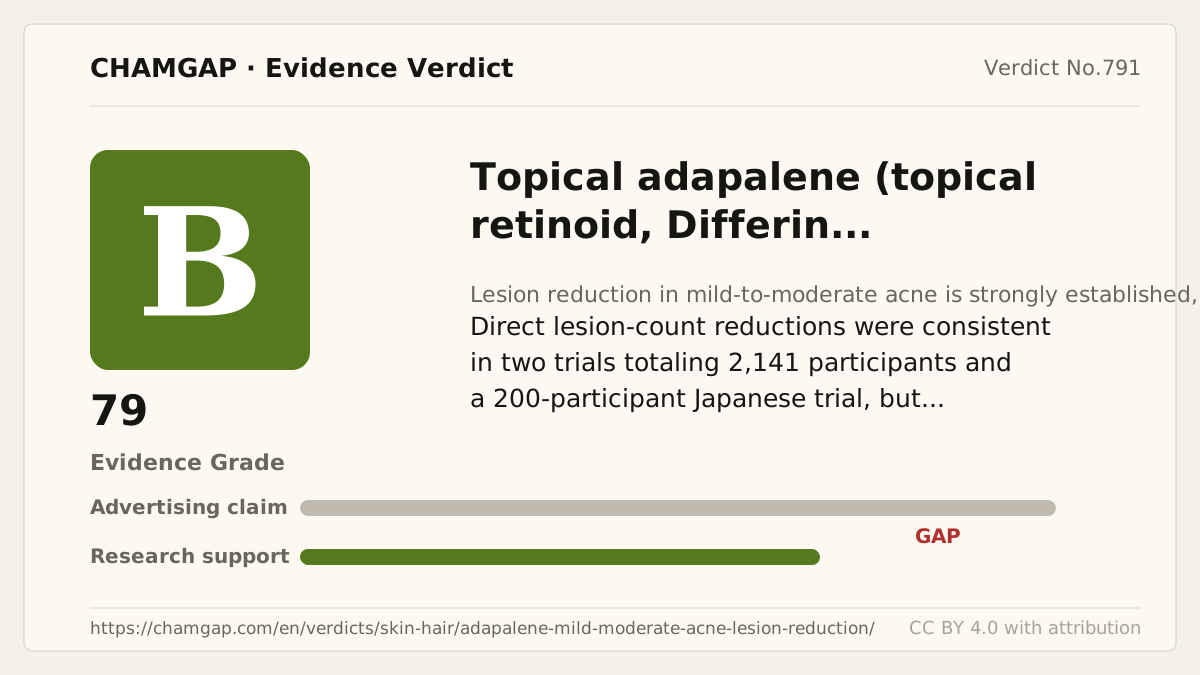
[Chamgap] Topical adapalene x reduced lesions in mild-to-moderate acne — Evidence Grade B·79. 4 cited sources checked. Source: https://chamgap.com/en/verdicts/skin-hair/adapalene-mild-moderate-acne-lesion-reduction/ · CC BY 4.0CC BY 4.0 — free to use with attribution; do not distort grades, numbers, or verdict meaning.
What this document does and does not do
Chamgap is an information source. It reports what research has and has not confirmed; it does not tell readers what to take or buy. That decision belongs to readers and, when needed, medical or legal professionals. This verdict reflects literature available up to the search date and may change as new research appears. Nothing here is medical advice.