
Volufiline,
does it really help with Filler-like correction of under-eye and cheek hollows by increasing fat volume?
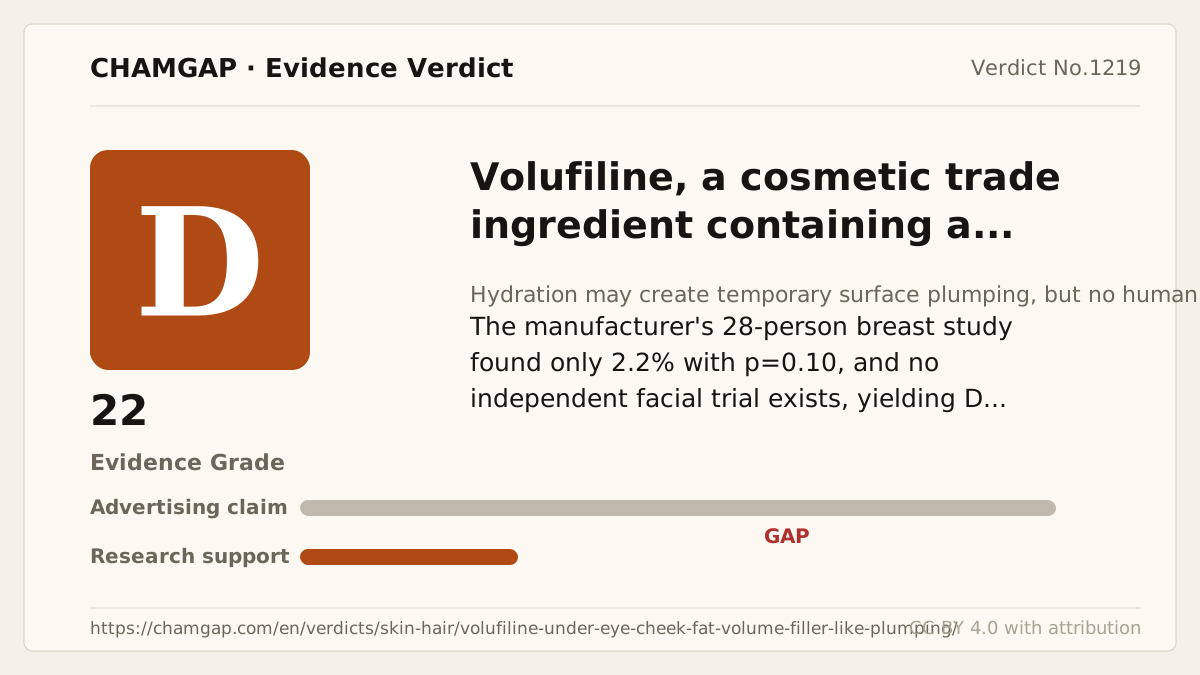
research showsVolufiline is rated D for filling under-eye or cheek hollows by increasing fat. The only identified human data are a manufacturer study in which women applied 5% Volufiline to one breast for 56 days. Only 28 participants were evaluable at day 56; the treated side increased by an average of 2.2%, the untreated side by 0.9%, and the treated-side change from baseline had a p value of 0.10, missing the conventional significance threshold. No independent randomized trial has tested the face, especially the under-eye or cheek, and lipid accumulation in cultured cells does not prove penetration to facial subcutaneous fat. Manufacturer-only, anatomically indirect, statistically null evidence yields D with 22 points.
ads claimMarketing turns adipocyte-culture results and an 8.4% value from the eight best responders into filler in a bottle. The full-sample manufacturer result was a statistically nonsignificant 2.2% change in the upper breast, with no trial of facial hollows or comparison with injectable filler.
Useful facts when choosing a product
- Volufiline is a Sederma trade ingredient whose listed INCI components are Hydrogenated Polyisobutene and Anemarrhena Asphodeloides Root Extract.
- The manufacturer recommends a 5% use level in a finished formula. Products sold online as 100% Volufiline or as finished cosmetics can differ in concentration, authenticity, and co-ingredients.
- The small manufacturer study reported good tolerability, but long-term facial and periocular safety data are limited. Stinging, redness, comedones, acne, or contact irritation can occur.
- It should be kept out of the eye and off mucosal surfaces and patch-tested first. Swelling, pain, or persistent rash warrants discontinuation, while true facial volume loss is better assessed by a dermatologist or plastic surgeon.
Chamgap Semantic Classification Code
Candidate index · review held
S.volufiline.UNK.filler-like-correction-of-under-eye-and-cheek-hollows-by-increasing-fat-volume.increase.noneSupplements and nutraceuticals > Volufiline > Unknown > Filler-like correction of under-eye and cheek hollows by increasing fat volume > Increase claim > No intervention
An automated migration candidate, not an issued permanent code; exact claim scope remains under review. This machine-generated migration candidate helps retrieval but is not a permanent assignment. The original verdict ID and URL remain authoritative.
What the research actually shows
Sederma's 2006 SPINCONTROL study enrolled 32 women with small breasts, randomized one breast to treatment, and left the other untreated. A cream gel containing 5% Volufiline was applied twice daily for 56 days; 30 completed the study, but only 28 had evaluable day-56 data. FOITS measurement of normalized upper-breast volume changed by +2.2% on the treated side and +0.9% on the control side, with p=0.10 for the treated side versus baseline. The manufacturer dossier also reports differentiation and lipid-storage signals in 3T3-L1 and human adipocyte cultures, but these do not establish skin penetration, delivery to facial subcutaneous fat, or clinical improvement of under-eye or cheek hollows. No independent randomized facial trial was identified in PubMed or web searches.
Why this is classified as D (22)
The only human evidence is a manufacturer one-breast study with 28 evaluable participants. Mean change was +2.2% on the treated side and +0.9% on the untreated side, with p=0.10 for treated versus baseline. There is no independent under-eye or cheek trial and no filler comparison, while cell-culture mechanisms do not establish clinical efficacy. Manufacturer-only, null, anatomically indirect evidence gives D with 22 points.
Counterpoint. It can be used as an ordinary cosmetic if the goal is hydration and transient surface smoothing. Current evidence does not justify expecting increased fat volume or replacement of an injectable filler.
Rejudgment record. Cross-check applied — Applied D because the only human evidence is a manufacturer one-breast study with 28 evaluable participants, a 2.2% day-56 change and p=0.10, while no independent under-eye or cheek randomized trial or filler comparison exists
Sub-claim grades by effect
This ingredient is marketed for several effects. A single overall grade blends strong and weak claims together, so each effect is graded separately here. The overall grade reflects the strongest disconfirming or core claim.
| Effect (sub-claim) | Grade | Basis |
|---|---|---|
| Increased fat volume in under-eye hollows | D | No independent human randomized trial directly assessed the under-eye area; only indirect manufacturer breast data exist. |
| Increased fat volume in hollow cheeks | D | No independent clinical trial tested the cheek, and cell-culture mechanisms do not establish facial efficacy. |
| Structural volume correction comparable to injectable filler | D | No filler-comparison trial exists, and the only manufacturer human study was null at 2.2% with p=0.10. |
Cross-check — AI research and Codex final gate
Evidence Table
| Study | Design | Sample | Funding | Endpoint | Result | Weight |
|---|---|---|---|---|---|---|
| Sederma SPINCONTROL study 2006 | Manufacturer single-blind treated-breast versus untreated-breast study | 32 enrolled, 30 completed, and 28 evaluable at day 56 | Conducted and reported by ingredient manufacturer Sederma | Normalized upper-breast volume by FOITS and cutometry | Day-56 change was +2.2% on the treated side and +0.9% on the untreated side, with p=0.10 for treated versus baseline. | Only human evidence, but manufacturer-controlled, anatomically indirect, and statistically null |
| Sederma cell-culture studies 2006 | In vitro mechanistic studies in 3T3-L1 and human adipocytes | Cell cultures; no clinical participants | Conducted by ingredient manufacturer Sederma | Markers of adipocyte differentiation, lipid storage, and cell volume | Differentiation and lipid-storage increases were reported, but skin penetration and facial subcutaneous volume were not tested. | Preclinical manufacturer mechanistic evidence |
Receipt — 2 References
All 2 cited sources were verified for existence at the original page (as of 2026-07-23).
Final verification and publication gate: Codex · Evidence date: 2026-07-23 · Corrections: none
Cite this verdict
[Chamgap] Volufiline x filler-like correction of under-eye and cheek hollows — Evidence Grade D·22. 2 cited sources checked. Source: https://chamgap.com/en/verdicts/skin-hair/volufiline-under-eye-cheek-fat-volume-filler-like-plumping/ · CC BY 4.0CC BY 4.0 — free to use with attribution; do not distort grades, numbers, or verdict meaning.
What this document does and does not do
Chamgap is an information source. It reports what research has and has not confirmed; it does not tell readers what to take or buy. That decision belongs to readers and, when needed, medical or legal professionals. This verdict reflects literature available up to the search date and may change as new research appears. Nothing here is medical advice.