
Topical caffeine,
does it really help with Reduced shedding and improved hair density in male or female pattern hair loss?
research showsTopical caffeine is rated low C rather than D because positive human trials do exist. A 2025 systematic review identified nine clinical trials with 684 participants, all favoring caffeine, but evidence was moderate in three, low in one, and very low in five; most lacked randomization, placebo, or a control group. In an open noninferiority trial of 210 men, a 0.2% caffeine liquid increased the anagen-hair ratio similarly to minoxidil, but there was no placebo and the study had manufacturer support. A controlled female AGA trial improved the hair-pull test, but caffeine content and product reproducibility were inadequate. A 2025 placebo-controlled trial in 154 men tested a combined caffeine and DMG-Na shampoo, so caffeine's isolated effect cannot be determined. Human signals are accepted, but branded combinations, surrogate outcomes, and industry concentration support C with 42 points.
ads claimMarketing converts follicular penetration and laboratory growth signals into a claim that any caffeine shampoo stops hair loss and restores dense hair. Actual results are tied to selected branded formulations, six months of use, and limited outcomes such as hair-pull counts and anagen ratios.
Useful facts when choosing a product
- A 0.2% leave-on caffeine liquid and a rinse-off shampoo differ in contact time and formulation and should not be treated as interchangeable products.
- Commercial caffeine shampoos and tonics often omit the caffeine concentration or add botanicals, adenosine, DMG-Na, or other ingredients, making equivalence to studied products difficult to establish.
- Scalp stinging, erythema, itching, or contact dermatitis from fragrances or preservatives can occur, and persistent irritation warrants discontinuation.
- Sudden patchy loss, scarring alopecia, marked inflammation, or rapid progression requires diagnosis rather than cosmetic delay, and validated hair-loss treatment should not be replaced without clinical guidance.
Chamgap Semantic Classification Code
Candidate index · review held
UNK.caffeine.topical-skin.shedding-and-improved-hair-density-in-male-or-female-pattern-hair-loss.reduce.MULTIUnknown > Caffeine > Topical skin > shedding and improved hair density in male or female pattern hair loss > Reduction claim > Multiple: primary unresolved
An automated migration candidate, not an issued permanent code; exact claim scope remains under review. This machine-generated migration candidate helps retrieval but is not a permanent assignment. The original verdict ID and URL remain authoritative.
What the research actually shows
The 2025 review by Szendzielorz and Spiewak screened 1,121 records through November 2024 and included nine trials with 684 participants. Three had moderate evidence, one low evidence, and five very low evidence, while women represented only 4.4% of participants. The Dhurat trial compared a 0.2% leave-on caffeine liquid with 5% minoxidil in male AGA, but its open-label, no-placebo noninferiority design could not establish caffeine's absolute effect. The Bussoletti female trial found fewer hairs on a pull test after six months than with control shampoo. The later 2025 Celleno trial found better hair-pull results with a combined DMG-Na and caffeine shampoo than placebo and positive phototrichography in 30 participants, but it was a manufacturer-funded combination-product study. This does not match the clinical evidence supporting standard minoxidil or finasteride.
Why this is classified as C (42)
Nine human trials and positive controlled studies place the evidence above D, but few trials had adequate controls, isolated caffeine effects are uncertain, and evidence concentrates on branded industry-funded combinations and hair-pull or anagen-ratio surrogates, yielding C with 42 points. Scalp irritation is an independent safety issue.
Counterpoint. This topical hair-loss axis is entirely different from the A-level evidence for oral caffeine as a stimulant, and oral efficacy cannot raise the topical alopecia grade.
Rejudgment record. New verdict — Revised the preclinical-only D hypothesis because the 2025 systematic review and controlled trials in men and women identified positive human signals, while applying a C ceiling for sparse adequate controls, failure to isolate caffeine, manufacturer-funded branded combinations, and hair-pull or anagen-ratio surrogates
Sub-claim grades by effect
This ingredient is marketed for several effects. A single overall grade blends strong and weak claims together, so each effect is graded separately here. The overall grade reflects the strongest disconfirming or core claim.
| Effect (sub-claim) | Grade | Basis |
|---|---|---|
| Reduced hair shedding in male pattern hair loss | C | Positive randomized trials exist, but they concentrate on an open no-placebo study or manufacturer-funded combination products. |
| Improved hair density in male pattern hair loss | C | A placebo-controlled combination-shampoo trial had positive phototrichography, but the subgroup contained 30 participants and did not isolate caffeine. |
| Reduced hair shedding in female pattern hair loss | C | A 140-person double-blind controlled trial had a positive hair-pull result, but density and long-term clinical benefit were not primary outcomes. |
Cross-check — AI research and Codex final gate
Evidence Table
| Study | Design | Sample | Funding | Endpoint | Result | Weight |
|---|---|---|---|---|---|---|
| Szendzielorz E and Spiewak R. 2025 | Systematic review and GRADE assessment of topical-caffeine clinical trials | Nine trials and 684 participants | Academic review; many original trials evaluated commercial products | Hair pull and shedding, anagen ratio, hair density, and subjective ratings | All trials concluded positively, but evidence was moderate in three, low in one, and very low in five, with only two appropriately controlled double-blind trials. | Pivotal updated synthesis with major quality limitations |
| Dhurat R et al. 2017 | Six-month open-label randomized multicenter active-control noninferiority trial | 210 enrolled men with AGA | Funded by Dr. Kurt Wolff GmbH & Co. KG with a manufacturer employee as coauthor | Frontal and occipital trichogram anagen-hair ratio | The anagen ratio increased by 10.59% with 0.2% caffeine and 11.68% with 5% minoxidil, meeting noninferiority without a placebo arm. | Direct human signal limited by open-label, no-placebo, industry context |
| Bussoletti C et al. 2020 | Six-month single-center randomized double-blind controlled trial | 140 women with AGA | Evaluation of a commercial phyto-caffeine shampoo; detailed funding was not provided in the PubMed record | Primary six-month hair-pull test with shedding intensity and hair strength | The change in hairs removed was minus 3.1 with phyto-caffeine shampoo and minus 0.5 with control, but hair density was not the primary endpoint. | Direct controlled female signal with a limited endpoint |
| Celleno L et al. 2025 | Twenty-four-week randomized double-blind placebo-controlled trial | 154 men with pattern hair loss; phototrichography subgroup of 30 | Funded by Dr. Kurt Wolff GmbH & Co. KG with manufacturer employees as coauthors | Primary hair-pull test and subgroup hair density and anagen ratio | A combined DMG-Na and caffeine shampoo improved hair-pull results versus placebo and increased density in a 30-person subgroup. | Positive placebo-controlled evidence limited by combination formulation and industry concentration |
Receipt — 4 References
All 4 cited sources were verified for existence at the original page (as of 2026-07-21).
Final verification and publication gate: Codex · Evidence date: 2026-07-21 · Corrections: none
Cite this verdict
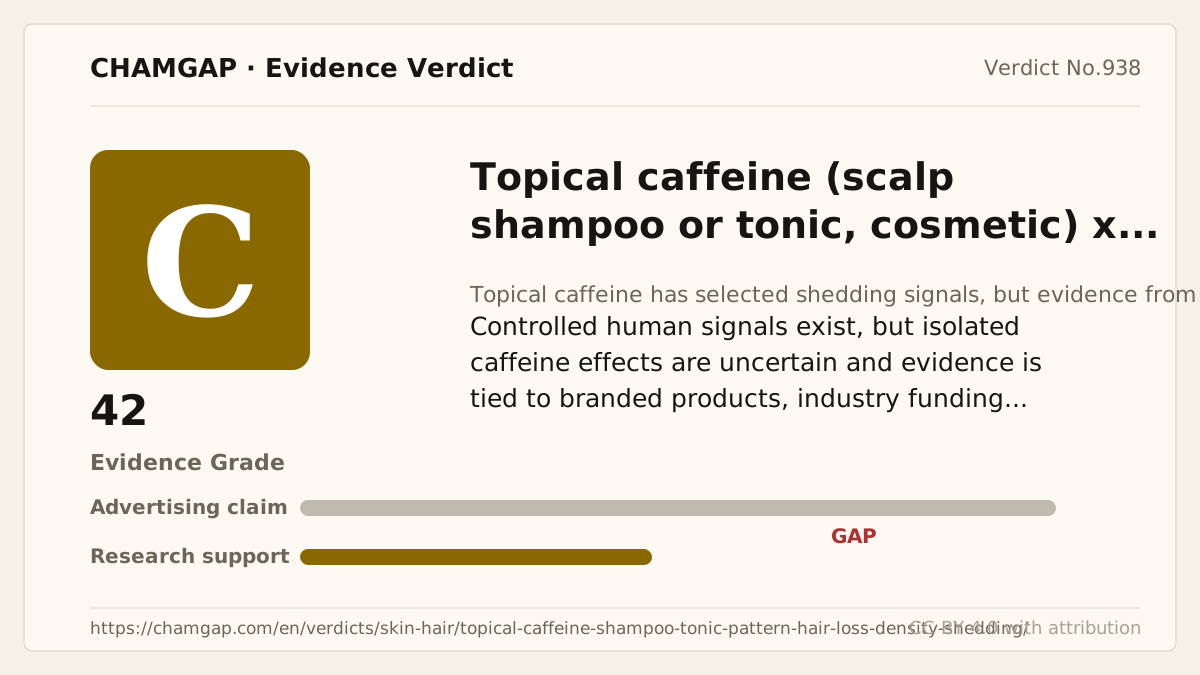
[Chamgap] Topical caffeine x reduced shedding and improved density in pattern hair loss — Evidence Grade C·42. 4 cited sources checked. Source: https://chamgap.com/en/verdicts/skin-hair/topical-caffeine-shampoo-tonic-pattern-hair-loss-density-shedding/ · CC BY 4.0CC BY 4.0 — free to use with attribution; do not distort grades, numbers, or verdict meaning.
What this document does and does not do
Chamgap is an information source. It reports what research has and has not confirmed; it does not tell readers what to take or buy. That decision belongs to readers and, when needed, medical or legal professionals. This verdict reflects literature available up to the search date and may change as new research appears. Nothing here is medical advice.