
Tirbanibulin 1% ointment,
does it really help with Complete day-57 clearance of actinic keratoses on the face or scalp treatment field?
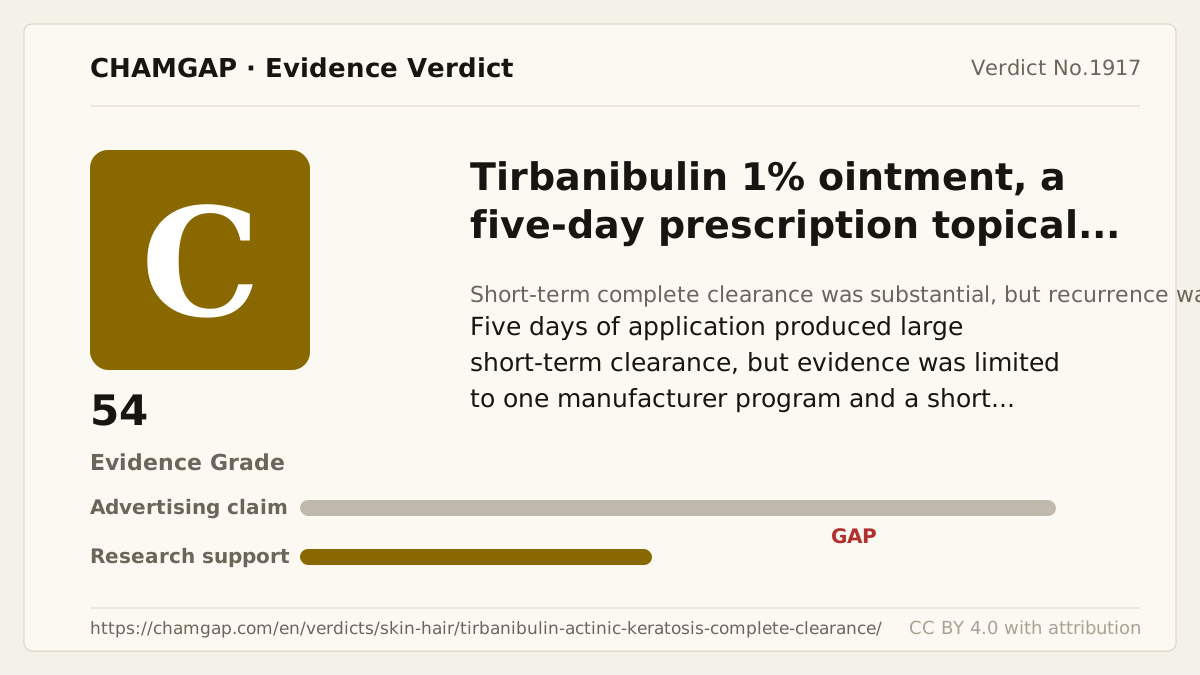
research showsThe grade is C. In two identically designed 351-participant trials, complete clearance at day 57 was 44% versus 5% and 54% versus 13%; both primary endpoints succeeded at P<0.001. Both trials were Athenex-sponsored and assessed the primary outcome before eight weeks, while estimated one-year lesion recurrence among complete responders was 47%, giving C with 50 points.
ads claimA five-day application course does not mean the field remains clear for a year. Marketing should pair day-57 clearance with recurrence and avoid unsupported superiority claims over active treatments.
Useful facts when choosing a product
- The tested regimen was tirbanibulin 1% ointment once daily for five consecutive days over a 25-cm2 field.
- Day-57 complete clearance meant a 100% reduction in baseline lesions within the treatment field.
- No existing verdict for the same tirbanibulin and clearance combination was identified.
Chamgap Semantic Classification Code
Candidate index · review held
M.tirbanibulin-1-percent-ointment.topical-skin.complete-day-57-clearance-of-actinic-keratoses-on-the-face-or-scalp-treatment-field.treat.UNKMedicinal interventions > Tirbanibulin 1% ointment > Topical skin > Complete day-57 clearance of actinic keratoses on the face or scalp treatment field > Treatment or remission claim > Unknown
An automated migration candidate, not an issued permanent code; exact claim scope remains under review. This machine-generated migration candidate helps retrieval but is not a permanent assignment. The original verdict ID and URL remain authoritative.
What the research actually shows
Each multicenter double-blind trial randomized 351 participants and analyzed 175 versus 176 in trial 1 and 178 versus 173 in trial 2. Participants applied ointment once daily for five days to a 25-cm2 facial or scalp area containing four to eight lesions. Both day-57 complete-clearance primary outcomes succeeded. Among 174 tirbanibulin complete responders at day 57, the one-year Kaplan-Meier estimate was 47% for recurrent lesions and 73% for recurrent or new lesions.
Why this is classified as C (50)
Both trials reproduced roughly 40-point absolute gains in complete clearance, but the shared manufacturer program and short day-57 primary assessment give C with 50 points.
Counterpoint. Common one-year recurrence limits durability but does not negate the short-term primary endpoint.
Rejudgment record. Cross-check applied — Both 351-participant Athenex trials succeeded on day-57 complete clearance, but the assessment was under 12 weeks and no independent replication was identified
| Endpoint | P | Symptom or function itself is the target - including patient reports and performance tests |
| Replication | R1 | Single confirmatory trial |
| Independence | I0 | Evidence comes only from manufacturer studies |
| Effect size | E+ | Meets the clinically important threshold |
Stored derived and displayed grades match; this is not a current recalculation or validity check (C).
Sub-claim grades by effect
This ingredient is marketed for several effects. A single overall grade blends strong and weak claims together, so each effect is graded separately here. The overall grade reflects the strongest disconfirming or core claim.
| Effect (sub-claim) | Grade | Basis |
|---|---|---|
| Complete clearance at day 57 | C | Both trials succeeded, with 44% versus 5% and 54% versus 13%. |
| Partial clearance at day 57 | C | Pooled partial clearance was 72% versus 18%, difference 54 points (95% CI 48 to 60). |
| Sustained complete clearance at one year | D | Only initial complete responders were followed, and estimated sustained complete clearance was 27%. |
Cross-check — AI research and Codex final gate
Evidence Table
| Study | Design | Sample | Funding | Endpoint | Result | Weight |
|---|---|---|---|---|---|---|
| Blauvelt et al. 2021 trial 1 | Multicenter randomized double-blind vehicle-controlled phase 3 trial | 351 randomized and analyzed, 175 versus 176 | Funded by Athenex | Primary complete clearance of all treatment-field lesions at day 57 | 77/175 (44%) versus 8/176 (5%), difference 40 points (95% CI 32 to 47), P<0.001. | Pivotal manufacturer confirmatory trial |
| Blauvelt et al. 2021 trial 2 | Multicenter randomized double-blind vehicle-controlled phase 3 trial using the identical protocol | 351 randomized and analyzed, 178 versus 173 | Funded by Athenex; same program as trial 1 | Primary complete clearance of all treatment-field lesions at day 57 | 97/178 (54%) versus 22/173 (13%), difference 42 points (95% CI 33 to 51), P<0.001. | Replication within the same manufacturer program |
| Blauvelt et al. 2021 one-year follow-up | Follow-up of day-57 complete responders | 174 tirbanibulin complete responders | Funded by Athenex | Recurrent and new lesions through one year | Estimated recurrence 47%, recurrent or new lesions 73%, and sustained complete clearance 27%. | Supportive durability evidence |
Receipt — 1 References
All 1 cited sources were verified for existence at the original page (as of 2026-08-01).
Final verification and publication gate: Codex · Evidence date: 2026-08-01 · Corrections: none
Cite this verdict
[Chamgap] Tirbanibulin 1% ointment x complete clearance of facial or scalp actinic keratosis — Evidence Grade C·50. 1 cited sources checked. Source: https://chamgap.com/en/verdicts/skin-hair/tirbanibulin-actinic-keratosis-complete-clearance/ · CC BY 4.0CC BY 4.0 — free to use with attribution; do not distort grades, numbers, or verdict meaning.
What this document does and does not do
Chamgap is an information source. It reports what research has and has not confirmed; it does not tell readers what to take or buy. That decision belongs to readers and, when needed, medical or legal professionals. This verdict reflects literature available up to the search date and may change as new research appears. Nothing here is medical advice.