
Rosemary oil,
does it really help with Hair regrowth in androgenetic alopecia through scalp application?
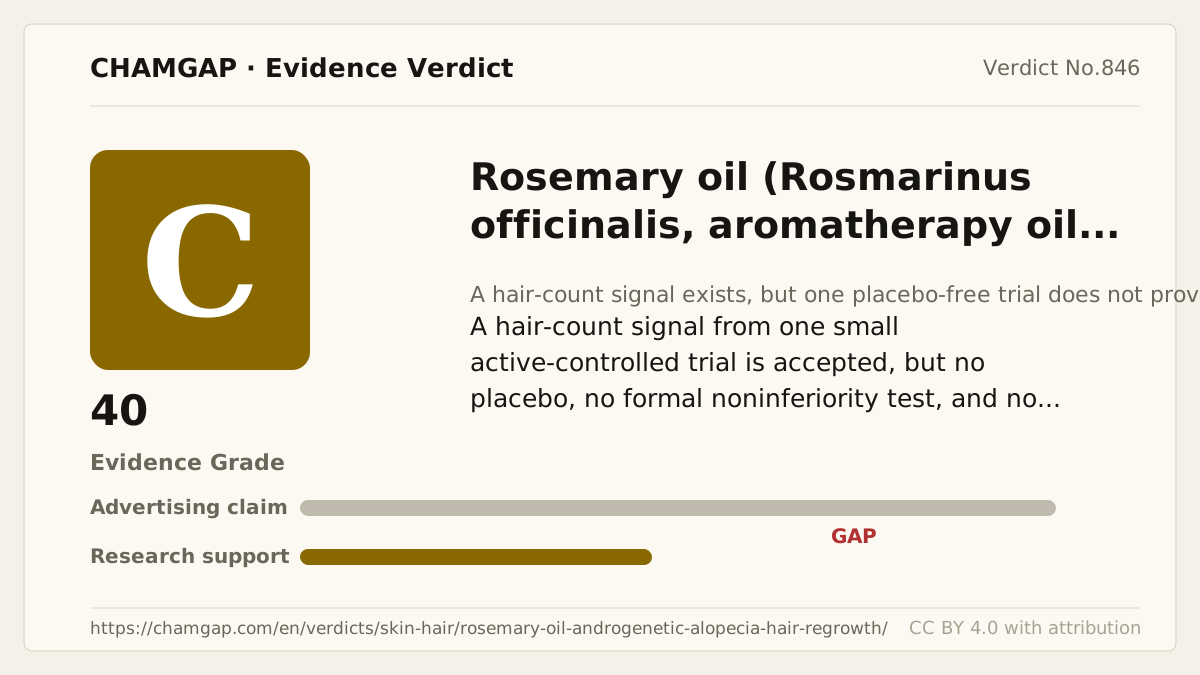
research showsRosemary oil receives C with 40 points because there is a signal for increased hair count in androgenetic alopecia. The central evidence is a single 2015 six-month trial that assigned 100 men to rosemary lotion or 2% minoxidil; mean hair count rose from 122.8 to 129.6 in the rosemary group. The study had no placebo, was not designed or tested as a formal noninferiority trial, did not blind participants, and has not been independently replicated, so natural history and measurement bias remain plausible. Scalp irritation, contact allergy, and fragrance sensitivity are separate safety issues.
ads claimMarketing turns the study into claims such as proven equal to minoxidil, natural hair-growth drug, or DHT blocker. The evidence applies to one specified lotion used for six months, not to aromatherapy oils with varying concentration, dilution, and vehicle.
Useful facts when choosing a product
- The pivotal trial used a lotion standardized to 3.7 mg/mL of 1,8-cineole at 1 mL twice daily, which is not equivalent to an improvised essential-oil mixture.
- Concentrated essential oil should not be applied neat to the scalp; users should follow product dilution instructions and avoid the eyes and damaged skin.
- Diagnosis and severity of androgenetic alopecia affect the choice of established options such as minoxidil or finasteride, so rosemary oil should not delay clinical assessment.
- Use should stop if itching, redness, irritation, or allergic contact dermatitis develops, and fragrance-sensitive users need particular caution.
Chamgap Semantic Classification Code
Candidate index · review held
UNK.rosemary-oil.UNK.hair-regrowth-in-androgenetic-alopecia-through-scalp-application.assess.MULTIUnknown > Rosemary oil > Unknown > Hair regrowth in androgenetic alopecia through scalp application > Association or change assessment > Multiple: primary unresolved
An automated migration candidate, not an issued permanent code; exact claim scope remains under review. This machine-generated migration candidate helps retrieval but is not a permanent assignment. The original verdict ID and URL remain authoritative.
What the research actually shows
Panahi and colleagues randomized 100 men with androgenetic alopecia to rosemary-oil lotion or 2% minoxidil, applied as 1 mL twice daily for six months. Neither group had a significant hair-count change at three months, while both increased from baseline at six months; rosemary was never compared with placebo. A 2025 review of nonprescription alopecia products likewise identified this single trial as the clinical rosemary evidence and characterized the broader evidence base as limited.
Why this is classified as C (40)
A direct human study observed a six-month increase in hair count, but the evidence is a single small trial without placebo, participant masking, a prespecified noninferiority analysis, or independent replication. The positive signal therefore receives C with 40 points, while scalp irritation and allergy remain separate safety issues.
Counterpoint. A standardized preparation may be considered as an adjunct when tolerated, but an independent placebo-controlled trial using the same conditions is needed to establish efficacy.
Rejudgment record. New verdict — Accepted the hair-count increase in one six-month active-controlled human trial, but applied the rule ① ceiling of C because there was no placebo, participant masking, prespecified noninferiority test, or independent replication
Sub-claim grades by effect
This ingredient is marketed for several effects. A single overall grade blends strong and weak claims together, so each effect is graded separately here. The overall grade reflects the strongest disconfirming or core claim.
| Effect (sub-claim) | Grade | Basis |
|---|---|---|
| Increased hair count in androgenetic alopecia | C | One six-month active-controlled trial found an increase, but the lack of placebo prevents a firm effect estimate. |
| Efficacy equivalent or noninferior to 2% minoxidil | ? | No significant between-group difference does not prove equivalence without a prespecified noninferiority margin. |
| The same regrowth effect across commercial rosemary aromatherapy products | ? | No human efficacy literature directly compares products with different concentrations, dilutions, and vehicles. |
Cross-check — AI research and Codex final gate
Evidence Table
| Study | Design | Sample | Funding | Endpoint | Result | Weight |
|---|---|---|---|---|---|---|
| Panahi Y et al. 2015 | Randomized investigator-blinded active-controlled trial | 100 men with androgenetic alopecia; 50 per group | Not clearly reported in the abstract or public indexing | Hair count in a standardized area at three and six months and scalp symptoms | There was no change at three months; rosemary hair count increased from 122.8 to 129.6 at six months, but there was no placebo comparison. | Only direct human trial with major design limitations |
| Gupta AK et al. 2025 | Review of nonprescription products for androgenetic alopecia | One direct rosemary clinical trial with 100 participants | Academic review with author conflicts disclosed | Hair density, hair diameter, and adverse events | The rosemary evidence depended on the single Panahi trial, and efficacy and safety evidence for nonprescription products was limited overall. | Confirmation of the replication gap |
Receipt — 2 References
All 2 cited sources were verified for existence at the original page (as of 2026-07-20).
Final verification and publication gate: Codex · Evidence date: 2026-07-20 · Corrections: none
Cite this verdict
[Chamgap] Rosemary oil x hair regrowth in androgenetic alopecia — Evidence Grade C·40. 2 cited sources checked. Source: https://chamgap.com/en/verdicts/skin-hair/rosemary-oil-androgenetic-alopecia-hair-regrowth/ · CC BY 4.0CC BY 4.0 — free to use with attribution; do not distort grades, numbers, or verdict meaning.
What this document does and does not do
Chamgap is an information source. It reports what research has and has not confirmed; it does not tell readers what to take or buy. That decision belongs to readers and, when needed, medical or legal professionals. This verdict reflects literature available up to the search date and may change as new research appears. Nothing here is medical advice.