
Oxymetazoline cream,
does it really help with Improvement of persistent facial erythema associated with rosacea?
research showsThe grade is C. Two phase 3 trials from the same manufacturer program found more patients with simultaneous two-grade clinician and patient improvement on day 29, but time-specific response rates were only 12% to 18% versus 5% to 9%. With no independent confirmatory trial and only 29 days of controlled treatment, the score is 55.
ads claimOnce-daily application can reduce persistent redness for several hours in some patients. That does not show that redness disappears in everyone or that rosacea itself is permanently corrected.
Useful facts when choosing a product
- Hour-by-hour post-dose outcomes show temporary daily redness relief, not disease modification.
- Both pivotal trials belonged to the same Allergan development program.
- Discontinuation-rebound data exist and rebound was uncommon in the pivotal and extension studies.
Chamgap Semantic Classification Code
Candidate index · review held
UNK.oxymetazoline-hydrochloride-cream-1-percent.UNK.persistent-facial-erythema-associated-with-rosacea.improve.placeboUnknown > Oxymetazoline hydrochloride cream 1% > Unknown > persistent facial erythema associated with rosacea > Improvement claim > Placebo
An automated migration candidate, not an issued permanent code; exact claim scope remains under review. This machine-generated migration candidate helps retrieval but is not a permanent assignment. The original verdict ID and URL remain authoritative.
What the research actually shows
REVEAL-1 randomized 440 (222/218) and REVEAL-2 randomized 445 (224/221). Composite response at 3, 6, 9, and 12 hours was 12%, 16%, 18%, and 15% versus 6%, 8%, 6%, and 6% in REVEAL-1, and 14%, 13%, 16%, and 12% versus 7%, 5%, 9%, and 6% in REVEAL-2; key comparisons were P<=0.001. Allergan supported both trials. These hour-by-hour outcomes show temporary same-day benefit.
Why this is classified as C (50)
The stringent clinician-and-patient response was reproduced in two phase 3 trials, but both were in one manufacturer program and controlled treatment lasted 29 days, giving C with 50 points.
Counterpoint. C does not mean no effect; it limits expectations because response rates were low and independent long-term confirmation is absent.
Rejudgment record. Cross-check applied — Two vehicle-controlled phase 3 trials in one manufacturer program succeeded, but absolute response was low and controlled treatment lasted 29 days
| Endpoint | P | Symptom or function itself is the target - including patient reports and performance tests |
| Replication | R1 | Single confirmatory trial |
| Independence | I0 | Evidence comes only from manufacturer studies |
| Effect size | E+ | Meets the clinically important threshold |
Stored derived and displayed grades match; this is not a current recalculation or validity check (C).
Sub-claim grades by effect
This ingredient is marketed for several effects. A single overall grade blends strong and weak claims together, so each effect is graded separately here. The overall grade reflects the strongest disconfirming or core claim.
| Effect (sub-claim) | Grade | Basis |
|---|---|---|
| Same-day composite response in persistent erythema on day 29 | C | Both trials favored treatment, but time-specific response was 12% to 18%. |
| At least one-grade erythema improvement on day 29 | C | The less stringent response was also positive within the manufacturer program, without independent confirmation. |
| Durable disease modification after discontinuation | ? | No long-term vehicle-controlled confirmatory trial was identified. |
Cross-check — AI research and Codex final gate
Evidence Table
| Study | Design | Sample | Funding | Endpoint | Result | Weight |
|---|---|---|---|---|---|---|
| Tanghetti EA et al. 2018 REVEAL-1 | Multicenter double-blind randomized vehicle-controlled phase 3 trial | 440 randomized, 222 versus 218, with all 440 in the intention-to-treat analysis | Allergan development program with company employees among the authors | At least two-grade improvement in both CEA and SSA at 3, 6, 9, and 12 hours on day 29 | 12%, 16%, 18%, and 15% versus 6%, 8%, 6%, and 6%; overall repeated-measures P<0.001 | Pivotal manufacturer confirmatory trial |
| Baumann L et al. 2018 REVEAL-2 | Matching multicenter double-blind randomized vehicle-controlled phase 3 trial | 445 randomized, 224 versus 221 | Same Allergan development program | Time-specific CEA and SSA composite response on day 29 | 14%, 13%, 16%, and 12% versus 7%, 5%, 9%, and 6% | Repeated trial within the same program |
Receipt — 2 References
All 2 cited sources were verified for existence at the original page (as of 2026-08-02).
Final verification and publication gate: Codex · Evidence date: 2026-08-02 · Corrections: none
Cite this verdict
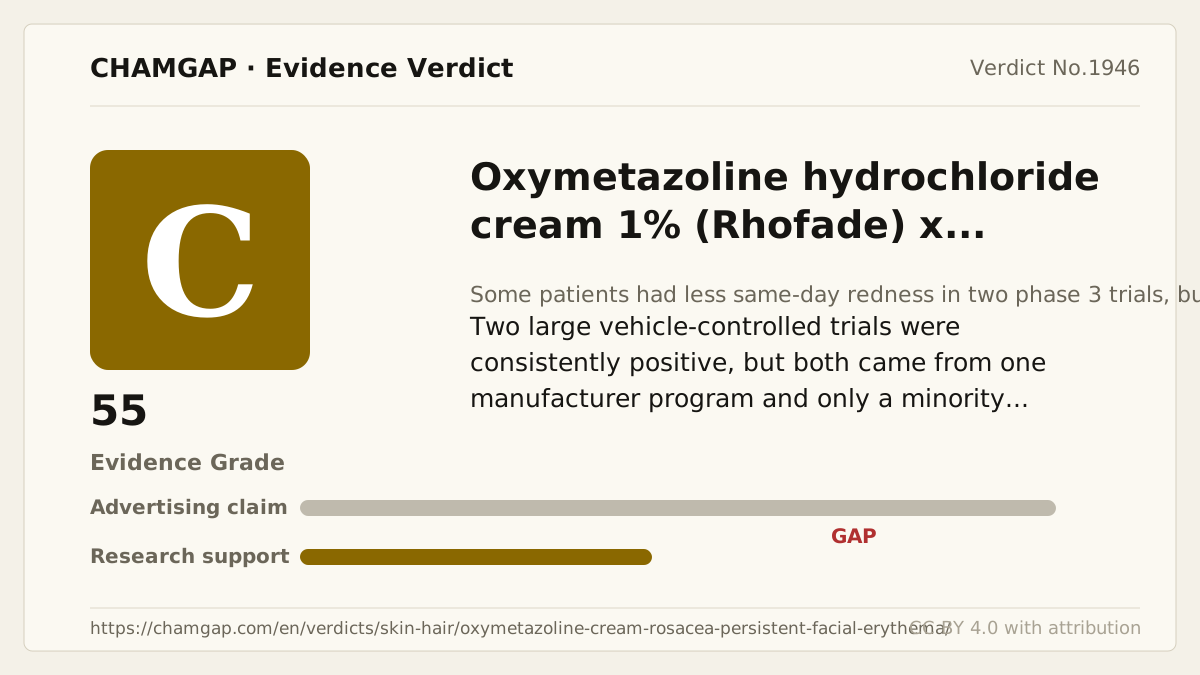
[Chamgap] Oxymetazoline cream x persistent facial erythema of rosacea — Evidence Grade C·50. 2 cited sources checked. Source: https://chamgap.com/en/verdicts/skin-hair/oxymetazoline-cream-rosacea-persistent-facial-erythema/ · CC BY 4.0CC BY 4.0 — free to use with attribution; do not distort grades, numbers, or verdict meaning.
What this document does and does not do
Chamgap is an information source. It reports what research has and has not confirmed; it does not tell readers what to take or buy. That decision belongs to readers and, when needed, medical or legal professionals. This verdict reflects literature available up to the search date and may change as new research appears. Nothing here is medical advice.