
Oral spironolactone,
does it really help with Added hair growth in female pattern hair loss when combined with topical minoxidil?
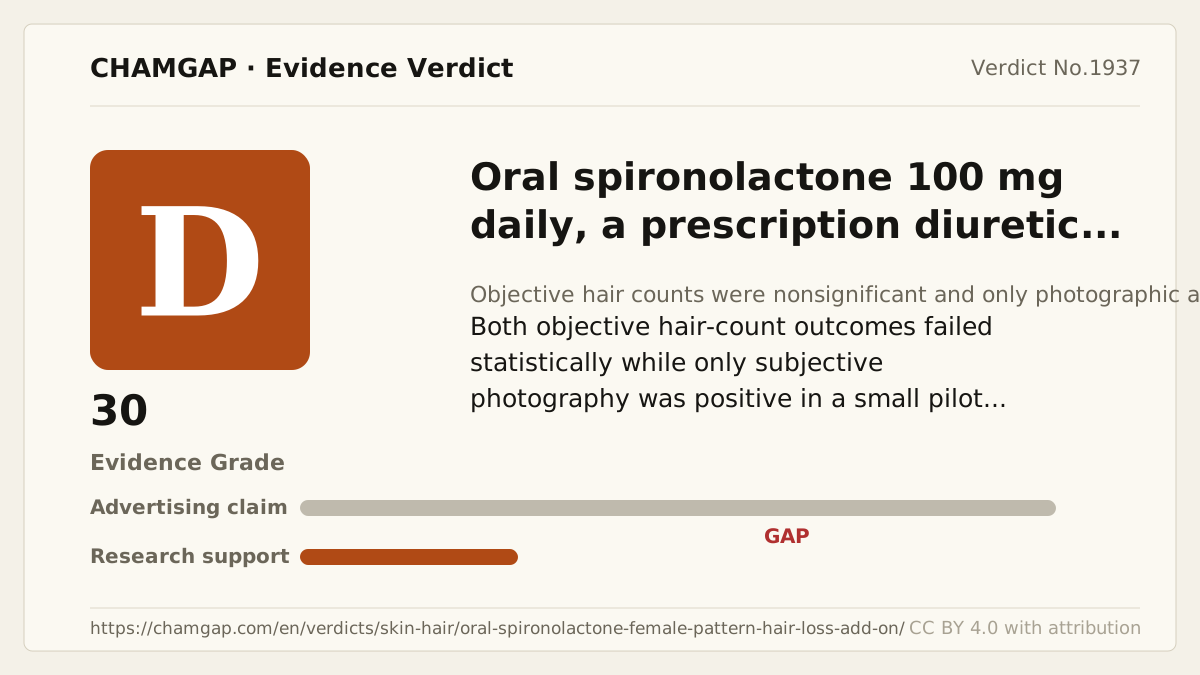
research showsThe grade is D. In an add-on minoxidil trial randomizing 48 women with 43 in modified intention-to-treat analysis, terminal hair change was +9.48+/-11.25 versus +5.32+/-6.81 hairs/cm2, between-group difference 4.16, P=0.063, and total hair change was +8.95+/-7.61 versus +5.64+/-5.30, difference 3.31, P=0.086. Both objective outcomes failed statistically; only photographic improvement was positive at 38% versus 9%, P=0.034, giving D with 30 points.
ads claimThe objective counts do not support a firm claim that spironolactone adds hair. These data do not establish monotherapy without minoxidil or effects in postmenopausal women or men.
Useful facts when choosing a product
- Spironolactone is a potassium-sparing prescription diuretic with antiandrogen effects; use for female pattern hair loss is off label.
- Both pivotal-trial groups used topical 3% minoxidil twice daily.
- Verdict 1192 is A with 94 points for death and hospitalization in severe HFrEF, while verdict 817 is B with 70 points for female acne; both indications differ.
Chamgap Semantic Classification Code
Candidate index · review held
M.spironolactone.oral.added-hair-growth-in-female-pattern-hair-loss-when-combined-with-topical-minoxidil.assess.MULTIMedicinal interventions > Spironolactone > Oral > Added hair growth in female pattern hair loss when combined with topical minoxidil > Association or change assessment > Multiple: primary unresolved
An automated migration candidate, not an issued permanent code; exact claim scope remains under review. This machine-generated migration candidate helps retrieval but is not a permanent assignment. The original verdict ID and URL remain authoritative.
What the research actually shows
Pimpakarn Werachattawatchai and colleagues randomized 48 premenopausal women to spironolactone 100 mg/day plus topical 3% minoxidil or placebo plus minoxidil; modified intention-to-treat included 43. Between-group differences were 4.16 hairs/cm2 for terminal hair, P=0.063, and 3.31 for total hair, P=0.086; the source provided no 95% CIs. Photographic improvement was 38% versus 9%, P=0.034, but was subjective. A single primary endpoint and multiplicity sequence were not clearly specified.
Why this is classified as D (30)
Two failed objective outcomes, a 48-person sample, and only one positive subjective assessment give D with 30 points; safety is separate from grading.
Counterpoint. A larger independent trial with objective assessment is needed.
Rejudgment record. Cross-check applied — In a 48-participant pilot with 43 in modified intention-to-treat analysis, objective hair-count outcomes failed and only subjective photographic assessment was positive
| Endpoint | P | Symptom or function itself is the target - including patient reports and performance tests |
| Replication | R1 | Single confirmatory trial |
| Independence | I2 | Decisive evidence is publicly or non-profit funded |
| Effect size | E0 | Null |
| Precision | CX | No pooled confidence interval could be confirmed |
Stored derived and displayed grades match; this is not a current recalculation or validity check (D).
Sub-claim grades by effect
This ingredient is marketed for several effects. A single overall grade blends strong and weak claims together, so each effect is graded separately here. The overall grade reflects the strongest disconfirming or core claim.
| Effect (sub-claim) | Grade | Basis |
|---|---|---|
| Additional objective hair-count increase | D | Between-group terminal and total hair-count results were P=0.063 and P=0.086. |
| Moderate-to-marked photographic improvement | C | Rates were 38% versus 9%, but this was evaluator-rated in one small trial. |
Cross-check — AI research and Codex final gate
Evidence Table
| Study | Design | Sample | Funding | Endpoint | Result | Weight |
|---|---|---|---|---|---|---|
| Werachattawatchai P et al. 2025 | Randomized double-blind placebo-controlled pilot | 48 randomized; 43 in modified intention-to-treat analysis | Faculty of Medicine, Srinakharinwirot University | Hair counts, diameter, and photographic assessment at 24 weeks | Terminal difference 4.16, P=0.063; total difference 3.31, P=0.086; no source 95% CIs; photographic improvement 38% versus 9%, P=0.034 | Only placebo-controlled add-on confirmation |
Receipt — 2 References
All 2 cited sources were verified for existence at the original page (as of 2026-08-01).
Final verification and publication gate: Codex · Evidence date: 2026-08-01 · Corrections: none
Cite this verdict
[Chamgap] Oral spironolactone x hair growth in female pattern hair loss — Evidence Grade D·30. 2 cited sources checked. Source: https://chamgap.com/en/verdicts/skin-hair/oral-spironolactone-female-pattern-hair-loss-add-on/ · CC BY 4.0CC BY 4.0 — free to use with attribution; do not distort grades, numbers, or verdict meaning.
What this document does and does not do
Chamgap is an information source. It reports what research has and has not confirmed; it does not tell readers what to take or buy. That decision belongs to readers and, when needed, medical or legal professionals. This verdict reflects literature available up to the search date and may change as new research appears. Nothing here is medical advice.