
Oral Single-Active Pantothenic Acid and Complete Healing of Chronic Cutaneous Ulcers
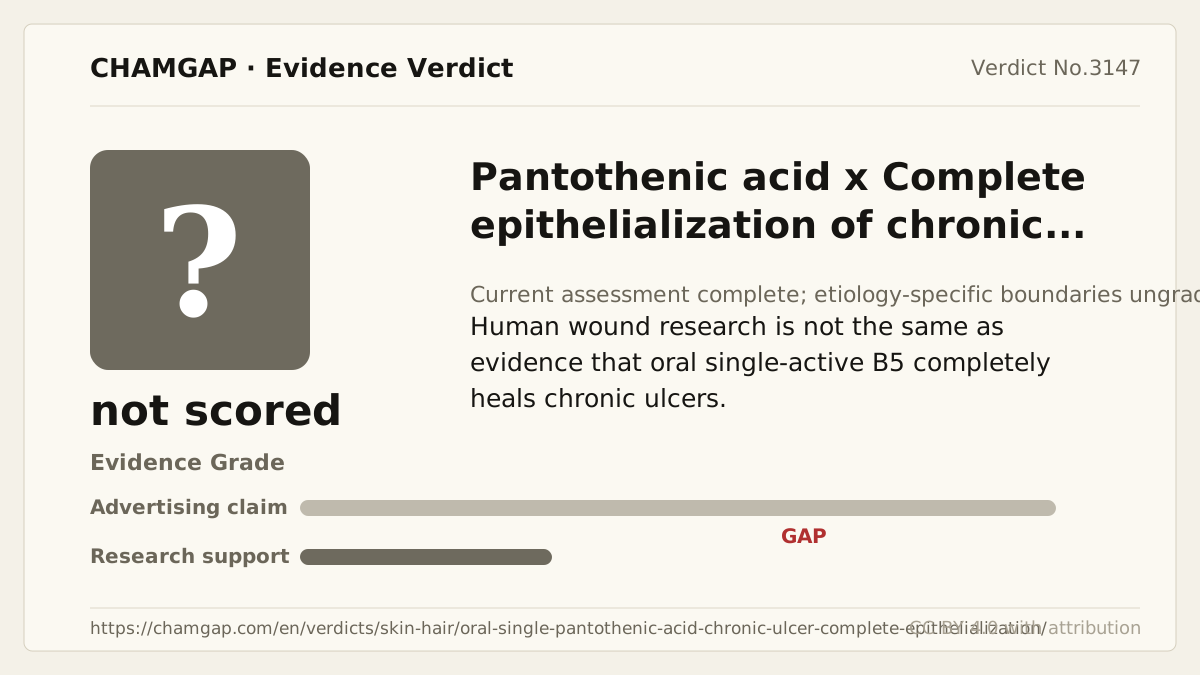
research showsWithin the disclosed search, no directly eligible human evidence was identified that isolates oral single-active pantothenic acid for complete epithelialization of chronic cutaneous ulcers at a defined time. Acute combined-vitamin, multinutrient-plus-education, shared intravenous-vitamin and topical-combination studies do not isolate this effect. This is not a declaration of zero effect, equivalence or absence of all human B5 research.
ads claimThis page does not endorse a product, a healing probability or a personal treatment dose.
Four separate assessment dimensions
| Effect direction and size | Within the disclosed search, no directly eligible human evidence was identified that isolates oral single-active pantothenic acid for complete epithelialization of chronic cutaneous ulcers at a defined time. Acute combined-vitamin, multinutrient-plus-education, shared intravenous-vitamin and topical-combination studies do not isolate this effect. This is not a declaration of zero effect, equivalence or absence of all human B5 research. |
|---|---|
| Evidence certainty | A directly applicable isolated human effect cannot be estimated. Certainty of benefit inferred from adjacent studies is very low; this is not a formal GRADE rating or a probability of treatment success. |
| Applicability | Restricted to oral single-active treatment, etiology-defined chronic ulcers and complete epithelialization. Acute tattoo excision, multinutrition/education, shared intravenous exposure, topical dexpanthenol/combinations and pantethine do not transfer. Deficiency correction is separated from unselected supplementation. |
| Safety | Caution. Gastrointestinal adverse events in a small short-term healthy-adult oral study warrant attention. Uncontrolled cohorts and repeated periods are not independent risk comparisons; salt/active-dose and total dietary exposure remain qualified. Safety in chronic ulcers, renal/hepatic disease, pregnancy, children and long-term co-use is not established. Research doses are not personal instructions or substitutes for standard wound care. |
The supplied stage-0 rule and exact calculator give ? with score null. This is the current level of directly identified human evidence for oral single-active B5, chronic cutaneous ulcers and complete epithelialization within the disclosed search. It follows actual design/eligibility review of adjacent human studies, not an automatic missing-text flag. It does not mean no human research exists, zero effect, equivalence or score zero. H classifies the intended endpoint; other efficacy axes and sub-boundaries remain unscored.
Useful facts when choosing a product
- The proposed oral single-active boundary is separate from each paper’s actual intervention.
- Calcium/sodium salts and active mass, dexpanthenol/panthenol and pantethine are distinguished.
- Calculated B5 content in a mixed drink is not evidence of single-active efficacy or a personal dose.
Chamgap Semantic Classification Code
Permanent code issued
S.pantothenic-acid-chronic-ulcer-single-active.oral.adults-etiology-defined-chronic-cutaneous-ulcer.complete-epithelialization-defined-time.chronic-ulcer-comparator-not-identified-in-searchSupplements and nutraceuticals > Oral single-active question; actual salt/active mass and products verified study by study > Proposed adults with etiology-defined chronic cutaneous ulcers > complete epithelialization/closure at a defined time > Unconfirmed — eligible direct comparator for the oral single-active chronic-ulcer question not identified > oral
Original ?/null and Caution preserved. Null display mapping is explicit; original fields remain retained. The code identifies the intervention and claim; it never contains the evidence grade, score, or safety result.
Exact Claim Classification
These independent facets prevent evidence from different forms, routes, populations, effects, and comparators from being mixed.
| Intervention class | S · Supplement or nutraceutical |
|---|---|
| Canonical ingredient or intervention | pantothenic acid |
| Source or part used | Single chemical nutrient; species/part not applicable |
| Formulation or processing | Oral single-active question; actual salt/active mass and products verified study by study |
| Route | oral |
| Dose | Unconfirmed — eligible direct-study dose not identified |
| Duration | Unconfirmed — eligible direct-study assessment duration not identified |
| Population | Proposed adults with etiology-defined chronic cutaneous ulcers |
| Effect or condition | Complete epithelialization of chronic cutaneous ulcers at a defined time |
| Primary endpoint | complete epithelialization/closure at a defined time |
| Comparator | Unconfirmed — eligible direct comparator for the oral single-active chronic-ulcer question not identified |
| Duplicate-detection key | S|pantothenic-acid|single-active|oral|adults-chronic-cutaneous-ulcer|complete-epithelialization|matched-background-comparator |
What the research actually shows
The question concerns oral single-active pantothenic acid and complete epithelialization of chronic cutaneous ulcers. Acute combined supplementation in Vaxman, multinutrient formula plus education in Basiri, shared intravenous vitamins in Khani, topical Cicatrol, and historical pressure-ulcer observations involving another vitamin are separated. No isolated single-active effect was identified; Rao supplies healthy-adult safety context only.
Why this is classified as ?
The supplied stage-0 rule and exact calculator give ? with score null. This is the current level of directly identified human evidence for oral single-active B5, chronic cutaneous ulcers and complete epithelialization within the disclosed search. It follows actual design/eligibility review of adjacent human studies, not an automatic missing-text flag. It does not mean no human research exists, zero effect, equivalence or score zero. H classifies the intended endpoint; other efficacy axes and sub-boundaries remain unscored.
Counterpoint. Not identified or inaccessible is not treated as null efficacy or equivalence.
Rejudgment record. Supplied stage0, exact calculator and final value agree. — The supplied stage-0 rule and exact calculator give ? with score null. This is the current level of directly identified human evidence for oral single-active B5, chronic cutaneous ulcers and complete epithelialization within the disclosed search. It follows actual design/eligibility review of adjacent human studies, not an automatic missing-text flag. It does not mean no human research exists, zero effect, equivalence or score zero. H classifies the intended endpoint; other efficacy axes and sub-boundaries remain unscored.
| Endpoint | H | Hard endpoint - actual events such as death |
Stored derived and displayed grades match; this is not a current recalculation or validity check (?).
Review performed and remaining limitations
Subscription texts, Cicatrol methods, registry histories, isolated B5 effects/CIs, total intake and long-term safety remain unverified. Basiri body42/analysis29 versus abstract wording, area-versus-closure findings and original units are not hidden or silently repaired.
Evidence Table
| Study | Design | Sample | Funding | Endpoint | Result | Weight |
|---|---|---|---|---|---|---|
| Vaxman 1995: tattoo-resection wounds | Reported randomized double-blind AA+PA supplementation; primary abstract only | 49 entered; 18 supplemented patients described. Arm-level allocation, analysis and attrition are unresolved. | Unconfirmed: the accessible primary abstract contains no funding statement and full text was not obtained. | Biochemical and mechanical skin/scar measures, not complete epithelialization of chronic ulcers. | A 21-day AA 1.0 g+PA 0.2 g regimen did not document major healing improvement. Route/frequency and a B5-only effect are not established. | Excluded from direct efficacy: acute wounds, combined intervention and different endpoints. This is not a null single-B5 trial. |
| Vaxman 1996: combined-vitamin dose comparison | Two AA+PA dose groups in tattoo-resection patients; primary abstract only | Arm sizes unavailable; cohort overlap with the 1995 paper is unconfirmed. | Unconfirmed because only the primary abstract/preview was accessible. | Scar breaking energy and more than 80 assessed parameters. | AA 1/3 g/day plus PA 0.2/0.9 g/day; higher-dose mechanical findings and correlation p=0.006 are not a closure-rate estimate or CI. | Not single B5 or chronic-ulcer evidence; not counted as an independent replication. |
| Vorhaus 1943: clinical experiments with different vitamins | Publisher conclusions and product-supply note accessible | Patient/wound counts, allocation and attrition are unavailable. | Overall funding not verified from subscription preview. | Decubital-ulcer discussion concerns riboflavin; calcium pantothenate discussion concerns gray hair. | Neither the oral inositol dose nor riboflavin ulcer observation is attributed to pantothenic acid. | Excluded because the actual vitamin/outcome attribution does not match. |
| Basiri 2020: multinutrient formula plus education for diabetic foot ulcers | Randomized multinutrient formula plus additional education versus standard care; full author-deposited article HTML | Body: 42 allocated, 21/21; analyzed 15/14. Abstract describes 29 as randomized. | Article explicitly states no external funding. | Publication primary: area change; secondary: complete healing. Registry outcome history is unverified. | Complete closure during up to 12 weeks: 9/15 versus 10/14. Area-velocity results differ. Labelled B5 2 mg/serving x2=4 mg/day is inseparable from other nutrients and education. | Human chronic-wound evidence, but not an isolated B5 effect. No RR, ARR or NNT calculated. |
| Khani 2025: heparin gel versus hydrocolloid | Topical-treatment RCT in acute stage-II pressure ulcers; intravenous multivitamins shared by both arms | 84 allocated (control 44/heparin 40); 14 lost per arm, leaving 30/26 in per-protocol analysis. | Kermanshah University of Medical Sciences, grant 980884. | 14-day PUSH, area and healing-time endpoints; PUSH <=1 is not assumed to be confirmed anatomical epithelialization. | A 5 mg B5-containing intravenous multivitamin is shared. There is no randomized contrast of oral single-active B5. | Excluded for route, absence of a B5 contrast and acute population. |
| Popovici 1992: Cicatrol | PubMed-indexed excerpts identify a topical combination ointment; full text inaccessible | People, wounds, arm sizes, completion and attrition unavailable. | Unconfirmed: full article and funding paragraph inaccessible; index excerpts do not establish independence. | Burns and varicose/trophic ulcers mentioned; precise complete-healing definition unverified. | Not oral monotherapy. No healing-time or animal quantities from commercial summaries are imported. | Excluded indexed lead; not presented as a fully verified clinical trial. |
| Rao 2021: oral safety/pharmacokinetics in healthy adults | Open-label, nonrandomized, no placebo; existing 3102 safety map reused with primary checks | 40 participants: 32 single-dose and a separate 8 repeated-dose participants; fed high-dose retest reuses the same 8. | CoA Therapeutics funded the study. | Pharmacokinetics and adverse events; no wound-healing endpoint. | Table 6: diarrhea 1/8 in the nominal 5000 mg fasted cohort, 0/8 in the same fed cohort, and 0/8 with nominal 2000 mg/day for 14 days. Salt/active-dose labelling remains qualified. | Safety context only; not evidence of chronic-ulcer efficacy, long-term safety or a personal dosing instruction. |
Complete submitted research report
# Does Oral Single-Active Pantothenic Acid Improve Complete Healing of Chronic Cutaneous Ulcers?
TASK-1031 / R01-071 · Evidence cutoff 2026-09-17 · NUT / R01 · Current assessment: **? / score not assigned (null)** · Safety: **Caution**
## The answer in 30 seconds
Within the disclosed search, **no directly eligible human study was identified that isolates the effect of oral single-active pantothenic acid on complete epithelialization of adults' chronic cutaneous ulcers at a defined time**. The direction and magnitude of benefit, and an effective treatment dose, therefore cannot be established. This does not mean zero effect, equivalence to an ineffective treatment, or absence of all human research involving pantothenic acid.
Human wound studies do exist. However, combined vitamin C/B5 supplementation after acute tattoo surgery, multinutrient drinks plus education for diabetic foot ulcers, shared intravenous multivitamins in a pressure-ulcer dressing trial, and topical combination ointments answer different questions. In particular, greater area-reduction velocity must not be rewritten as increased complete healing from B5 alone. [S01–S06]
Research doses are not personal dosing or treatment-change instructions. This evidence does not support replacing existing wound management, including dressings and cause-specific pressure relief, compression where appropriate, or assessment of infection and blood supply. This report does not prescribe a new wound-care protocol.
## 1. The question versus the actual study facts
The page asks about the **independent effect of adding oral pantothenic acid as a single active ingredient**. Actual ulcer etiology, nutritional status, background care and comparator must be established. The proposed population of chronic-ulcer patients was not copied into every retrieved paper as though it were a verified diagnosis.
| Boundary | Treatment in this assessment | |---|---| | Molecule, salt and active mass | Pantothenic acid and calcium/sodium pantothenate require exact product and salt-versus-active-mass verification. Unreported equivalences are not calculated. | | Route and combinations | Oral single-active products are separated from topical/injected dexpanthenol/panthenol, pantethine and multinutrient formulas. | | Population | Diabetic, venous, arterial/ischemic, pressure and other chronic ulcers remain separate. Acute surgical/experimental wounds, burns and acne are not substitutes. | | Main endpoint | Complete epithelialization/closure at a defined time. Area reduction, granulation, scar strength, TEWL and pain are different outcomes. | | Comparator | Actual placebo, usual-care and active/lower-dose comparisons are distinguished. Shared B5 exposure does not create a randomized B5 contrast. | | Nutritional status | Correcting confirmed B5 deficiency differs from additional supplementation without confirmed deficiency. Diet, blood measurements and mechanisms do not establish treatment benefit. |
Because no directly eligible study was identified, the actual single-active dose, treatment/follow-up duration, comparator and complete-healing effect for this page remain **unestablished**, not filled with anticipated values or mixture-trial data. Etiology-specific boundaries were not separately graded.
## 2. Study-level evidence and directness
AA denotes ascorbic acid (vitamin C), and PA denotes pantothenic acid.
| Study | Actual people, design and comparison | Verified outcome and interpretation | Direct efficacy eligibility | |---|---|---|---| | S01 Vaxman 1995 | 49 patients entered serial tattoo-resection surgery research, described as randomized and double-blind; AA+PA versus controls. The abstract separately describes 18 supplemented patients. | A 21-day AA 1.0 g+PA 0.2 g regimen assessed skin/scar biochemistry and mechanics. Major healing improvement was not documented. Route, dose frequency and complete-healing arm counts cannot be certified from the abstract. | Excluded: acute surgery, combination and different outcomes. Controls are not invented as 49 minus 18. | | S02 Vaxman 1996 | Two combined-dose groups in tattoo-resection patients: AA 1/3 g/day plus PA 0.2/0.9 g/day. Arm sizes, route and total exposure are not available in the abstract. | More than 80 parameters including scar breaking energy. Higher-dose mechanical findings and correlation p=0.006 are not a B5-specific closure estimate or CI. | Excluded. Overlap with S01 is unconfirmed, so these papers are not added as independent replications. | | S03 Vorhaus 1943 | Historical clinical observations involving several vitamins; publisher conclusions and supply note accessed. | The decubital-ulcer passage concerns riboflavin/B complex; calcium pantothenate is discussed for gray hair. The oral inositol dose is not borrowed as a B5 dose. | Excluded for incorrect vitamin/outcome attribution. | | S04 Basiri 2020 | Diabetic foot ulcers; body reports 42 allocated (21/21), with 15/14 analyzed. Oral multinutrient formula plus education versus standard care. | Complete closure during up to 12 weeks: 9 of 15 analyzed intervention patients and 10 of 14 controls. Area-reduction velocity is a separate result. | Excluded as direct B5 efficacy: multiple nutrients and extra education cannot be separated. | | S05 Khani 2025 | Acute stage-II pressure ulcers; topical 1% heparin gel versus hydrocolloid. 84 randomized, 56 analyzed. | Both groups receive intravenous multivitamins containing 5 mg pantothenic acid. The 14-day PUSH, area and healing-time results concern topical treatment. | Excluded: not oral, no B5 exposure contrast, chronicity not assumed. | | S06 Popovici 1992 | Indexed primary excerpts describe topical combination Cicatrol in burns and varicose/trophic ulcers. | Full text inaccessible; patient counts, comparator, dose, precise healing definition and CI unverified. Commercial healing-time/animal numbers are not imported. | Excluded for verified topical-combination boundary; not represented as a fully checked controlled human trial. | | S07 Rao 2021 | Oral pharmacokinetic/safety study in 40 healthy adults; open-label, nonrandomized, no placebo. Existing 3102 map reused. | No wound-healing outcome; short-exposure adverse events provide indirect safety context only. | Excluded from efficacy; retained for safety context. |
The access level, identifiers and study-specific funding limitations are linked below and in `sources.json` and `study_extractions.json`. An article, its abstract, a review and a related report are not counted as separate trials.
## 3. Critical distinctions in the diabetic-foot study
Basiri studied patients close to the target population, but **not single-active pantothenic acid**. Intervention patients received two servings, 474 mL/day, of Boost Glucose Control and additional nutrition education. Table A1 lists 2 mg pantothenic acid per 237 mL serving; two servings yield a **calculated labelled supplemental amount of 4 mg/day**. This is not a verified salt-mass conversion, total dietary B5 intake or recommended personal dose. The formula also supplied 500 kcal and 28 g protein daily plus many nutrients; extra education was intervention-only. The independent B5 contribution cannot be extracted. The paper says the product was purchased. [S04]
The body and flow text report 95 screened and 42 randomized, whereas the abstract describes 29 as randomized. Analyzed groups contain 15 and 14 people. **42−(15+14)=13 people** were not in the primary analysis, but that arithmetic does not supply full 42-person ITT outcomes. The HTML flow layout does not independently resolve assignment of the displayed six/seven clinic-change dropouts. Repeated assessments are not new participants, and selection/clustering of multiple ulcers is not verified. [S04]
The publication describes 12-week area change as primary and complete healing as secondary. **Closure counts of 9/15 versus 10/14** differ from favorable area-velocity results. Reported additional area reduction was 6.43 mm²/week overall; during the first four weeks it was 18.01 versus 1.4 mm²/week (p=0.01). These original units and direction are retained. They are not converted into a healing-probability multiple, RR, HR, ARR or NNT. Wound shrinkage and complete closure are distinct; within-group, time-interaction or covariate significance cannot create an independent B5 effect. [S04]
Estimated wound age was mean±SD 10.97±15.09 versus 10.58±18.27 months, with median six months in each arm. Methods specify UT grade 1A, while Results state grade 1 or 2, stage A; the conflict is retained. Baseline area is written as 45±11 versus 45±15 mm² in the narrative, but its ± type is not assigned and its unit is not silently corrected. HbA1c mean±SD was 7.95±2.06 versus 8.40±2.16%, and BMI 33.54±7.98 versus 34.07±6.04. HbA1c above 12% and chronic kidney disease were excluded. Smoking-category counts conflict with the control denominator, so no precise rate is used. [S04]
Confirmed B5 deficiency, blood B5, total dietary B5 and detailed objective vascular/infection tests are not established. Identical dressings, offloading, debridement, antibiotics or vascular procedures are not assumed merely because both arms received standard care. Clinic visits occurred every two weeks, area/diet assessments every four weeks and at closure, with weekly visits near closure; an exact blinded epithelialization definition, confirmation interval, durable closure and recurrence are not verified. Repeated-measures ANOVA and Bonferroni posthoc testing are reported, but the original primary endpoint, registration timing and amendment history of NCT04055064 could not be read directly. [S04]
## 4. Other causal and statistical boundaries
The limited/non-significant 1995 Vaxman findings do not prove that oral single B5 is ineffective. The favorable higher-combination-dose mechanical finding in 1996 does not establish the opposite claim that B5 closes chronic ulcers. Route, completed-arm denominators, concealment, ITT and funding remain limited to what the primary abstracts establish. The 1995 article's later online-posting date is distinguished from its original publication year. [S01,S02]
Khani recruited from November 2019 to September 2020 and published on December 19, 2025. Control 44/heparin 40 became 30/26 after 14 losses per arm: a per-protocol rather than full randomized analysis. Shared repositioning, beds, nutrition and **intravenous** B5-containing vitamins do not provide a B5 exposure difference. The frequency of the reported 5 mg B5 component is not assumed to be daily. The paper's PUSH≤1 time-to-healing rule is distinguished from anatomical complete epithelialization, particularly because PUSH zero is described as healed. IRCT20190624043993N1 is verified in the paper, not through its registry history. [S05]
No separate arbitrary scores are assigned to area, granulation, pain, infection, amputation or recurrence for venous, arterial, pressure or other ulcers. Animal/cell/CoA mechanisms and diet/blood associations are not clinical healing estimates. Without an eligible single-active comparator and compatible time-specific risks, no CI, MCID, ARR, NNT or pooled meta-analytic effect is constructed.
## 5. Safety and total exposure
**Caution** does not imply established efficacy or a known safe ceiling. The oral-exposure/diarrhea map from existing 3102 was reused, and key Rao dose/AE details were checked against the primary source. The 32 single-dose and separate eight repeated-dose healthy participants are not ulcer patients. The high-dose fed retest uses the same eight participants, not eight new individuals. Table 6 reports diarrhea in 1/8 at nominal 5000 mg fasted, 0/8 in the same fed cohort, and 0/8 with nominal 2000 mg/day for 14 days. These small uncontrolled observations do not identify food protection or a no-risk threshold. [S07]
The product is described as pantothenic acid 500 mg, as D-calcium pantothenate, while the paper also uses calcium-pantothenate dose wording and a salt/“free base” correction for PK analysis. This ambiguity is disclosed rather than silently converted into a new clinical active dose. Single-dose follow-up on day nine and repeated-dose follow-up on day22 are separated from the actual 14-day repeated exposure. Other gastrointestinal/headache/laboratory events are distinguished from the absence of reported serious events, deaths or AE withdrawals; short-term non-reporting is not a long-term safety guarantee. CoA Therapeutics funding and related employment, consulting and equity interests are disclosed. [S07]
Comparative risks in chronic-ulcer patients, hepatic/renal disease, pregnancy, lactation, children and long-term co-use remain unestablished. S04's statement that the mixed drink was tolerated with no adverse events reported does not establish long-term single-B5 safety. A fresh NIH ODS page request returned403. Its official safety map in supplied 3102 was preserved with reuse provenance, not presented as newly completed verification of all current regulations or warnings. [S04,S07,S08]
## 6. Funding, conflicting findings and search limits
Funding, supply and conflicts in S01/S02 remain unconfirmed because access was limited to abstracts. S03 acknowledges Abbott provision of inositol/calcium pantothenate, but overall funding is not established. S04 states no external funding, purchased formula and no conflicts. S05 reports Kermanshah University of Medical Sciences grant980884 and no competing interests. S06's funding paragraph/full text was unavailable. Unconfirmed funding is not treated as independent funding. [S01–S07]
The search date is 2026-09-17. English/Korean molecule, salt, ulcer-etiology and endpoint terms, PubMed/ClinicalTrials.gov-targeted searches, original-title/DOI and correction/retraction queries are recorded in `search_log.json`. Six named adjacent wound records and one healthy-safety record are a curated ledger, not the total number of database hits. The web tool did not expose exhaustive hit totals; no fabricated PRISMA counts were created. LPI was a reference trail to Vaxman, not an independent trial. [S09]
Main limitations are subscription full texts, restricted Cicatrol index access, Basiri abstract/body/flow/grade conflicts, original registry histories and participant-level data. No applicable correction/retraction was identified in the retrieved primary pages and limited targeted searches; this is not comprehensive clearance from a retraction database. No author contact, exhaustive paid-database export or independent expert review was performed.
## 7. Classification and current assessment
The existing kind **S**, category **skin-hair**, and internal endpoint key **WOUND** are retained. Existing028/3099/3100/3101/3102, all3146 index entries and the70-completion scope were checked. Skin/acne, LDL, fatigue and diarrhea are different independent claims, so this is not an exact duplicate. Existing manuscripts and grades are unchanged; source, molecular-form and safety maps alone are reused. Automatic candidate presence/absence does not guarantee novelty. Current supplied completion/deployment records preserve TASK-1030's published ID3146; its historical unassigned original manifest does not reverse that status.
The assessment is **? with score null**. The actual supplied stage-0 rule and exact calculator were executed. `claim_type=B`, intended anatomical clinical endpoint `endpoint=H`, and the question-scoped `no_human_study=true` give proposed and final grade?. This flag means **no directly eligible study identified in the disclosed search**, after reviewing actual adjacent human designs and exclusions. It is not a claim of no human B5 research, zero effect or equivalence. Replication, independence, effect, bias, precision and etiology-specific boundaries remain unscored/null. The supplied? anchor is NULL, not zero or an invented A–F score.
Effect direction and size are unresolved; directly applicable human-effect certainty cannot be meaningfully established. Any benefit inferred from adjacent material has very low certainty, not a formal GRADE classification. **Manuscript quality A** is a separate self-review assessment of source traceability, boundaries, uncertainty, bilingual content and formatting. Same-author self-review is not independent peer review, journal certification or an error-free guarantee.
Result: `completed_with_uncertainty`; content readiness: `ready_with_uncertainty`; content verification: `completed_with_declared_scope`; publication: `needs_id_assignment`. New ID, slug, URL and first-publication date are unassigned. Postpublication `corrections=[]` remains separate from the presubmission extraction/editorial audit. The current content decision is complete; no clinical re-verification or new-value decision TODO is passed to the receiver.
## 8. Unresolved details and revision triggers
A new eligible oral single-active B5 study in an explicitly defined chronic-ulcer etiology, with verified salt/active mass, shared care, ITT denominators, registered primary outcome, complete-healing definition and CI, would trigger reassessment of this same claim. Official corrections/retractions, clarified cohort overlap, or newly accessible primary text exposing a material attribution/numeric error also trigger revision. These are conditions for updating the completed current assessment, not a hold or an instruction delegating new clinical judgment to the receiver.
## Sources and traceability
The identifiers below were checked against actual accessed originals/indexes. Unverified DOI/PMID values remain unfilled. `sources.json` records access location, products and funding limitations; `study_extractions.json` records study-specific confirmed, unreported and inaccessible items; `verification_report.md` provides numeric checks, corrections and actual verification scope.
**[S01] Effect of Pantothenic Acid and Ascorbic Acid Supplementation on Human Skin Wound Healing Process** DOI 10.1159/000129395; PMID 7781653 https://karger.com/esr/article/27/3/158/126794/Effect-of-Pantothenic-Acid-and-Ascorbic-Acid Access: publisher_primary_abstract. Abstract; Eur Surg Res 1995;27:158-166. Full PDF not accessed.
**[S02] Can the Wound Healing Process Be Improved by Vitamin Supplementation?: Experimental Study on Humans** DOI 10.1159/000129471; PMID 8813656 https://karger.com/esr/article/28/4/306/127165/Can-the-Wound-Healing-Process-Be-Improved-by Access: publisher_primary_abstract. Abstract Objective/Method/Results; Eur Surg Res 1996;28:306-314. Full PDF fetch failed.
**[S03] Clinical experiments with Riboflavin, inositol and calcium Pantothenate** DOI 10.1007/BF02996908 https://link.springer.com/article/10.1007/BF02996908 Access: publisher_primary_conclusions_preview. Conclusions and article notes; Am J Dig Dis 1943;10:45-48.
**[S04] Nutritional Supplementation Concurrent with Nutrition Education Accelerates the Wound Healing Process in Patients with Diabetic Foot Ulcers** DOI 10.3390/biomedicines8080263; PMID 32756299; Registry NCT04055064 (paper identifier; history unverified) https://www.mdpi.com/2227-9059/8/8/263
Access copy: https://www.researchgate.net/publication/343401133_Nutritional_Supplementation_Concurrent_with_Nutrition_Education_Accelerates_the_Wound_Healing_Process_in_Patients_with_Diabetic_Foot_Ulcers Access: author_deposited_full_article_text_html. Sections 2.1-2.8, Results 3.1/3.4, Figure1 text, Tables2/A1, Discussion and funding. Author-deposited publisher-layout text on ResearchGate; PDF visual cross-check unavailable.
**[S05] Evaluation of heparin gel’s effects on stage II pressure ulcers: a randomized controlled trial** DOI 10.1186/s40001-025-03503-5; Registry IRCT20190624043993N1 (paper identifier; history unverified) https://link.springer.com/article/10.1186/s40001-025-03503-5 Access: publisher_full_text_html. Participants, Interventions, Outcome measures, Statistical analysis, Results, Funding and declarations.
**[S06] [The physicochemical characterization and therapeutic evaluation of Cicatrol]** PMID 1410926 https://pubmed.ncbi.nlm.nih.gov/1410926/ Access: primary_index_search_excerpt_only. PubMed indexed title/abstract snippets identify Cicatrol ointment and burns/varicose/trophic ulcers; individual page returned no readable body.
**[S07] The Pharmacokinetics of Orally Administered Calcium Pantothenate in Healthy Adults** DOI 10.29011/JVM-106.100006 https://www.gavinpublishers.com/article/view/the-pharmacokinetics-of-orally-administered-calcium-pantothenate-in-healthy-adults Access: reused_3102_map_primary_html_and_pdf_checked. Methods/PK analytics/Safety; Table6 PDF p7 visually checked; funding in HTML. PDF p9 screenshot failed; funding verified in HTML instead.
**[S08] Pantothenic Acid: Fact Sheet for Health Professionals** No unverified study identifier added. https://ods.od.nih.gov/factsheets/PantothenicAcid-HealthProfessional/ Access: exact_current_input_3102_extraction_reused_current_web_fetch_403. Existing 3102 assessment_profile and citations/official safety map. Current fresh page open was forbidden.
**[S09] Pantothenic Acid** No unverified study identifier added. https://lpi.oregonstate.edu/mic/vitamins/pantothenic-acid Access: reference_map_only. Wound-healing reference trail to Vaxman 1995/1996.
Receipt — 9 References
Evidence access cutoff: 2026-09-17. Each citation states its actual access level (full-text transcription, abstract, index, or other) and remaining limitations. Bibliographic checking does not certify the study results or treatment efficacy.
Technical integration by: Codex · Evidence date: 2026-09-17 · Corrections: none
Cite this verdict
[Chamgap] Oral Single-Active Pantothenic Acid and Complete Healing of Chronic Cutaneous Ulcers — Evidence Grade ?. 9 cited sources checked. Source: https://chamgap.com/en/verdicts/skin-hair/oral-single-pantothenic-acid-chronic-ulcer-complete-epithelialization/ · CC BY 4.0CC BY 4.0 — free to use with attribution; do not distort grades, numbers, or verdict meaning.
What this document does and does not do
Chamgap is an information source. It reports what research has and has not confirmed; it does not tell readers what to take or buy. That decision belongs to readers and, when needed, medical or legal professionals. This verdict reflects literature available up to the search date and may change as new research appears. Nothing here is medical advice.