
Houttuynia cordata extract,
does it really help with Suppression of androgenetic alopecia and hair regrowth after scalp application?
research showsThere is no confirmed human efficacy evidence. The available studies involve cultured cells, excised human hair follicles, or animals and mixed extracts; no clinical efficacy trial of a single-ingredient topical Houttuynia product in people with androgenetic alopecia was identified.
ads claimCell proliferation, reduced enzyme-gene expression, or mouse hair growth should not be presented as demonstrated treatment or hair-regrowth efficacy in humans.
Useful facts when choosing a product
- Houttuynia cordata is a botanical extract used in cosmetics, scalp tonics, and shampoos.
- Commercial products differ in extraction solvent, concentration, co-ingredients, and contact time, so they are not necessarily equivalent to research extracts.
- The representative studies identified used cultured cells, excised human follicles, or mice rather than living patients with hair loss.
- Human efficacy for androgenetic alopecia and long-term scalp safety of a single-ingredient topical Houttuynia product have not been established.
Chamgap Semantic Classification Code
Candidate index · review held
S.houttuynia-cordata-extract.topical-skin.suppression-of-androgenetic-alopecia-and-hair-regrowth-after-scalp-application.assess.UNKSupplements and nutraceuticals > Houttuynia cordata extract > Topical skin > Suppression of androgenetic alopecia and hair regrowth after scalp application > Association or change assessment > Unknown
An automated migration candidate, not an issued permanent code; exact claim scope remains under review. This machine-generated migration candidate helps retrieval but is not a permanent assignment. The original verdict ID and URL remain authoritative.
What the research actually shows
A blinded randomized controlled trial should compare a standardized single-ingredient topical formulation with an identical vehicle and assess hair count, density, and shaft diameter over a sufficiently long period in patients with confirmed androgenetic alopecia.
Why this is classified as ?
The grade is ? because no human efficacy literature was identified and the evidence is preclinical.
Counterpoint. Preclinical findings can generate a hypothesis for a clinical trial, but they do not prove hair-regrowth efficacy in people.
Rejudgment record. New verdict — The boundary rule assigning ? when human efficacy literature is absent was applied because no clinical efficacy trial of a single-ingredient topical Houttuynia product for androgenetic alopecia was identified.
Sub-claim grades by effect
This ingredient is marketed for several effects. A single overall grade blends strong and weak claims together, so each effect is graded separately here. The overall grade reflects the strongest disconfirming or core claim.
| Effect (sub-claim) | Grade | Basis |
|---|---|---|
| Hair regrowth after scalp application | ? | No efficacy trial was identified that evaluated hair regrowth after use of a single-ingredient topical Houttuynia product in living humans. |
| Suppression of androgenetic alopecia progression | ? | Only cellular 5α-reductase gene-expression findings were identified, with no clinical trial measuring progression in patients. |
| Increased hair density and shaft diameter | ? | No single-ingredient clinical efficacy data objectively measuring human hair density or shaft diameter were identified. |
Cross-check — AI research and Codex final gate
Evidence Table
| Study | Design | Sample | Funding | Endpoint | Result | Weight |
|---|---|---|---|---|---|---|
| Kim J et al., Biological & Pharmaceutical Bulletin 2019 | Cultured human dermal papilla cell and ex vivo organ-cultured human hair-follicle study | Cultured cells and excised human follicles; not a trial in living humans | Company-authored research conducted by investigators affiliated with LG Household & Health Care | Cell proliferation, energy metabolism, apoptosis-related markers, and anagen prolongation in organ-cultured follicles | The extract produced growth-related signals in cells and excised follicles but did not test hair count, density, or androgenetic alopecia improvement after scalp use in humans. | Weighted only as preclinical support for a mechanistic hypothesis |
| Cho NJ et al., Journal of Physiology & Pathology in Korean Medicine 2017 | Dermal papilla cell culture study | Cultured dermal papilla cells; not a human clinical trial | University-affiliated research as reported in the article | Antioxidant activity and expression of 5α-reductase and hair-growth-related genes | Type 2 5α-reductase mRNA expression decreased to 56.1% of control, but this was a cellular gene-expression result and did not measure hair-loss suppression or regrowth in people. | Cell-level evidence that does not establish human efficacy |
| Chung MS et al., BMC Complementary and Alternative Medicine 2017 | Randomized mouse experiment using an oral mixture of Houttuynia, Perilla, and green tea extracts | 20 male C57BL/6 mice, 5 per group | University and public research support reported in the article | Hair-regrowth area on depilated skin after 25 days | Hair-regrowth area was 70.2% at 200 mg/kg and 83.5% at 400 mg/kg versus 55.1% in controls, but this was neither a single-ingredient topical Houttuynia study nor a human hair-loss trial. | Very low directness for human topical efficacy because the route, mixture, and species differ |
Receipt — 3 References
All 3 cited sources were verified for existence at the original page (as of 2026-07-24).
Final verification and publication gate: Codex · Evidence date: 2026-07-24 · Corrections: none
Cite this verdict
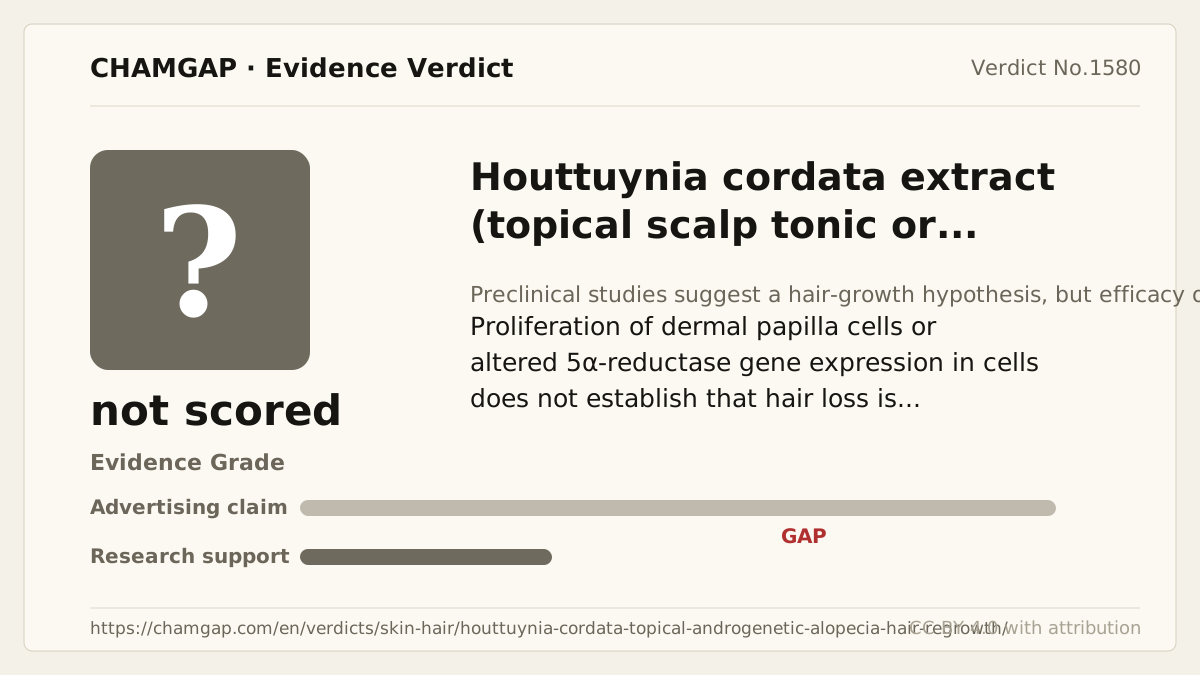
[Chamgap] Does topical Houttuynia cordata suppress androgenetic alopecia and regrow hair? — Evidence Grade ?. 3 cited sources checked. Source: https://chamgap.com/en/verdicts/skin-hair/houttuynia-cordata-topical-androgenetic-alopecia-hair-regrowth/ · CC BY 4.0CC BY 4.0 — free to use with attribution; do not distort grades, numbers, or verdict meaning.
What this document does and does not do
Chamgap is an information source. It reports what research has and has not confirmed; it does not tell readers what to take or buy. That decision belongs to readers and, when needed, medical or legal professionals. This verdict reflects literature available up to the search date and may change as new research appears. Nothing here is medical advice.