
Dutasteride,
does it really help with Increased hair count and width in male androgenetic alopecia?
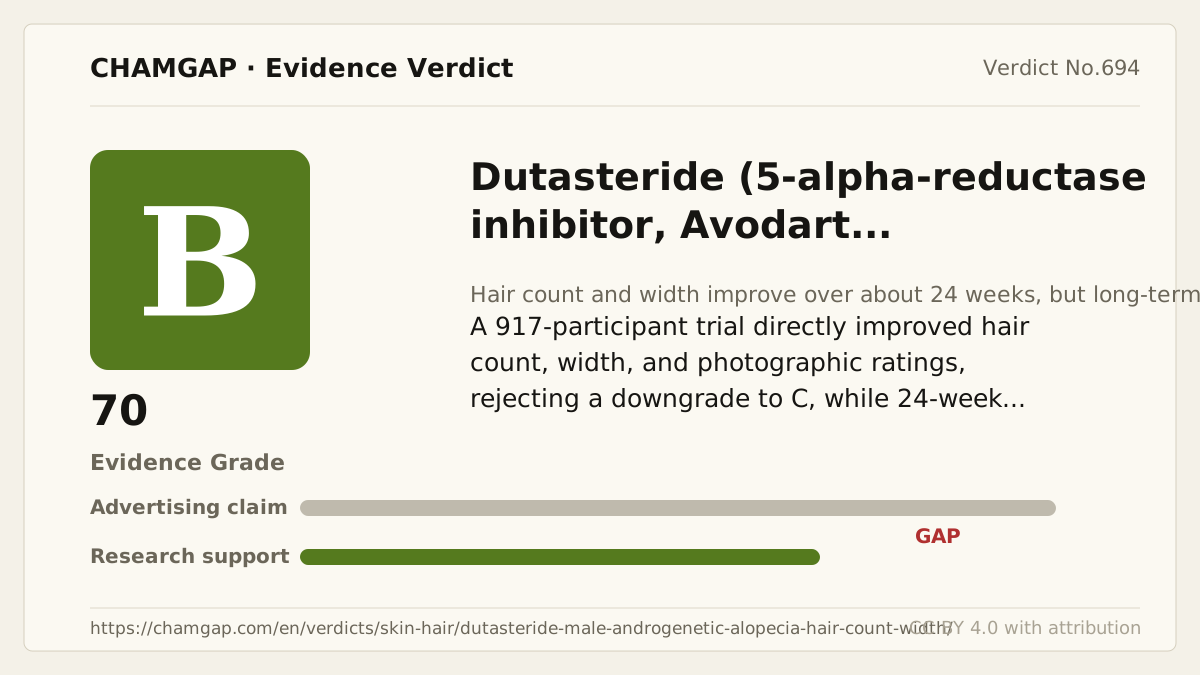
research showsDutasteride is rated B because it increases hair count and width in male androgenetic alopecia. In a 917-participant randomized placebo- and finasteride-controlled trial, 0.5 mg improved hair count, width, and photographic assessment at 24 weeks versus placebo and finasteride, and improvement in hair counts was reproduced in a 153-participant Korean placebo-controlled phase 3 trial and a low-dose 0.2-mg phase 3 trial. Most pivotal trials lasted about 24 weeks, were concentrated in manufacturer funding, and provided limited evidence for long-term persistence and patient-important outcomes such as quality of life. Sexual dysfunction, reduced sperm parameters, and avoidance of leaking capsules by people who could become pregnant are separate safety issues.
ads claimMarketing can broaden the findings into complete regrowth, permanent recovery, or superiority to finasteride in every respect. The evidence concerns objective increases in hair count and width during about 24 weeks of treatment; persistence after discontinuation, individual appearance satisfaction, and long-term quality of life are separate questions.
Useful facts when choosing a product
- Dutasteride inhibits both type 1 and type 2 5-alpha-reductase and lowers dihydrotestosterone; in South Korea it is prescribed for male androgenetic alopecia at 0.5 mg once daily.
- Its very long half-life means effects and adverse effects may not disappear immediately after discontinuation, and capsules should be swallowed intact as prescribed.
- Reduced libido, erectile or ejaculatory dysfunction, breast symptoms, and reductions in sperm count or semen volume can occur, so fertility plans and persistent symptoms should be discussed with a clinician.
- Because exposure may impair external genital development in a male fetus, anyone who is pregnant or could become pregnant should not handle leaking or broken capsules.
Chamgap Semantic Classification Code
Candidate index · review held
M.dutasteride.UNK.hair-count-and-width-in-male-androgenetic-alopecia.increase.MULTIMedicinal interventions > Dutasteride > Unknown > hair count and width in male androgenetic alopecia > Increase claim > Multiple: primary unresolved
An automated migration candidate, not an issued permanent code; exact claim scope remains under review. This machine-generated migration candidate helps retrieval but is not a permanent assignment. The original verdict ID and URL remain authoritative.
What the research actually shows
Gubelin Harcha and colleagues randomized 917 men to dutasteride 0.02, 0.1, or 0.5 mg, finasteride 1 mg, or placebo for 24 weeks. Dutasteride increased hair count and width dose dependently, and 0.5 mg outperformed both placebo and finasteride on target-area hair count, width, and frontal photographic assessment. The Korean phase 3 trial by Eun and colleagues found that 0.5 mg increased six-month hair count more than placebo among 153 men. A 2025 phase 3 trial by Lee and colleagues across 11 Korean centers compared 0.2 mg, 0.5 mg, and placebo in 139 men and confirmed improved 24-week hair count and photography with 0.2 mg. All were centered on short-term hair measures, without multiyear randomized persistence data.
Why this is classified as B (70)
A 917-participant active- and placebo-controlled trial directly improved hair count, width, and photographic assessment with 0.5 mg, and Korean phase 3 trials reproduced objective hair-count gains. Rule ②-b for branded supplements and individually approved functional ingredients does not cap a prescription-drug large randomized trial at C, and corpus parity with other manufacturer-funded drug trials supports B. Predominantly 24-week follow-up and manufacturer concentration place it at lower B with 70 points.
Counterpoint. This verdict concerns the 0.5-mg male hair-loss strategy and is distinct from prior finasteride evidence for benign-prostatic-hyperplasia progression or other doses and indications. It should not be generalized to female-pattern hair loss, pregnancy exposure, or other forms of alopecia.
Rejudgment record. New verdict — Kept B because a 917-participant active- and placebo-controlled trial directly improved hair count, width, and photographic ratings and Korean phase 3 trials reproduced hair-count gains; rule ②-b for branded supplements and individually approved functional ingredients does not cap a large prescription-drug trial at C, while roughly 24-week duration and manufacturer concentration place the evidence at lower B
Sub-claim grades by effect
This ingredient is marketed for several effects. A single overall grade blends strong and weak claims together, so each effect is graded separately here. The overall grade reflects the strongest disconfirming or core claim.
| Effect (sub-claim) | Grade | Basis |
|---|---|---|
| Increased hair count and width in male androgenetic alopecia | B | Multiple randomized placebo- and active-controlled trials reproduced objective improvements in hair count and width over about 24 weeks. |
| Persistence beyond 24 weeks and permanent recovery | ? | No long-term randomized human efficacy literature establishes this broad persistence claim. |
| Effects on sexual function and sperm parameters | ? | This is separated as a safety axis rather than an efficacy subclaim. |
Cross-check — AI research and Codex final gate
Evidence Table
| Study | Design | Sample | Funding | Endpoint | Result | Weight |
|---|---|---|---|---|---|---|
| Gubelin Harcha W et al. 2014 | Multinational randomized double-blind placebo- and finasteride-controlled dose-response trial | 917 men with androgenetic alopecia | Manufacturer funding and employee coauthorship from GlaxoSmithKline | Target-area hair count and width and masked photographic assessment at 24 weeks | The 0.5-mg dose significantly outperformed placebo and finasteride 1 mg for hair count, width, and frontal photographic assessment. | Pivotal large short-term randomized trial with direct hair measures |
| Eun HC et al. 2010 | Korean randomized double-blind placebo-controlled phase 3 trial | 153 men aged 18 to 49 years | Product-development trial associated with GlaxoSmithKline | Target-area hair count and photographic assessment at six months | Dutasteride 0.5 mg produced a significantly greater increase in target-area hair count than placebo. | Korean placebo-controlled phase 3 replication |
| Lee S et al. 2025 | Randomized double-blind placebo-controlled low-dose phase 3 trial at 11 Korean centers | 139 men | Supported by the manufacturer, Daewoong Pharmaceutical | Target-area hair count, width, and photographic assessment at 24 weeks | The 0.2-mg dose improved 24-week hair count and investigator and independent-panel photographic assessments versus placebo. | Korean replication at a lower dose |
Receipt — 3 References
All 3 cited sources were verified for existence at the original page (as of 2026-07-19).
Final verification and publication gate: Codex · Evidence date: 2026-07-19 · Corrections: none
Cite this verdict
[Chamgap] Dutasteride x increased hair count and width in male androgenetic alopecia — Evidence Grade B·70. 3 cited sources checked. Source: https://chamgap.com/en/verdicts/skin-hair/dutasteride-male-androgenetic-alopecia-hair-count-width/ · CC BY 4.0CC BY 4.0 — free to use with attribution; do not distort grades, numbers, or verdict meaning.
What this document does and does not do
Chamgap is an information source. It reports what research has and has not confirmed; it does not tell readers what to take or buy. That decision belongs to readers and, when needed, medical or legal professionals. This verdict reflects literature available up to the search date and may change as new research appears. Nothing here is medical advice.