
Topical minoxidil 5%,
does it really help with Hair regrowth in male and female androgenetic alopecia?
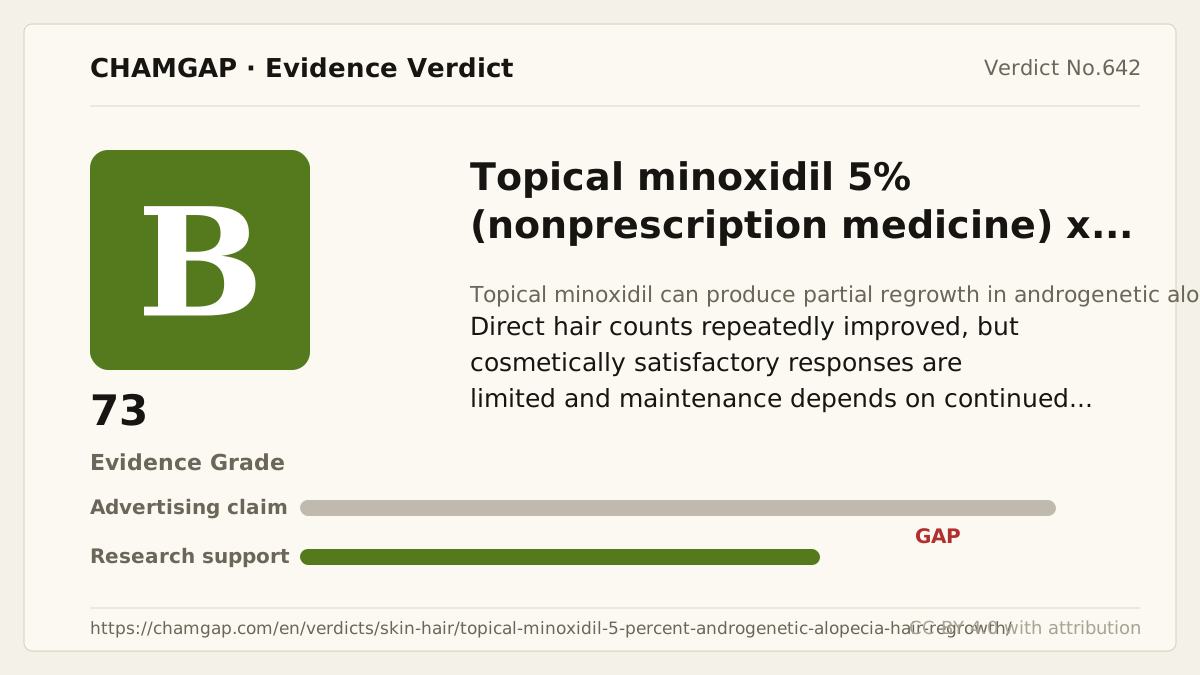
research showsTopical minoxidil 5% is rated B because it significantly increases hair regrowth in male and female androgenetic alopecia. A meta-analysis found mean increases over placebo of 16.68 total hairs and 20.90 nonvellus hairs, and 48-week multicenter trials in men and women also improved hair counts and patient and investigator assessments. Response is limited to a subset of patients, is not complete restoration, and newly regrown hair can be lost within about three to four months after treatment stops. This is a topical hair-growth drug distinct from ingested biotin, saw palmetto, or collagen, with efficacy, maintenance dependence, and safety kept separate.
ads claimMarketing can imply full density restoration or permanent benefit after a finite course. The evidence supports partial regrowth in responders during continued use and does not automatically apply to alopecia areata, scarring alopecia, thyroid disease, or other causes.
Useful facts when choosing a product
- Minoxidil 5% is applied to the scalp, and formulation-specific directions and authorized populations can differ between male and female pattern hair-loss products.
- Assessment generally requires several months, shedding can temporarily increase for about two weeks at initiation, and not every user regrows hair.
- Continued use is required to retain benefit, and newly regrown hair is generally lost within three to four months after complete discontinuation.
- Runoff can cause hair growth on unwanted areas, scalp irritation and itching are common, and rare palpitations, chest pain, dizziness, or edema require stopping treatment and seeking care.
Chamgap Semantic Classification Code
Candidate index · review held
M.minoxidil-5-percent.topical-skin.hair-regrowth-in-male-and-female-androgenetic-alopecia.assess.MULTIMedicinal interventions > minoxidil 5% > Topical skin > Hair regrowth in male and female androgenetic alopecia > Association or change assessment > Multiple: primary unresolved
An automated migration candidate, not an issued permanent code; exact claim scope remains under review. This machine-generated migration candidate helps retrieval but is not a permanent assignment. The original verdict ID and URL remain authoritative.
What the research actually shows
Gupta 2015 reported significant gains over placebo in total and nonvellus hair counts, with an investigator-assessment RR of 2.28 and self-assessment RR of 1.56. The 393-man Olsen 2002 trial and 381-woman Lucky 2004 trial found that 5% solution outperformed placebo on hair count and coverage measures at 48 weeks. Follow-up is mainly limited to 48 weeks, and labeling states that regrown hair is not maintained without continued use, so the findings do not establish a permanent cure.
Why this is classified as B (73)
Multicenter trials in men and women plus meta-analysis replicated direct hair-count improvements, including mean differences of 16.68 total hairs and 20.90 nonvellus hairs versus placebo, so a C grade would understate the evidence. Responses are nevertheless partial, cosmetically satisfactory outcomes occur in only some users, evidence centers on 48 weeks, and maintenance requires continued treatment. This supports B with 73 points; irritation, hypertrichosis, initial shedding, and rare palpitations remain separate safety issues.
Counterpoint. Standardized photographs and same-area hair counts can assess response after four to six months; absent response or diagnostic uncertainty warrants dermatologic evaluation. Sudden, patchy, or inflamed scalp hair loss requires diagnosis before self-treatment.
Rejudgment record. New verdict — Applied B because placebo-controlled trials and meta-analysis improved direct hair-count endpoints, including mean differences of 16.68 total hairs and 20.90 nonvellus hairs, while cosmetic satisfaction was limited, follow-up centered on 48 weeks, continued use was required, and complete restoration was not shown
Sub-claim grades by effect
This ingredient is marketed for several effects. A single overall grade blends strong and weak claims together, so each effect is graded separately here. The overall grade reflects the strongest disconfirming or core claim.
| Effect (sub-claim) | Grade | Basis |
|---|---|---|
| Hair regrowth in androgenetic alopecia | B | Placebo-controlled trials in men and women plus meta-analysis improved direct hair counts and assessments. |
| Complete restoration of hair | ? | Trials assessed partial regrowth, and no human evidence establishes complete restoration. |
| Permanent maintenance after discontinuation | D | Continued use is required, and newly regrown hair is generally lost within three to four months after stopping. |
Cross-check — AI research and Codex final gate
Evidence Table
| Study | Design | Sample | Funding | Endpoint | Result | Weight |
|---|---|---|---|---|---|---|
| Gupta AK and Charrette A. 2015 | Systematic review and random-effects meta-analysis | Eligible controlled topical-minoxidil trials; total sample not reported in the abstract | Funding not reported in the abstract | Total and nonvellus hair counts plus investigator and patient assessments | Versus placebo, the MD was 16.68 for total hair and 20.90 for nonvellus hair; investigator RR was 2.28 and self-assessment RR was 1.56. | Key synthesized efficacy evidence |
| Olsen EA et al. 2002 | Forty-eight-week randomized double-blind multicenter placebo- and active-controlled trial | 393 men | Funding not reported in the abstract | Nonvellus hair count and patient and investigator scalp-coverage assessments | The 5% solution outperformed 2% and placebo on hair count and assessments at 48 weeks, with more local irritation. | Direct randomized evidence in men |
| Lucky AW et al. 2004 | Forty-eight-week randomized double-blind multicenter placebo- and active-controlled trial | 381 women | Funding not reported in the abstract | Nonvellus hair count and patient and investigator hair-growth and coverage assessments | The 5% solution was superior to placebo on all three primary efficacy variables. | Direct randomized evidence in women |
Receipt — 4 References
All 4 cited sources were verified for existence at the original page (as of 2026-07-19).
Final verification and publication gate: Codex · Evidence date: 2026-07-19 · Corrections: none
Cite this verdict
[Chamgap] Topical minoxidil 5% x hair regrowth in androgenetic alopecia — Evidence Grade B·73. 4 cited sources checked. Source: https://chamgap.com/en/verdicts/skin-hair/topical-minoxidil-5-percent-androgenetic-alopecia-hair-regrowth/ · CC BY 4.0CC BY 4.0 — free to use with attribution; do not distort grades, numbers, or verdict meaning.
What this document does and does not do
Chamgap is an information source. It reports what research has and has not confirmed; it does not tell readers what to take or buy. That decision belongs to readers and, when needed, medical or legal professionals. This verdict reflects literature available up to the search date and may change as new research appears. Nothing here is medical advice.