
Dupilumab,
does it really help with Improvement of pruritus and skin lesions in moderate-to-severe atopic dermatitis?
research showsDupilumab is rated B because repeated phase 3 trials substantially improved skin lesions and pruritus in moderate-to-severe atopic dermatitis inadequately controlled by topical therapy. Among 1,379 participants in SOLO 1 and 2, week-16 IGA 0/1 occurred in about 36% to 38% with dupilumab versus 8% to 10% with placebo, while EASI-75 and pruritus also improved significantly. In the 740-participant CHRONOS trial with topical corticosteroids, week-16 EASI-75 was 64% to 69% versus 23% and persisted to week 52. All pivotal trials were funded by Sanofi and Regeneron and relied on EASI, IGA, and pruritus scales, limiting the verdict to upper B.
ads claimPromotion may describe biological targeting as a root-cause cure for atopy or a treatment for every eczema. The evidence applies to reducing lesions and symptoms during treatment of inadequately controlled moderate-to-severe atopic dermatitis.
Useful facts when choosing a product
- Dupilumab is a subcutaneous prescription biologic that blocks IL-4Rα shared by IL-4 and IL-13 signaling, with dosing that varies by age, weight, and indication.
- It controls lesions and pruritus in moderate-to-severe atopic dermatitis but does not prove cure or permanent remission after treatment stops.
- Conjunctivitis or keratitis symptoms require assessment, and injection-site reactions and transient eosinophilia have been reported.
- Live vaccines should be avoided during treatment, and helminth infection or changes to therapy for coexisting allergic disease should be discussed with the prescriber.
Chamgap Semantic Classification Code
Candidate index · review held
M.dupilumab.UNK.pruritus-and-skin-lesions-in-moderate-to-severe-atopic-dermatitis.improve.placeboMedicinal interventions > Dupilumab > Unknown > pruritus and skin lesions in moderate-to-severe atopic dermatitis > Improvement claim > Placebo
An automated migration candidate, not an issued permanent code; exact claim scope remains under review. This machine-generated migration candidate helps retrieval but is not a permanent assignment. The original verdict ID and URL remain authoritative.
What the research actually shows
SOLO 1 and SOLO 2 assigned 671 and 708 adults inadequately controlled by topical treatment to 16 weeks of dupilumab or placebo. IGA 0/1 with every-other-week treatment was 38% and 36% versus 10% and 8% with placebo; EASI-75, pruritus, and quality of life also improved. CHRONOS allowed topical corticosteroids in all 740 participants and compared dupilumab with placebo for one year. Week-16 EASI-75 was 64% weekly, 69% every other week, and 23% with placebo, with similar week-52 findings. Sanofi and Regeneron supported both programs.
Why this is classified as B (76)
Repeated placebo-controlled phase 3 trials in SOLO 1, SOLO 2, and CHRONOS produced large, consistent improvements in EASI-75, IGA, and pruritus. These outcomes are clinically and patient relevant, but are scale- and patient-report-based and the pivotal evidence is concentrated in Sanofi and Regeneron funding, supporting B with 76 points. Conjunctivitis, injection reactions, and eosinophilia remain separate safety issues.
Counterpoint. An inadequate response calls for reassessment of diagnosis, adherence, topical co-therapy, infection, and contact dermatitis. Treatment selection should compare symptom burden, cost, convenience, and risks of alternative systemic therapies.
Rejudgment record. New verdict — Assigned upper B for large replicated EASI-75 and pruritus improvements in SOLO 1, SOLO 2, and CHRONOS while accounting for concentrated manufacturer funding and clinical-scale and patient-reported outcomes
Sub-claim grades by effect
This ingredient is marketed for several effects. A single overall grade blends strong and weak claims together, so each effect is graded separately here. The overall grade reflects the strongest disconfirming or core claim.
| Effect (sub-claim) | Grade | Basis |
|---|---|---|
| Improvement of EASI-75 and pruritus in moderate-to-severe atopic dermatitis | B | Repeated phase 3 trials showed large consistent improvements, with manufacturer funding and scale-based outcomes considered. |
| The same effect in mild atopic dermatitis or nonspecific eczema generally | ? | This lies outside the pivotal trial populations and is not established in this verdict. |
| Cure of atopic dermatitis or permanent remission after discontinuation | ? | Trials demonstrated control of signs and symptoms during treatment, not cure. |
Cross-check — AI research and Codex final gate
Evidence Table
| Study | Design | Sample | Funding | Endpoint | Result | Weight |
|---|---|---|---|---|---|---|
| Simpson EL et al. SOLO 1 and 2 2016 | Two identically designed randomized double-blind placebo-controlled phase 3 trials | 671 and 708 adults, 1,379 total | Sanofi and Regeneron Pharmaceuticals | Week-16 IGA 0/1, EASI-75, pruritus, and quality of life | IGA 0/1 was 38% and 36% with every-other-week treatment versus 10% and 8% with placebo; EASI-75 and pruritus also improved significantly. | Key replicated monotherapy evidence |
| Blauvelt A et al. CHRONOS 2017 | One-year randomized double-blind placebo-controlled phase 3 trial | 740 adults | Sanofi and Regeneron Pharmaceuticals | IGA 0/1 and EASI-75 at weeks 16 and 52 with topical corticosteroids | Week-16 EASI-75 was 64% to 69% with dupilumab versus 23% with placebo, with similar benefit at week 52. | Longer-term confirmatory combination evidence |
Receipt — 2 References
All 2 cited sources were verified for existence at the original page (as of 2026-07-20).
Final verification and publication gate: Codex · Evidence date: 2026-07-20 · Corrections: none
Cite this verdict
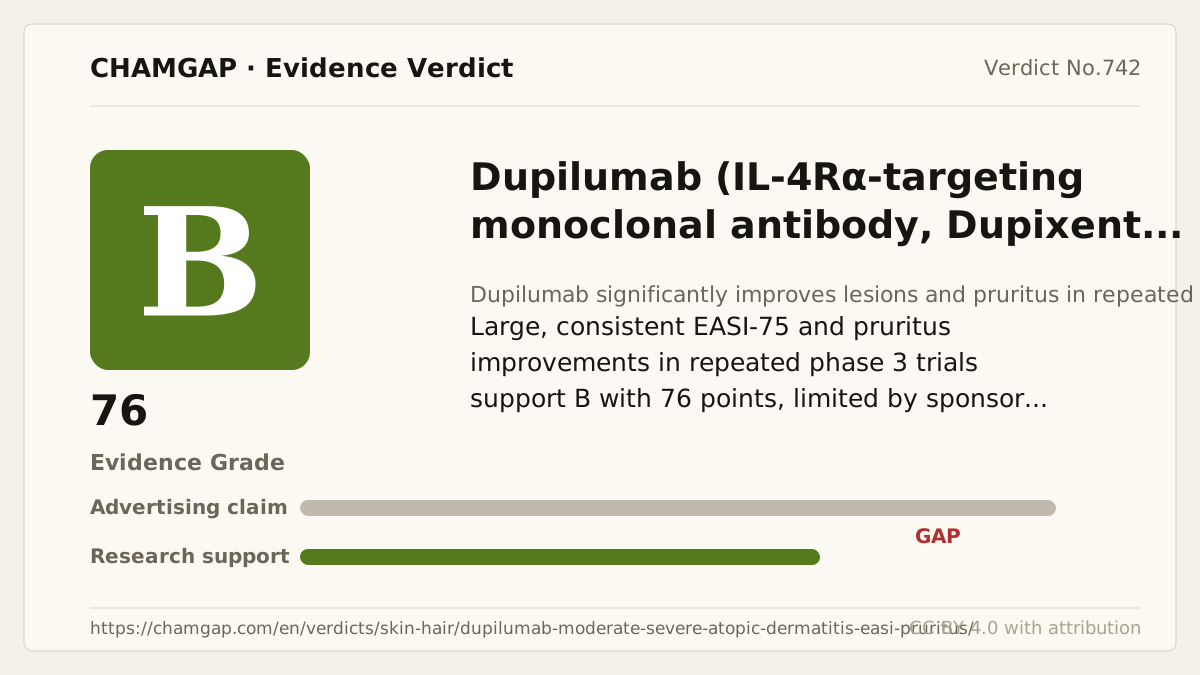
[Chamgap] Dupilumab x EASI-75 and pruritus improvement in moderate-to-severe atopic dermatitis — Evidence Grade B·76. 2 cited sources checked. Source: https://chamgap.com/en/verdicts/skin-hair/dupilumab-moderate-severe-atopic-dermatitis-easi-pruritus/ · CC BY 4.0CC BY 4.0 — free to use with attribution; do not distort grades, numbers, or verdict meaning.
What this document does and does not do
Chamgap is an information source. It reports what research has and has not confirmed; it does not tell readers what to take or buy. That decision belongs to readers and, when needed, medical or legal professionals. This verdict reflects literature available up to the search date and may change as new research appears. Nothing here is medical advice.