
Baricitinib,
does it really help with Scalp hair regrowth in severe alopecia areata?
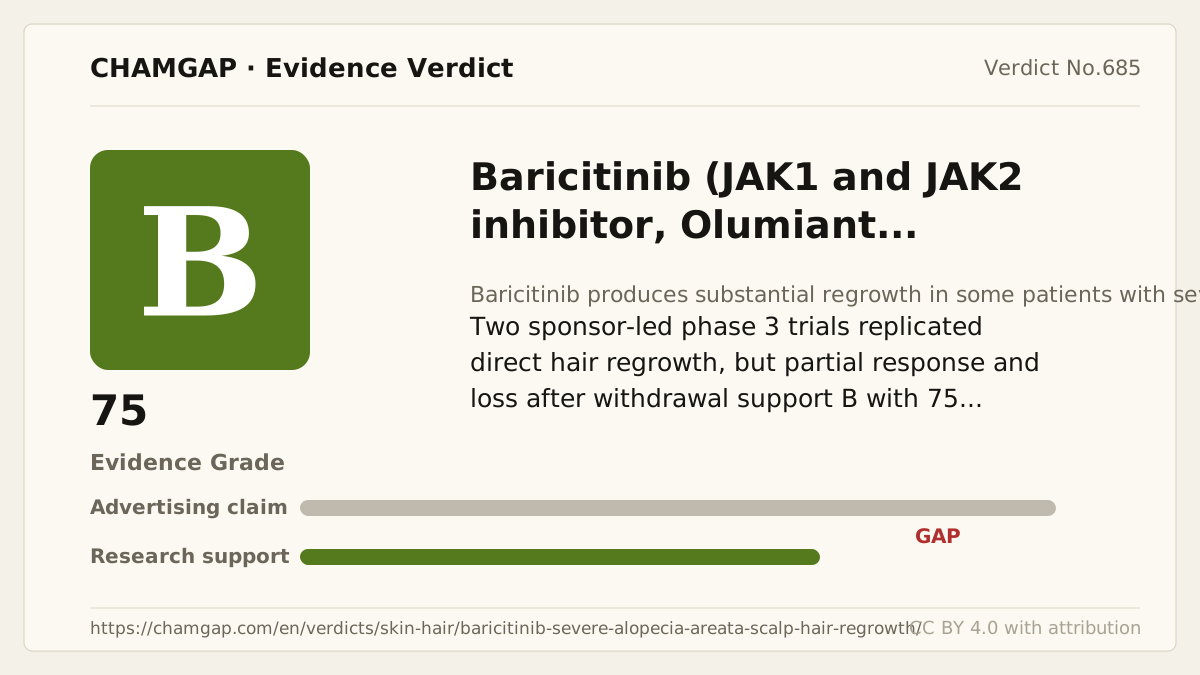
research showsBaricitinib is rated B because it produces clinically substantial scalp hair regrowth in severe alopecia areata. In the phase 3 BRAVE-AA1 and BRAVE-AA2 randomized trials, week-36 response rates for a SALT score of 20 or less were 38.8% and 35.9% with 4 mg, 22.8% and 19.4% with 2 mg, and 6.2% and 3.3% with placebo, reproducing the result across two trials. Only a minority responded, both trials were led by Eli Lilly, and long-term dosing is usually required. In a randomized withdrawal study of week-52 responders, at least 80% lost treatment benefit by week 152 after withdrawal, so the result does not establish cure or persistence after stopping; the grade is B with 75 points.
ads claimPromotion can turn photographs of selected responders into claims that every form of hair loss is cured or that regrowth persists after stopping. The evidence applies to some adults with severe autoimmune alopecia areata while they are treated; it does not establish efficacy for androgenetic alopecia or permanent cure.
Useful facts when choosing a product
- Baricitinib is an oral prescription immunomodulator that inhibits JAK1 and JAK2, and Olumiant is its principal brand. The prescriber selects the dose for severe alopecia areata according to patient factors and labeling, and it is not interchangeable with medicines for other hair-loss types.
- Tuberculosis and viral-hepatitis risk, blood counts, liver and kidney function, and lipids are assessed before treatment and monitored during therapy. Live vaccines are avoided, and a serious active infection requires prompt reassessment of starting or continuing treatment.
- Upper respiratory infection, headache, acne, lipid and creatine-kinase elevations, urinary infection, liver-enzyme elevation, and herpes zoster have been reported. A serious infection can require interruption under medical guidance.
- Class warnings for JAK inhibitors include mortality, malignancy, major adverse cardiovascular events, and venous thrombosis. Older age, smoking history, and cardiovascular, thrombotic, or cancer risk require an individualized comparison of hair-regrowth benefit against serious harm.
Chamgap Semantic Classification Code
Candidate index · review held
M.baricitinib.UNK.scalp-hair-regrowth-in-severe-alopecia-areata.assess.placeboMedicinal interventions > Baricitinib > Unknown > Scalp hair regrowth in severe alopecia areata > Association or change assessment > Placebo
An automated migration candidate, not an issued permanent code; exact claim scope remains under review. This machine-generated migration candidate helps retrieval but is not a permanent assignment. The original verdict ID and URL remain authoritative.
What the research actually shows
BRAVE-AA1 with 654 participants and BRAVE-AA2 with 546 participants randomized adults with a SALT score of at least 50 to baricitinib 4 mg, 2 mg, or placebo. Week-36 rates of SALT 20 or less were 38.8%, 22.8%, and 6.2% in AA1 and 35.9%, 19.4%, and 3.3% in AA2, with the stronger result at 4 mg. Continuous-treatment analysis through week 52 found further response, but remained part of the same company program. In the BRAVE-AA1 withdrawal study, switching week-52 responders to placebo led at least 80% to lose benefit through week 152, defined as a worsening of more than 20 SALT points, compared with about 7% among those who continued treatment.
Why this is classified as B (75)
Two placebo-controlled phase 3 trials reproduced the direct scalp-hair outcome of SALT 20 or less with a dose response. Only about 36% to 39% responded to 4 mg, all positive trials were led by Eli Lilly, and at least 80% of withdrawn responders eventually lost benefit in a randomized withdrawal trial. Strong directness and replication support B, but sponsor concentration, partial response, and treatment dependence limit the score to 75 and do not support a claim of cure.
Counterpoint. For a patient with extensive hair loss and major psychosocial burden, restoring coverage to no more than 20% scalp loss can have substantial clinical value. The decision still requires a personalized comparison with infection, thrombosis, cardiovascular, malignancy, and long-term-treatment risks.
Rejudgment record. New verdict — Applied grade B because BRAVE-AA1 and BRAVE-AA2 reproduced direct scalp hair regrowth with dose response in severe alopecia areata, while accounting for concentration in the Eli Lilly program, response in only a minority even at 4 mg, and loss of benefit in most responders after randomized withdrawal
Sub-claim grades by effect
This ingredient is marketed for several effects. A single overall grade blends strong and weak claims together, so each effect is graded separately here. The overall grade reflects the strongest disconfirming or core claim.
| Effect (sub-claim) | Grade | Basis |
|---|---|---|
| Scalp hair regrowth in severe alopecia areata | B | A direct hair outcome with dose response was replicated in two placebo-controlled phase 3 trials. |
| Cure of alopecia areata or maintenance of hair after discontinuation | ? | At least 80% of withdrawn responders eventually lost benefit, so cure and post-discontinuation persistence are not established. |
| Hair regrowth in every patient with severe alopecia areata | ? | Even with 4 mg, only about 36% to 39% achieved a SALT 20 response at week 36. |
| Hair regrowth in androgenetic alopecia | ? | BRAVE-AA studied autoimmune alopecia areata and does not directly apply to androgenetic alopecia. |
Cross-check — AI research and Codex final gate
Evidence Table
| Study | Design | Sample | Funding | Endpoint | Result | Weight |
|---|---|---|---|---|---|---|
| King B et al. BRAVE-AA1 and BRAVE-AA2. 2022 | Two separate randomized double-blind placebo-controlled phase 3 trials | 654 and 546 adults with severe alopecia areata, 1,200 total | Eli Lilly under license from Incyte | Scalp hair regrowth to a SALT score of 20 or less at week 36 | Response rates were 38.8% and 35.9% with 4 mg, 22.8% and 19.4% with 2 mg, and 6.2% and 3.3% with placebo. | Pivotal replicated direct regrowth evidence |
| Kwon O et al. BRAVE-AA 52-week analysis. 2023 | Fifty-two-week continuous-treatment analysis of two phase 3 trials | The severe alopecia areata populations from BRAVE-AA1 and BRAVE-AA2 | Eli Lilly; multiple company-affiliated authors | SALT, eyebrow, and eyelash responses through week 52 | Some patients responded after week 36, suggesting persistence and additional benefit during continuous treatment. | Continuous-treatment context; not an independent trial |
| King B et al. BRAVE-AA1 withdrawal trial. 2024 | Randomized double-blind withdrawal and retreatment study of week-52 responders | Week-52 responders from the original 654-adult BRAVE-AA1 trial | Eli Lilly | Loss of treatment benefit and retreatment response through week 152 | At least 80% of those switched to placebo lost benefit, compared with about 7% who continued treatment. | Limits claims of cure and persistence after withdrawal |
Receipt — 3 References
All 3 cited sources were verified for existence at the original page (as of 2026-07-19).
Final verification and publication gate: Codex · Evidence date: 2026-07-19 · Corrections: none
Cite this verdict
[Chamgap] Baricitinib x scalp hair regrowth in severe alopecia areata — Evidence Grade B·75. 3 cited sources checked. Source: https://chamgap.com/en/verdicts/skin-hair/baricitinib-severe-alopecia-areata-scalp-hair-regrowth/ · CC BY 4.0CC BY 4.0 — free to use with attribution; do not distort grades, numbers, or verdict meaning.
What this document does and does not do
Chamgap is an information source. It reports what research has and has not confirmed; it does not tell readers what to take or buy. That decision belongs to readers and, when needed, medical or legal professionals. This verdict reflects literature available up to the search date and may change as new research appears. Nothing here is medical advice.