
Clascoterone,
does it really help with Improved treatment success and lesion counts in moderate-to-severe facial acne?
research showsB. Two phase 3 trials reported in a peer-reviewed article, with ITT populations of 708 and 732, met all co-primary IGA and lesion-count endpoints, supporting B with 68 points. The publication form is one peer-reviewed original article reporting two phase 3 trials, corroborated by an independent FDA regulatory review. The actual ITT populations were 708 in CB-03-01/25 and 732 in /26. All three co-primary endpoints—Week 12 IGA treatment success and changes in inflammatory and noninflammatory lesion counts—were met in both trials. Clinical treatment success and lesion counts are acne treatment targets, not mere biomarkers. Replication supports B with 68 points, but sponsor-program origin, 12-week duration, and limited maintenance evidence preclude A.
ads claimMarketing may expand a topical antiandrogen into a permanent root-cause cure for hormonal acne. Confirmatory evidence covers 12-week facial-acne IGA success and lesion-count reductions.
Useful facts when choosing a product
- Clascoterone 1% cream is a prescription topical treatment applied in a thin layer twice daily for facial acne in patients 12 years or older.
- Contact with eyes, mouth, mucosa, and broken skin should be avoided, and treated skin should be washed and dried before application.
- Local erythema, dryness, itching, or burning can occur.
- Possible hypothalamic-pituitary-adrenal axis suppression has been reported, particularly with extensive exposure or in pediatric patients, so labeled use should be followed.
Chamgap Semantic Classification Code
Candidate index · review held
M.clascoterone.topical-skin.treatment-success-and-lesion-counts-in-moderate-to-severe-facial-acne.improve.UNKMedicinal interventions > Clascoterone > Topical skin > treatment success and lesion counts in moderate-to-severe facial acne > Improvement claim > Unknown
An automated migration candidate, not an issued permanent code; exact claim scope remains under review. This machine-generated migration candidate helps retrieval but is not a permanent assignment. The original verdict ID and URL remain authoritative.
What the research actually shows
The publication form is one peer-reviewed original article reporting two phase 3 trials, corroborated by an independent FDA regulatory review. The actual ITT populations were 708 in CB-03-01/25 and 732 in /26. All three co-primary endpoints—Week 12 IGA treatment success and changes in inflammatory and noninflammatory lesion counts—were met in both trials. Clinical treatment success and lesion counts are acne treatment targets, not mere biomarkers. Replication supports B with 68 points, but sponsor-program origin, 12-week duration, and limited maintenance evidence preclude A.
Why this is classified as B (68)
The publication form is one peer-reviewed original article reporting two phase 3 trials, corroborated by an independent FDA regulatory review. The actual ITT populations were 708 in CB-03-01/25 and 732 in /26. All three co-primary endpoints—Week 12 IGA treatment success and changes in inflammatory and noninflammatory lesion counts—were met in both trials. Clinical treatment success and lesion counts are acne treatment targets, not mere biomarkers. Replication supports B with 68 points, but sponsor-program origin, 12-week duration, and limited maintenance evidence preclude A. Rule ①: (a) improvement only in surrogate biomarkers such as HbA1c, LDL, blood pressure, intraocular pressure, bone density, laboratory values, or imaging has a ceiling of C; (b) a failed primary endpoint with only positive subjective secondary endpoints has a ceiling of C; and (c) small, single-manufacturer, short-term, or conflicting evidence has a ceiling of C. Patient-reported symptoms that are themselves treatment targets, including pain, sleep, bowel function, IRLS, IIEF/SEP, and depression or anxiety scales, are not surrogates. Consistent achievement of clinical-importance thresholds such as MCID in multiple independent randomized trials can support B, and large, consistent, independent evidence can exceptionally support A. If effects do not meet clinical-importance thresholds, the grade remains C regardless of trial count.
Counterpoint. Efficacy was judged separately from safety and regulatory status. Diagnosis and standard treatment choices require clinical discussion.
Rejudgment record. Cross-check applied — The publication form is one peer-reviewed original article reporting two phase 3 trials, corroborated by an independent FDA regulatory review. The actual ITT populations were 708 in CB-03-01/25 and 732 in /26. All three co-primary endpoints—Week 12 IGA treatment success and changes in inflammatory and noninflammatory lesion counts—were met in both trials. Clinical treatment success and lesion counts are acne treatment targets, not mere biomarkers. Replication supports B with 68 points, but sponsor-program origin, 12-week duration, and limited maintenance evidence preclude A. Rule ①: (a) improvement only in surrogate biomarkers such as HbA1c, LDL, blood pressure, intraocular pressure, bone density, laboratory values, or imaging has a ceiling of C; (b) a failed primary endpoint with only positive subjective secondary endpoints has a ceiling of C; and (c) small, single-manufacturer, short-term, or conflicting evidence has a ceiling of C. Patient-reported symptoms that are themselves treatment targets, including pain, sleep, bowel function, IRLS, IIEF/SEP, and depression or anxiety scales, are not surrogates. Consistent achievement of clinical-importance thresholds such as MCID in multiple independent randomized trials can support B, and large, consistent, independent evidence can exceptionally support A. If effects do not meet clinical-importance thresholds, the grade remains C regardless of trial count.
Sub-claim grades by effect
This ingredient is marketed for several effects. A single overall grade blends strong and weak claims together, so each effect is graded separately here. The overall grade reflects the strongest disconfirming or core claim.
| Effect (sub-claim) | Grade | Basis |
|---|---|---|
| Week 12 IGA treatment success | B | The co-primary endpoint succeeded in both phase 3 trials. |
| Reduction in inflammatory facial-acne lesions | B | The co-primary endpoint succeeded in both phase 3 trials. |
| Reduction in noninflammatory facial-acne lesions | B | The co-primary endpoint succeeded in both phase 3 trials. |
Cross-check — AI research and Codex final gate
Evidence Table
| Study | Design | Sample | Funding | Endpoint | Result | Weight |
|---|---|---|---|---|---|---|
| Hebert A et al. 2020, CB-03-01/25 | Phase 3 randomized double-blind vehicle-controlled trial; peer-reviewed original article | ITT 708 | Cassiopea | Three co-primary endpoints: Week 12 IGA success and inflammatory and noninflammatory lesion-count changes | All three co-primary endpoints met; IGA success 18.4% versus 9.0%. | Key efficacy evidence |
| Hebert A et al. 2020, CB-03-01/26 | Phase 3 randomized double-blind vehicle-controlled trial; peer-reviewed original article | ITT 732 | Cassiopea | Three co-primary endpoints: Week 12 IGA success and inflammatory and noninflammatory lesion-count changes | All three co-primary endpoints met; IGA success 20.3% versus 6.5%. | Key efficacy evidence |
Receipt — 2 References
All 2 cited sources were verified for existence at the original page (as of 2026-07-24).
Final verification and publication gate: Codex · Evidence date: 2026-07-24 · Corrections: none
Cite this verdict
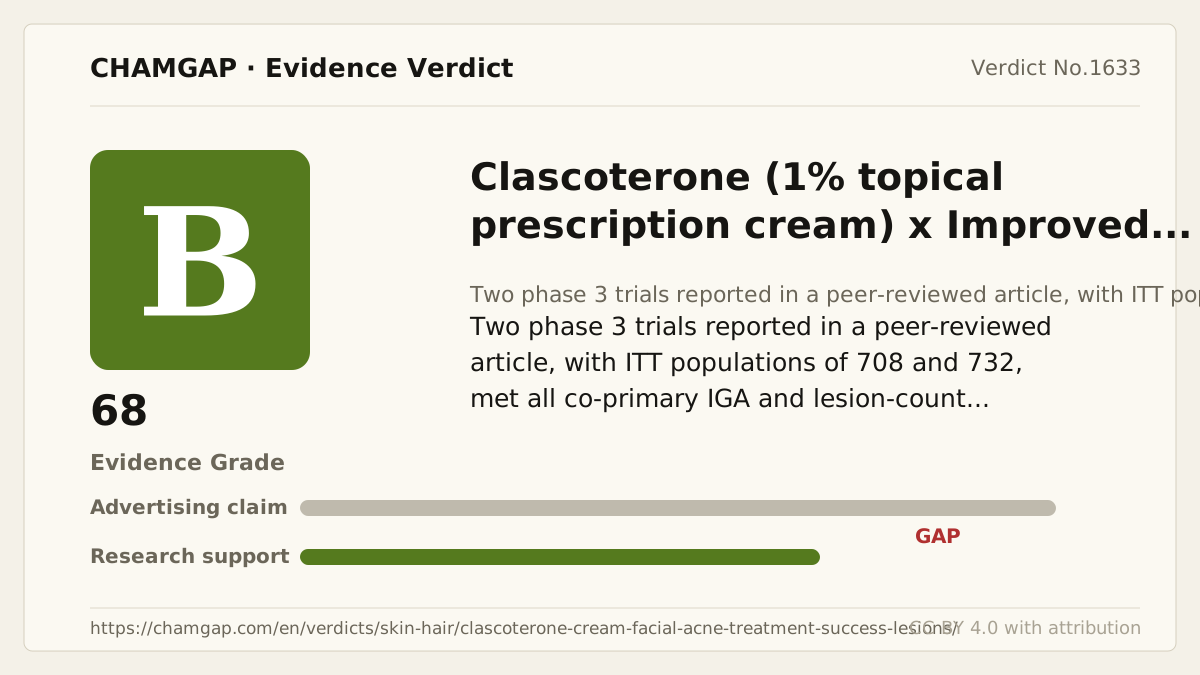
[Chamgap] Clascoterone x Improved treatment success and lesion counts in moderate-to-severe facial acne — Evidence Grade B·68. 2 cited sources checked. Source: https://chamgap.com/en/verdicts/skin-hair/clascoterone-cream-facial-acne-treatment-success-lesions/ · CC BY 4.0CC BY 4.0 — free to use with attribution; do not distort grades, numbers, or verdict meaning.
What this document does and does not do
Chamgap is an information source. It reports what research has and has not confirmed; it does not tell readers what to take or buy. That decision belongs to readers and, when needed, medical or legal professionals. This verdict reflects literature available up to the search date and may change as new research appears. Nothing here is medical advice.