
Calcarea carbonica 30C,
does it really help with Relief of infant cradle cap and seborrheic scalp dermatitis?
research showsCalcarea carbonica 30C receives F with 5 points. A 30C preparation repeats a 100-fold dilution thirty times, producing an approximate 10^-60 dilution with no realistic chance of retaining source-material molecules in an ordinary dose. No credible placebo-controlled trial of this product for infant cradle cap was identified, and the Cochrane review of infantile seborrheic dermatitis provides no Calcarea 30C efficacy evidence. More broadly, the larger higher-quality subset of 110 placebo-controlled homeopathy trials was compatible with placebo, making this F for absent mechanism and repeated class-level refutation rather than ? for a direct-evidence gap alone.
ads claimMarketing matches infant constitution, scalp scale, and milk crust to a Calcarea constitutional-remedy profile and presents natural improvement as treatment response. This is not product-specific placebo-controlled evidence, and repeated homeopathic consultation does not establish efficacy of the 30C pellet.
Useful facts when choosing a product
- The 30C label means thirty successive 1-to-100 dilution steps, yielding a theoretical final dilution of approximately 10^-60.
- Given the Avogadro constant, an ordinary 30C bottle or dose has effectively no realistic chance of containing a molecule of the starting material.
- Infant cradle cap is usually benign and self-limiting, and conservative care commonly includes gentle cleansing and light brushing after softening the scale.
- Direct toxicity of the preparation is generally low, but delaying care when there is marked redness, oozing, odor, pain, spread, or fever, or replacing effective treatment, is the principal safety concern.
Chamgap Semantic Classification Code
Candidate index · review held
K.calcarea-carbonica-30c-homeopathic-product.UNK.infant-cradle-cap-and-seborrheic-scalp-dermatitis.relieve.placeboFolk and alternative interventions > Calcarea carbonica 30C homeopathic product > Unknown > infant cradle cap and seborrheic scalp dermatitis > Symptom-relief claim > Placebo
An automated migration candidate, not an issued permanent code; exact claim scope remains under review. This machine-generated migration candidate helps retrieval but is not a permanent assignment. The original verdict ID and URL remain authoritative.
What the research actually shows
Victoire and colleagues in 2019 reviewed six randomized trials with 310 infants from birth to 24 months and found mostly very-low-certainty evidence with a generally favorable natural course. Calcarea carbonica 30C was not among the included interventions. Shang and colleagues in 2005 compared 110 placebo-controlled homeopathy trials with 110 conventional-medicine trials; the estimate from eight larger higher-quality homeopathy trials was compatible with placebo. The 2002 study by Smith and colleagues reported benefit in 41 adults using a blend of potassium bromide 1X, sodium bromide 2X, nickel sulfate 3X, and sodium chloride 6X, but a material low-dilution adult blend is not evidence for 30C Calcarea in infants.
Why this is classified as F (5)
A missing direct trial alone could suggest ?, but the material implausibility of 30C and placebo-compatible results in larger less-biased homeopathy trials provide repeated refutation. The verdict is therefore F with 5 points, consistent with other 30C homeopathy entries; natural resolution and delayed-care risk are separated under efficacy and safety.
Counterpoint. Most cradle cap resolves gradually, but pediatric or dermatologic evaluation is appropriate when infection, atopic dermatitis, psoriasis, persistence, or worsening is suspected.
Rejudgment record. New verdict — Applied F based on no direct Calcarea carbonica 30C infant cradle-cap trial, effectively absent source material at approximately 10^-60 dilution, the condition-specific gap in the Cochrane review, and placebo-compatible results in larger higher-quality homeopathy trials
Sub-claim grades by effect
This ingredient is marketed for several effects. A single overall grade blends strong and weak claims together, so each effect is graded separately here. The overall grade reflects the strongest disconfirming or core claim.
| Effect (sub-claim) | Grade | Basis |
|---|---|---|
| Relief of infant cradle cap and seborrheic scalp dermatitis | F | No product-specific direct trial exists, 30C lacks material plausibility, and higher-quality class evidence is compatible with placebo. |
| Presence of active source material in a 30C dilution | F | An approximately 10^-60 dilution is far beyond the Avogadro limit and effectively contains no source molecules in an ordinary dose. |
| Specific effects of homeopathy beyond placebo | F | The pooled effect from larger higher-quality trials less prone to bias was indistinguishable from placebo. |
Cross-check — AI research and Codex final gate
Evidence Table
| Study | Design | Sample | Funding | Endpoint | Result | Weight |
|---|---|---|---|---|---|---|
| Victoire A et al. 2019 | Cochrane systematic review of interventions for infantile seborrheic dermatitis | Six randomized trials with 310 infants | Cochrane Skin and academic research | Change in severity, complete resolution, and adverse events | Included evidence was mostly of very low certainty, and no Calcarea carbonica 30C trial was identified. | Condition-specific evidence-gap assessment |
| Shang A et al. 2005 | Comparative meta-analysis of placebo-controlled homeopathy and conventional-medicine trials | 110 trials in each set; subset of eight larger higher-quality homeopathy trials | Swiss public evaluation program and academic research | Condition-specific effects in larger trials less prone to bias | Eight larger higher-quality homeopathy trials produced OR 0.88 (95% CI 0.65 to 1.19), compatible with placebo. | Key class-wide refuting evidence |
| Smith SA et al. 2002 | Adult randomized double-blind placebo-controlled trial followed by open crossover | 41 adults assigned; 29 completed the blinded phase | Research affiliated with Loma Lux Laboratories | Severity of adult seborrheic dermatitis and dandruff | A material low-dilution 1X-to-6X mineral blend was positive, but it cannot be attributed to Calcarea 30C in infant cradle cap because the product, dilution, age group, and intervention all differ. | Counterevidence without direct applicability |
Receipt — 3 References
All 3 cited sources were verified for existence at the original page (as of 2026-07-20).
Final verification and publication gate: Codex · Evidence date: 2026-07-20 · Corrections: none
Cite this verdict
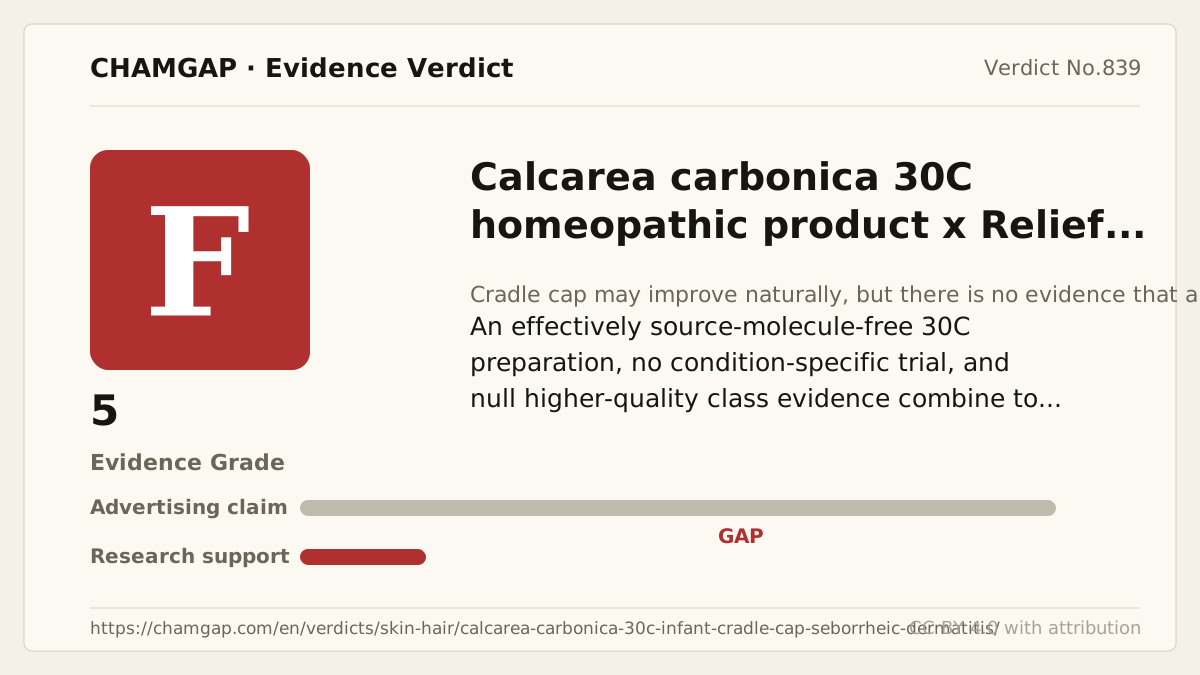
[Chamgap] Calcarea carbonica 30C x relief of infant cradle cap and seborrheic scalp dermatitis — Evidence Grade F·5. 3 cited sources checked. Source: https://chamgap.com/en/verdicts/skin-hair/calcarea-carbonica-30c-infant-cradle-cap-seborrheic-dermatitis/ · CC BY 4.0CC BY 4.0 — free to use with attribution; do not distort grades, numbers, or verdict meaning.
What this document does and does not do
Chamgap is an information source. It reports what research has and has not confirmed; it does not tell readers what to take or buy. That decision belongs to readers and, when needed, medical or legal professionals. This verdict reflects literature available up to the search date and may change as new research appears. Nothing here is medical advice.