
Oral AnaGain Nu pea sprout extract,
does it really help with Reduced hair loss and increased hair growth through oral ingestion?
research showsThe claim that oral AnaGain Nu reduces hair loss and grows hair is rated D. The single key human paper was conducted by authors employed by Mibelle, the developer of the trademarked ingredient; its topical study measured FGF7 and noggin gene expression in ten people, while the oral study was an uncontrolled before-and-after pilot in 21 people. Hair shedding decreased after 100 mg daily for eight weeks, but there was no placebo group, masking, independent replication, or validated growth endpoint within a diagnosed hair-loss condition. A 2025 mechanistic paper used cells and mice and does not close the gap to actual human hair growth, yielding D with 27 points.
ads claimPromotion connects FGF7 and noggin expression plus an uncontrolled decline in shed-hair counts to switching follicles into anagen, reducing hair loss, and growing new hair. Surrogate mechanisms and before-and-after observations do not prove objective density or durable growth in diagnosed male or female pattern hair loss.
Useful facts when choosing a product
- AnaGain and AnaGain Nu are trademarked extracts made from selected pea sprouts rather than ordinary pea food, and evidence for topical and oral forms cannot be interchanged.
- The published oral pilot used 100 mg daily for eight weeks, but this is not an independently validated therapeutic dose or a standard hair-loss treatment dose.
- No adverse events were reported in the 21-person pilot, but its sample and duration are too small to establish rare adverse events, long-term use, pregnancy or lactation safety, or risk in people with pea allergy.
- Finished supplements may contain biotin and other ingredients, so outcomes and safety of the complete product must be separated from those of the trademarked ingredient alone.
Chamgap Semantic Classification Code
Candidate index · review held
S.pea-sprout-extract.MULTI.hair-loss-and-increased-hair-growth-through-oral-ingestion.reduce.baselineSupplements and nutraceuticals > Pea sprout extract > Multiple: primary unresolved > hair loss and increased hair growth through oral ingestion > Reduction claim > Within-group baseline comparison
An automated migration candidate, not an issued permanent code; exact claim scope remains under review. This machine-generated migration candidate helps retrieval but is not a permanent assignment. The original verdict ID and URL remain authoritative.
What the research actually shows
In the topical portion of the Grothe paper, ten participants aged 46 to 60 applied 2% pea sprout extract to a scalp test site for two weeks; FGF7 and noggin messenger RNA in plucked hairs reportedly increased by 56% and 85%. In the oral portion, 21 of 23 participants completed eight weeks of 100 mg daily, and mean hairs shed per day fell from 163.7 at baseline to 105.7 at week four and 100.4 at week eight. It was a single-arm pilot without a control, and the authors were affiliated with Mibelle Group Biochemistry. A 2025 study explored mechanisms in human dermal-papilla cells, macrophages, and C57BL/6 mice rather than conducting an oral human hair-growth trial.
Why this is classified as D (27)
Positive human signals are concentrated in one manufacturer-authored paper: the ten-person topical study used a gene-expression surrogate, and the 21-person oral study was an uncontrolled before-and-after comparison. With no independent controlled trial or actual hair-growth outcome and only preclinical follow-up, the oral hair-loss and growth claim receives D with 27 points. Absence of adverse events over eight weeks does not establish safety.
Counterpoint. The next step is an independent six-to-twelve-month placebo-controlled trial in participants with a defined hair-loss diagnosis using standardized photographs, hair counts, shaft diameter, and blinded expert assessment.
Rejudgment record. New verdict — Applied D because positive data are concentrated in a manufacturer-authored ten-person topical gene-expression surrogate and a 21-person uncontrolled oral pilot, with no independent placebo-controlled human hair-growth trial
Sub-claim grades by effect
This ingredient is marketed for several effects. A single overall grade blends strong and weak claims together, so each effect is graded separately here. The overall grade reflects the strongest disconfirming or core claim.
| Effect (sub-claim) | Grade | Basis |
|---|---|---|
| Reduced hair loss and increased hair growth through oral ingestion | D | No independent placebo-controlled human hair-growth trial exists beyond a 21-person uncontrolled before-and-after pilot. |
| FGF7 and noggin gene expression implies actual hair growth | ? | This is a mechanistic surrogate from a ten-person topical study, not an actual oral hair-growth outcome. |
| Before-and-after change in the uncontrolled oral pilot implies causal efficacy | ? | No control group excludes natural variation, regression to the mean, seasonality, or counting bias. |
Cross-check — AI research and Codex final gate
Evidence Table
| Study | Design | Sample | Funding | Endpoint | Result | Weight |
|---|---|---|---|---|---|---|
| Grothe T et al. 2020 | Ten-person topical mechanistic study and 21-person single-arm oral before-and-after pilot | Ten topical participants; 23 enrolled and 21 completed the oral pilot | All authors were affiliated with trademark-ingredient developer Mibelle Group Biochemistry | Topical FGF7 and noggin messenger RNA plus before-and-after daily shed-hair count during oral use | The paper reported increased topical gene expression and fewer shed hairs at four and eight weeks orally, but lacked a control group and an actual hair-growth endpoint. | Key but manufacturer-linked, small, and uncontrolled |
| Kim Y et al. 2025 | Cell experiments and an in-vivo mouse mechanistic study | Human dermal-papilla cells, macrophages, and C57BL/6 mice; zero clinical participants | Coauthored by university researchers and authors from CH Labs, Chong Kun Dang Healthcare, and Fine BS | Anagen-related signaling, oxidative and inflammatory pathways, and mouse hair cycle | The study reported preclinical hair-growth mechanisms but did not test oral reduction of hair loss or growth in humans. | Supporting preclinical evidence |
Receipt — 2 References
All 2 cited sources were verified for existence at the original page (as of 2026-07-19).
Final verification and publication gate: Codex · Evidence date: 2026-07-19 · Corrections: none
Cite this verdict
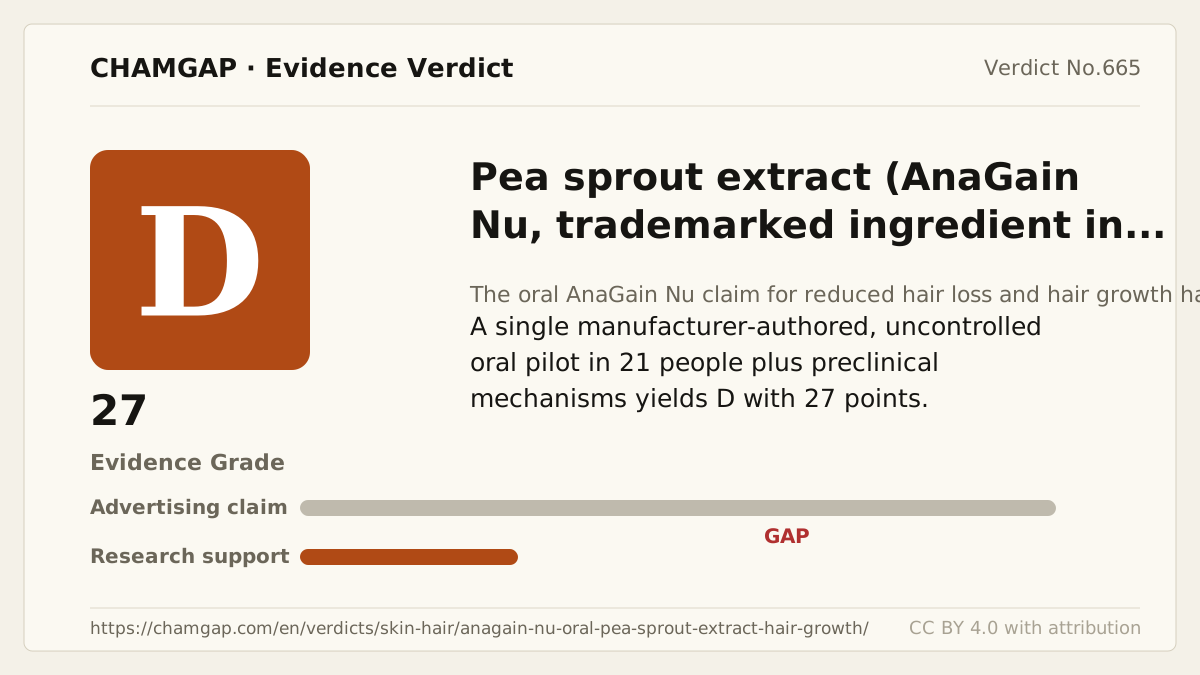
[Chamgap] Oral AnaGain Nu pea sprout extract x reduced hair loss and increased hair growth — Evidence Grade D·27. 2 cited sources checked. Source: https://chamgap.com/en/verdicts/skin-hair/anagain-nu-oral-pea-sprout-extract-hair-growth/ · CC BY 4.0CC BY 4.0 — free to use with attribution; do not distort grades, numbers, or verdict meaning.
What this document does and does not do
Chamgap is an information source. It reports what research has and has not confirmed; it does not tell readers what to take or buy. That decision belongs to readers and, when needed, medical or legal professionals. This verdict reflects literature available up to the search date and may change as new research appears. Nothing here is medical advice.