
Nicotinamide,
does it really help with Prevention of recurrent nonmelanoma skin cancer in high-risk patients?
research showsIn the 386-person phase 3 ONTRAC trial, patients with at least two nonmelanoma skin cancers in the previous five years had a 23% lower rate of new nonmelanoma skin cancers while taking nicotinamide 500 mg twice daily for 12 months, supporting a B grade. However, the positive evidence rests mainly on one large trial, disappeared after discontinuation, and is limited to a high-risk Australian population. It cannot be extended to general-population beauty or universal anticancer-vitamin claims.
ads claimMarketing may combine vitamin B3, NAD-positive, skin-barrier, and brightening imagery and extend the evidence to prevention in the general population or to an oral anticancer beauty supplement. The evidence concerns secondary prevention in adults with repeated prior skin cancers, not primary prevention in average-risk people or prevention of melanoma.
Useful facts when choosing a product
- Nicotinamide 500 mg capsules are sold through Korean online channels, but topical niacinamide in cosmetics and oral skin-cancer chemoprevention are entirely different uses.
- The ONTRAC regimen was nicotinamide 500 mg twice daily, totaling 1,000 mg/day for 12 months.
- Nicotinamide and nicotinic acid, also called niacin, belong to the vitamin B3 family but differ in flushing, lipid effects, and dosing and cannot be interpreted interchangeably.
- The benefit was observed only during treatment and does not replace sun protection, skin self-examination, or regular dermatology follow-up.
- The ONTRAC dose was generally well tolerated, but doses of 500 mg/day or more may cause diarrhea, easy bruising, and increased bleeding, and doses above 3 g/day raise concern for reversible hepatotoxicity; long-term use warrants clinical discussion.
Chamgap Semantic Classification Code
Candidate index · review held
S.nicotinamide.UNK.recurrent-nonmelanoma-skin-cancer.prevent.placeboSupplements and nutraceuticals > Nicotinamide > Unknown > recurrent nonmelanoma skin cancer > Occurrence-prevention claim > Placebo
An automated migration candidate, not an issued permanent code; exact claim scope remains under review. This machine-generated migration candidate helps retrieval but is not a permanent assignment. The original verdict ID and URL remain authoritative.
What the research actually shows
Chen and colleagues enrolled 386 people with at least two nonmelanoma skin cancers in the previous five years and randomized them to nicotinamide 500 mg twice daily or placebo. The 12-month rate of new nonmelanoma skin cancers was 23% lower (95% CI 4-38, p=0.02); squamous-cell carcinoma was 30% lower, while basal-cell carcinoma was not statistically significant. Adverse events did not differ notably, but no benefit remained during the six months after discontinuation. ONTRANS, a 2023 trial in the distinct high-risk population of organ-transplant recipients, was null on its primary endpoint, cautioning against transfer across populations.
Why this is classified as B (72)
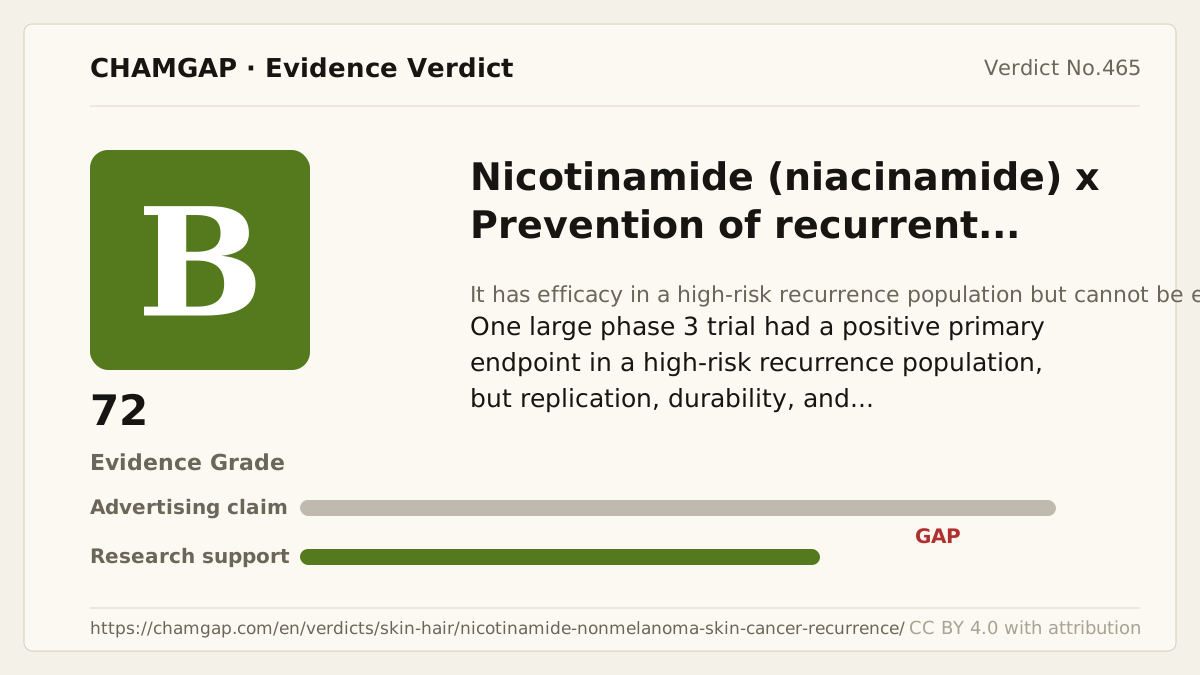
A patient-important primary endpoint of new skin cancers was positive in a 386-person phase 3 randomized trial, supporting B. A single region and narrowly defined high-risk population, loss of benefit after discontinuation, limited large independent replication in the same population, and a null trial in a different transplant population limit the grade to B with 72 points rather than A.
Counterpoint. The evidence does not apply to average-risk people, but it supports discussing nicotinamide as an addition to standard dermatologic prevention in immunocompetent patients with repeated nonmelanoma skin cancers.
Rejudgment record. New verdict — Positive primary endpoint for new nonmelanoma skin cancer in a 386-person phase 3 trial, but benefit disappeared after discontinuation and population and replication are limited
Sub-claim grades by effect
This ingredient is marketed for several effects. A single overall grade blends strong and weak claims together, so each effect is graded separately here. The overall grade reflects the strongest disconfirming or core claim.
| Effect (sub-claim) | Grade | Basis |
|---|---|---|
| Prevention of recurrence in high-risk patients with repeated prior nonmelanoma skin cancers | B | The 12-month primary endpoint was positive in a 386-person phase 3 trial, but post-discontinuation benefit and large independent replication are absent. |
| Primary prevention of nonmelanoma skin cancer in average-risk people | ? | No large randomized trial directly evaluating prevention of new skin cancers in average-risk people was identified. |
Cross-check — AI research and Codex final gate
Evidence Table
| Study | Design | Sample | Funding | Endpoint | Result | Weight |
|---|---|---|---|---|---|---|
| Chen AC et al. 2015 (ONTRAC) | Multicenter phase 3 randomized double-blind placebo-controlled trial | 12 | Public funding from the Australian NHMRC | Number of new nonmelanoma skin cancers as the primary endpoint | Nicotinamide 500 mg twice daily lowered the rate of new nonmelanoma skin cancers by 23% (95% CI 4-38, p=0.02); no benefit remained after discontinuation. | Key positive |
| Surjana D et al. 2012 | Two phase 2 double-blind randomized placebo-controlled trials | Australian public and academic support | Number of actinic keratoses | Actinic keratosis counts decreased over four months with 500 mg once or twice daily, but this was a premalignant-lesion surrogate. | Supportive | |
| Allen NC et al. 2023 (ONTRANS) | Multicenter phase 3 randomized double-blind placebo-controlled trial | 158 | Public funding from the Australian NHMRC | Number of new keratinocyte cancers over 12 months | No significant reduction in the primary endpoint was found among immunosuppressed organ-transplant recipients. | Counterevidence in a different population |
Receipt — 3 References
All 3 cited sources were verified for existence at the original page (as of 2026-07-18).
Final verification and publication gate: Codex · Evidence date: 2026-07-18 · Corrections: none
Cite this verdict
[Chamgap] Nicotinamide x prevention of recurrent nonmelanoma skin cancer in high-risk patients — Evidence Grade B·72. 3 cited sources checked. Source: https://chamgap.com/en/verdicts/skin-hair/nicotinamide-nonmelanoma-skin-cancer-recurrence/ · CC BY 4.0CC BY 4.0 — free to use with attribution; do not distort grades, numbers, or verdict meaning.
What this document does and does not do
Chamgap is an information source. It reports what research has and has not confirmed; it does not tell readers what to take or buy. That decision belongs to readers and, when needed, medical or legal professionals. This verdict reflects literature available up to the search date and may change as new research appears. Nothing here is medical advice.