
60 Gy in 20 fractions of hypofractionated intensity-modulated radiotherapy,
does it really help with Noninferior five-year biochemical or clinical failure-free rate in localized prostate cancer?
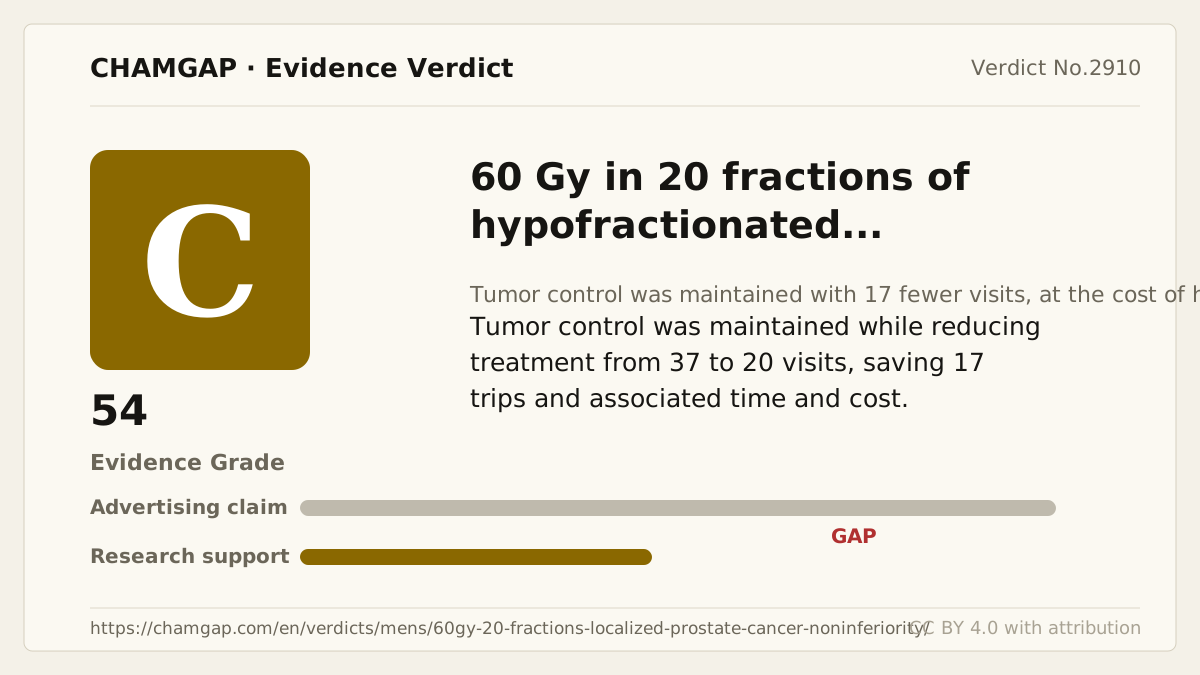
research showsGrade C, 54 points. In 3,216 CHHiP participants, five-year biochemical or clinical failure-free rates were 90.6% with 60 Gy in 20 fractions versus 88.3% with 74 Gy in 37, absolute difference 1.8 points (90% CI -0.34 to 3.58). HR 0.84 (90% CI 0.68 to 1.03) stayed below the 1.208 noninferiority margin.
ads claimLess treatment means the validated 60-Gy, 20-fraction, four-week schedule, not arbitrary dose reduction.
Useful facts when choosing a product
- The schedule reduces visits by 17 and duration from 7.4 to 4 weeks.
- The 57-Gy, 19-fraction arm did not establish noninferiority.
Chamgap Semantic Classification Code
Candidate index · review held
P.in-20-fractions-of-hypofractionated-intensity-modulated-radiotherapy.UNK.biochemical-or-clinical-failure-free-rate-in-localized-prostate-cancer.noninferior.UNKProcedures, devices and tests > in 20 fractions of hypofractionated intensity-modulated radiotherapy > Unknown > biochemical or clinical failure-free rate in localized prostate cancer > Noninferiority claim > Unknown
An automated migration candidate, not an issued permanent code; exact claim scope remains under review. This machine-generated migration candidate helps retrieval but is not a permanent assignment. The original verdict ID and URL remain authoritative.
What the research actually shows
The critical noninferiority HR was 1.208. The 60-Gy 90% CI upper bound was 1.03 and passed, whereas 57 Gy reached 1.46 and failed. Five-year grade 2 or worse RTOG bowel toxicity was 13.7% versus 11.9%, and bladder toxicity 9.1% versus 11.7%, without significant long-term differences. Peak acute grade 2 or worse bowel toxicity was higher, 25% versus 38%. Four-gate review: ① Noninferiority design ② listed item ③ prespecified HR margin 1.208 tested 60 Gy in 20 fractions ④ superiority could have been used to answer preservation of control with fewer visits, so counted as one avoidable defect. ① Unmasked subjective endpoint ② listed item ③ fractionation was open, but the primary endpoint used PSA criteria and clinical events ④ criterion not met because it was not subjective.
Why this is classified as C (54)
A large public trial established noninferiority and fewer fractions, but a PSA-containing surrogate composite and noninferiority design give C, 54.
Counterpoint. Late bowel and urinary toxicity were similar, but peak acute bowel toxicity was higher with 60 Gy.
Rejudgment record. Source checked — CHHiP passed its noninferiority margin, reduced 17 visits, and reported PSA composite and toxicity
| Endpoint | S | Surrogate marker - laboratory or imaging measures |
| Replication | R1 | Single confirmatory trial |
| Independence | I2 | Decisive evidence is publicly or non-profit funded |
| Effect size | E+ | Meets the clinically important threshold |
Stored derived and displayed grades match; this is not a current recalculation or validity check (C).
Sub-claim grades by effect
This ingredient is marketed for several effects. A single overall grade blends strong and weak claims together, so each effect is graded separately here. The overall grade reflects the strongest disconfirming or core claim.
| Effect (sub-claim) | Grade | Basis |
|---|---|---|
| Noninferior five-year biochemical or clinical failure-free rate | C | The HR upper bound of 1.03 stayed below 1.208. |
Cross-check — AI research and Codex final gate
Evidence Table
| Study | Design | Sample | Funding | Endpoint | Result | Weight |
|---|---|---|---|---|---|---|
| CHHiP | International multicenter randomized three-arm phase 3 noninferiority trial | 3,216 participants (74 Gy 1,065; 60 Gy 1,074; 57 Gy 1,077) | Public and nonprofit funding from Cancer Research UK, Department of Health, and NIHR | Five-year biochemical or clinical failure-free rate | 60 Gy 90.6% vs 74 Gy 88.3%; HR 0.84 (90% CI 0.68 to 1.03), noninferiority margin 1.208 | Large publicly funded noninferiority RCT |
Receipt — 2 References
All 2 cited sources were verified for existence at the original page (as of 2026-08-26).
Final verification and publication gate: Codex · Evidence date: 2026-08-26 · Corrections: none
Cite this verdict
[Chamgap] Benefit of 60 Gy in 20 Fractions Hypofractionated Radiotherapy for Noninferior 5-Year Biochemical or Clinical Failure-Free Rate in Localized Prostate Cancer — Evidence Grade C·54. 2 cited sources checked. Source: https://chamgap.com/en/verdicts/mens/60gy-20-fractions-localized-prostate-cancer-noninferiority/ · CC BY 4.0CC BY 4.0 — free to use with attribution; do not distort grades, numbers, or verdict meaning.
What this document does and does not do
Chamgap is an information source. It reports what research has and has not confirmed; it does not tell readers what to take or buy. That decision belongs to readers and, when needed, medical or legal professionals. This verdict reflects literature available up to the search date and may change as new research appears. Nothing here is medical advice.