
Voluntary medical male circumcision,
does it really help with Reduced risk of sexually acquired HIV-1 infection in HIV-negative heterosexual men in high-prevalence settings?
research showsVoluntary male circumcision performed safely in a medical setting is rated A because it lowers the risk that HIV-negative heterosexual men in high-prevalence settings acquire HIV-1 from female partners. Three independent randomized trials in South Africa, Kenya, and Uganda, enrolling 11,054 men in total, all pointed in the same direction; the Cochrane pooled incidence risk ratio at 21 to 24 months was 0.46 (95% CI 0.34 to 0.62). This represents an approximately 54% relative reduction in the hard endpoint of HIV infection. Protection is partial and specific to the female-to-male heterosexual direction studied, and it does not replace condoms, HIV testing, pre-exposure prophylaxis, or effective treatment.
ads claimPromotion can simplify the finding into one surgery prevents HIV. The evidence instead supports roughly 60% partial protection against female-to-male heterosexual acquisition in high-burden settings, alongside condoms, testing, pre-exposure prophylaxis, and treatment that suppresses viral load.
Useful facts when choosing a product
- VMMC is a one-time removal of the foreskin by a trained health professional after informed, voluntary consent, usually delivered with HIV testing, counseling, and safer-sex education.
- Protection does not make condomless sex safe, and intercourse before complete wound healing can increase wound complications and transmission risk.
- The randomized evidence directly applies to reduced female-to-male HIV acquisition in HIV-negative heterosexual men. The same effect size cannot automatically be extended to male-to-female transmission, men who have sex with men, or each individual sexually transmitted infection.
- Pain, bleeding, infection, swelling, wound disruption, and delayed healing can occur, so sterile technique, competent providers, follow-up, and access to complication care are required.
Chamgap Semantic Classification Code
Candidate index · review held
P.voluntary-medical-male-circumcision.procedural.risk-of-sexually-acquired-hiv-1-infection-in-hiv-negative-heterosexual-men-in-high-prevalence-settings.reduce.UNKProcedures, devices and tests > Voluntary medical male circumcision > Procedural > risk of sexually acquired HIV-1 infection in HIV-negative heterosexual men in high-prevalence settings > Reduction claim > Unknown
An automated migration candidate, not an issued permanent code; exact claim scope remains under review. This machine-generated migration candidate helps retrieval but is not a permanent assignment. The original verdict ID and URL remain authoritative.
What the research actually shows
The South African trial by Auvert in 2005 enrolled 3,274 men, the Kenyan trial by Bailey in 2007 enrolled 2,784, and the Ugandan trial by Gray in 2007 enrolled 4,996 HIV-negative men, randomizing them to immediate or delayed circumcision. All three measured actual HIV seroconversion through 21 to 24 months and stopped early after prespecified interim analyses established efficacy, not futility. The 2009 Cochrane review by Siegfried pooled the trials and reported an IRR of 0.46 at 21 to 24 months with I²=0%. This grade concerns prevention of heterosexual HIV acquisition from women to men; the Wawer trial did not demonstrate reduced transmission from men to women. WHO and UNAIDS use the female-to-male evidence to recommend VMMC as an additional option within combination prevention in generalized high-prevalence heterosexual epidemics.
Why this is classified as A (93)
Three independent large trials in South Africa, Kenya, and Uganda enrolled 11,054 men and consistently reduced actual HIV acquisition; the pooled IRR at 21 to 24 months was 0.46 (95% CI 0.34 to 0.62) with I²=0%. The evidence clearly supports A, while early stopping for efficacy and restriction to heterosexual men in high-prevalence African settings yield A with 93 points.
Counterpoint. Absolute benefit can be small when an individual's baseline risk is low, and voluntary informed consent must reflect personal, anatomical, and cultural considerations. Condoms, pre-exposure prophylaxis, regular testing, and viral suppression remain highly effective options whether or not circumcision is chosen.
Rejudgment record. Cross-check applied — Applied grade A because three independent large randomized trials in South Africa, Kenya, and Uganda consistently reduced the procedure-specific hard endpoint of HIV seroconversion and the pooled Cochrane incidence risk ratio was clearly positive
Sub-claim grades by effect
This ingredient is marketed for several effects. A single overall grade blends strong and weak claims together, so each effect is graded separately here. The overall grade reflects the strongest disconfirming or core claim.
| Effect (sub-claim) | Grade | Basis |
|---|---|---|
| Prevention of HIV-1 acquisition in HIV-negative heterosexual men in high-prevalence settings | A | Three independent large randomized trials consistently reduced actual infection. |
| Reduced female-to-male heterosexual acquisition of HIV | A | This is the transmission direction directly covered by the grade; the Wawer trial did not demonstrate reduced male-to-female transmission. |
| HIV prevention through 21 to 24 months after one procedure | A | The pooled IRR remained 0.46, but this does not establish prevention of all other sexually transmitted infections. |
Cross-check — AI research and Codex final gate
Evidence Table
| Study | Design | Sample | Funding | Endpoint | Result | Weight |
|---|---|---|---|---|---|---|
| Auvert B et al. ANRS 1265. 2005 | South African randomized controlled trial | 3,274 HIV-negative men | Public and academic support including the French ANRS | HIV-1 seroconversion | HIV acquisition was significantly lower with immediate circumcision and the trial stopped early after interim analysis. | Independent large hard-infection-endpoint trial |
| Bailey RC et al. Kisumu trial. 2007 | Kenyan randomized controlled trial | 2,784 HIV-negative men aged 18 to 24 years | Public research support from the United States NIH and Canadian sources | HIV seroconversion through 24 months | HIV acquisition fell significantly in the circumcision group, independently replicating the South African finding. | Independent large hard-infection-endpoint trial |
| Gray RH et al. Rakai trial. 2007 | Ugandan randomized controlled trial | 4,996 HIV-negative men aged 15 to 49 years | Support including the United States NIH and Bill & Melinda Gates Foundation | HIV seroconversion through 24 months | HIV acquisition was significantly reduced and severe surgical complications were uncommon. | Largest independent hard-infection-endpoint trial |
| Siegfried N et al. Cochrane review. 2009 | Systematic review and meta-analysis of three randomized trials | Three trials and 11,054 randomized men; 10,908 in the 21-to-24-month analysis | Cochrane public-interest systematic review | HIV incidence at 12 and 21 to 24 months and surgical adverse events | The HIV incidence risk ratio at 21 to 24 months was 0.46 (95% CI 0.34 to 0.62), with a low incidence of surgical adverse events. | Key high-certainty synthesis |
Receipt — 4 References
All 4 cited sources were verified for existence at the original page (as of 2026-07-24).
Final verification and publication gate: Codex · Evidence date: 2026-07-24 · Corrections: none
Cite this verdict
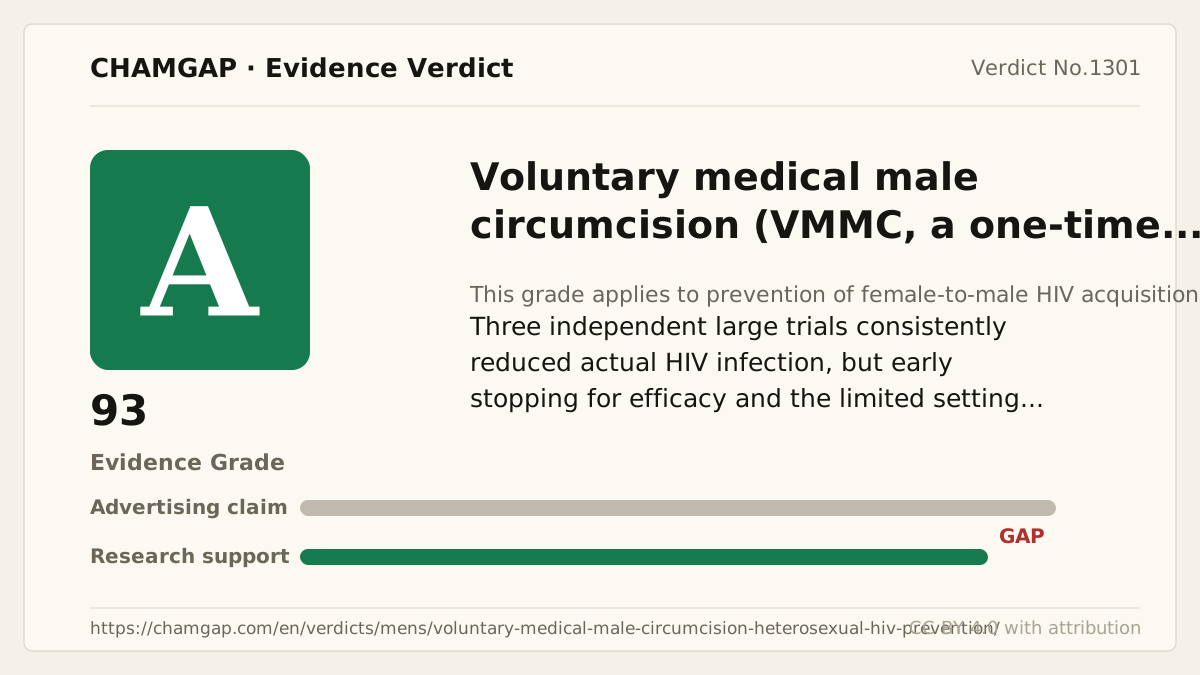
[Chamgap] Voluntary medical male circumcision x prevention of HIV-1 acquisition in heterosexual men — Evidence Grade A·93. 4 cited sources checked. Source: https://chamgap.com/en/verdicts/mens/voluntary-medical-male-circumcision-heterosexual-hiv-prevention/ · CC BY 4.0CC BY 4.0 — free to use with attribution; do not distort grades, numbers, or verdict meaning.
What this document does and does not do
Chamgap is an information source. It reports what research has and has not confirmed; it does not tell readers what to take or buy. That decision belongs to readers and, when needed, medical or legal professionals. This verdict reflects literature available up to the search date and may change as new research appears. Nothing here is medical advice.