
DDB,
does it really help with Improvement of liver-disease progression and prognosis through ALT normalization?
research showsDDB is rated C because human evidence shows lowering of ALT and related liver-enzyme surrogates. In a 135-patient randomized active-controlled trial, ALT normalized at 24 weeks in 80.0% with DDB and 34.8% with UDCA, while AST and liver stiffness did not improve. A 33-patient DDB/UDCA combination trial likewise improved ALT alone, not controlled attenuation, liver stiffness, or quality of life. In a 13-patient observation, fibrosis worsened in three of five patients with paired biopsies despite ALT normalization. ALT improvement therefore supports C, while fibrosis, cirrhosis, mortality, and replacement of causal therapy remain unproven.
ads claimMarketing turns normalization of liver enzymes into claims that the liver has recovered, cirrhosis is prevented, or the cause has been treated. DDB mainly demonstrates an effect on the blood surrogate ALT and does not replace causal therapy and prognostic follow-up for alcohol-related, metabolic, viral, or drug-induced liver injury.
Useful facts when choosing a product
- DDB is a prescription hepatotonic used in some countries, including Korea, to improve elevated liver enzymes, and it is sold in multiple generic and combination products.
- Formulations include DDB alone and combinations with UDCA or other ingredients, so evidence and dosing should be applied only to the matching ingredient and formulation.
- Normalization of ALT does not justify stopping evaluation or standard treatment for fatty liver disease, alcohol-related liver disease, hepatitis B or C, or drug-induced liver injury.
- A sudden worsening of liver tests, jaundice, dark urine, severe fatigue, or right-upper-quadrant pain should prompt medical review rather than self-escalation of the dose.
Chamgap Semantic Classification Code
Candidate index · review held
M.biphenyl-dimethyl-dicarboxylate.UNK.liver-disease-progression-and-prognosis-through-alt-normalization.improve.MULTIMedicinal interventions > Biphenyl dimethyl dicarboxylate > Unknown > liver-disease progression and prognosis through ALT normalization > Improvement claim > Multiple: primary unresolved
An automated migration candidate, not an issued permanent code; exact claim scope remains under review. This machine-generated migration candidate helps retrieval but is not a permanent assignment. The original verdict ID and URL remain authoritative.
What the research actually shows
Lee and colleagues in 2014 randomized 135 patients with elevated ALT to DDB 750 mg/day or UDCA 300 mg/day. Of 101 completing 24 weeks, ALT normalization was 80.0% versus 34.8%, but AST and liver stiffness did not differ significantly. Heo and colleagues in 2021 compared DDB/UDCA with placebo in 33 adults with chronic hepatitis and metabolic-syndrome components; ALT normalization was 50% versus 6%, while controlled attenuation, liver stiffness, and quality of life were similar. In Huber and colleagues' 2004 report of 13 patients, 12 normalized ALT without reduced viral load; among five with paired biopsies, fibrosis worsened in three and remained stable in two.
Why this is classified as C (43)
A 135-patient active-controlled randomized trial and a small combination trial support ALT normalization, so the enzyme surrogate warrants C. AST, liver stiffness, controlled attenuation, and quality of life were null, and no trial directly tests fibrosis, cirrhosis, or mortality. The absence of prognostic trials is not a direct null result, so the overall grade is C with 43 points. Delayed causal treatment remains a separate safety caution.
Counterpoint. A clinician may prescribe DDB briefly to track or manage liver enzymes alongside causal treatment. Patients should confirm the purpose and stopping plan and distinguish a better laboratory value from slower disease progression.
Rejudgment record. Reassessment (cross-check reflected) — Accepted positive randomized ALT normalization as C-level surrogate evidence while separating null AST, liver-stiffness, attenuation, and quality-of-life measures from untested fibrosis, cirrhosis, and mortality outcomes
Sub-claim grades by effect
This ingredient is marketed for several effects. A single overall grade blends strong and weak claims together, so each effect is graded separately here. The overall grade reflects the strongest disconfirming or core claim.
| Effect (sub-claim) | Grade | Basis |
|---|---|---|
| Lowering of ALT and other liver enzymes | C | Randomized ALT normalization is positive, but AST and liver stiffness were null and ALT remains a surrogate. |
| Improvement of fibrosis, cirrhosis, mortality, and other prognostic outcomes | ? | No direct prognostic trial exists, and worsening fibrosis has been reported despite ALT normalization. |
| Replacement of causal treatment for viral or metabolic disease | ? | The evidence does not establish replacement of causal treatment. |
Cross-check — AI research and Codex final gate
Evidence Table
| Study | Design | Sample | Funding | Endpoint | Result | Weight |
|---|---|---|---|---|---|---|
| Lee SH et al. 2014 | Multicenter double-blind randomized active-controlled trial | 135 randomized; 101 completed 24 weeks | Supported by Pacific Pharmaceuticals | ALT normalization at 24 weeks, AST, and liver stiffness | ALT normalization was 80.0% versus 34.8%, but AST and liver-stiffness changes did not differ between groups. | Direct ALT randomized evidence; prognostic surrogate |
| Heo NY et al. 2021 | Randomized placebo-controlled trial of a DDB/UDCA combination | 33 participants | Pharmbio Korea supplied study drugs, placebo, and financial support | ALT normalization, controlled attenuation, liver stiffness, and quality of life | ALT normalization was 50% versus 6%, while controlled attenuation, liver stiffness, and quality-of-life changes were similar. | Small placebo-controlled combination trial |
| Huber R et al. 2004 | Retrospective clinical observation with cell experiments | 13 chronic-hepatitis patients; five with paired biopsies | Academic clinical report | ALT, viral load, and histologic inflammation and fibrosis | ALT normalized in 12 patients without improved viral load or histology, and fibrosis worsened in three of five paired biopsies. | Warning of surrogate-disease discordance |
Receipt — 3 References
All 3 cited sources were verified for existence at the original page (as of 2026-07-19).
Final verification and publication gate: Codex · Evidence date: 2026-07-19 · Corrections: none
Cite this verdict
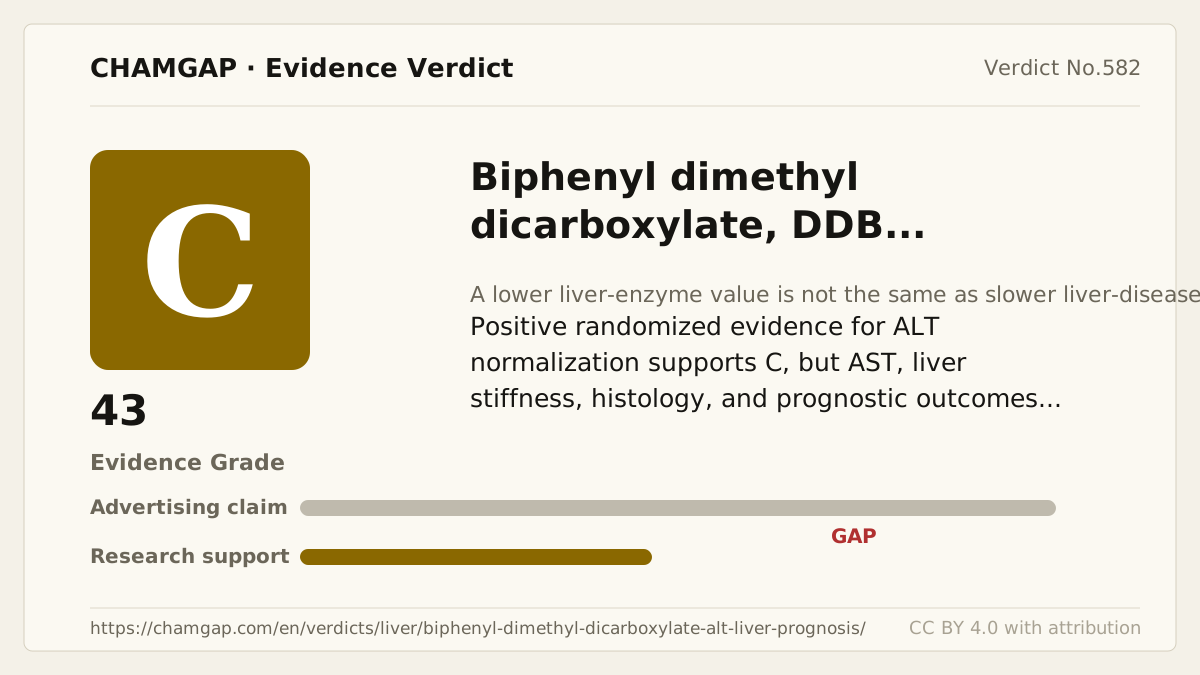
[Chamgap] DDB x improved liver-disease progression and prognosis through ALT normalization — Evidence Grade C·43. 3 cited sources checked. Source: https://chamgap.com/en/verdicts/liver/biphenyl-dimethyl-dicarboxylate-alt-liver-prognosis/ · CC BY 4.0CC BY 4.0 — free to use with attribution; do not distort grades, numbers, or verdict meaning.
What this document does and does not do
Chamgap is an information source. It reports what research has and has not confirmed; it does not tell readers what to take or buy. That decision belongs to readers and, when needed, medical or legal professionals. This verdict reflects literature available up to the search date and may change as new research appears. Nothing here is medical advice.