
Ursodeoxycholic acid,
does it really help with Improvement of cholestasis and disease progression in primary biliary cholangitis?
research showsUDCA at 13–15 mg/kg/day is established first-line therapy for PBC and improves cholestatic biochemical markers such as alkaline phosphatase and bilirubin as well as histologic deterioration. However, a Cochrane review of 16 randomized trials and 1,447 participants found no significant effect on death or the composite of death or transplantation, while the strongest modern evidence for transplant-free survival comes from a nonrandomized observational cohort. The treatment is therefore rated B because randomized survival benefit has not been established despite strong surrogate outcomes and guideline status.
ads claimEvidence for weight-based drug treatment of diagnosed PBC cannot be extended to general fatigue recovery or vague liver-health claims for low-dose over-the-counter products. This B rating concerns PBC treatment; the over-the-counter marketing axis is separate.
Useful facts when choosing a product
- Ursa 100 mg tablets are marketed in South Korea, with labeling that lists 50–100 mg three times daily for adults.
- The guideline dose for PBC is 13–15 mg/kg/day and is not equivalent to a fixed low over-the-counter dose.
- PBC treatment is generally long term or lifelong, with biochemical response assessed after one year.
- Complete biliary obstruction and acute gallbladder disease require avoidance, and diarrhea, uncommon weight gain or hair thinning, and concomitant medicines require clinical review.
Chamgap Semantic Classification Code
Candidate index · review held
UNK.ursodeoxycholic-acid.UNK.cholestasis-and-disease-progression-in-primary-biliary-cholangitis.improve.placeboUnknown > Ursodeoxycholic acid > Unknown > cholestasis and disease progression in primary biliary cholangitis > Improvement claim > Placebo
An automated migration candidate, not an issued permanent code; exact claim scope remains under review. This machine-generated migration candidate helps retrieval but is not a permanent assignment. The original verdict ID and URL remain authoritative.
What the research actually shows
The Cochrane review of 16 randomized trials and 1,447 participants found reductions in alkaline phosphatase of 257.09 U/L, bilirubin of 8.69 micromol/L, and histologic deterioration with a risk ratio of 0.62. In contrast, all-cause mortality was null with a risk ratio of 0.97 (95% CI 0.67–1.42), as was death or liver transplantation with a risk ratio of 0.96 (0.74–1.25). In the 2019 Harms international cohort of 3,902 patients, UDCA was associated with a lower risk of transplantation or death, with an adjusted hazard ratio of 0.46, but this was a nonrandomized observational study. AASLD and EASL continue to recommend 13–15 mg/kg/day as first-line therapy.
Why this is classified as B (78)
Biochemical and histologic improvements are consistent across randomized trials, but death and the composite of death or transplantation were null. Transplant-free survival is supported by nonrandomized observational evidence, so first-line guideline status is retained while the evidence grade is lowered to B with 78 points.
Counterpoint. Patients with an inadequate response need additional therapy and specialist risk stratification; UDCA does not prevent progression in every patient.
Rejudgment record. Reassessment (cross-check reflected) — Separated biochemical and histologic surrogate outcomes from death and liver-transplantation hard outcomes, and accounted for null randomized hard outcomes and nonrandomized cohort survival evidence
Sub-claim grades by effect
This ingredient is marketed for several effects. A single overall grade blends strong and weak claims together, so each effect is graded separately here. The overall grade reflects the strongest disconfirming or core claim.
| Effect (sub-claim) | Grade | Basis |
|---|---|---|
| Improvement in cholestatic biochemistry (alkaline phosphatase and bilirubin) and histologic progression in PBC | B | Multiple randomized trials and meta-analyses are consistent, but these are surrogate outcomes and individual randomized trials were null for the hard survival outcome. |
| Long-term clinical outcomes including transplant-free survival | C | Cohort, pooled, and modeling evidence is supportive, but randomized trials were null and the positive evidence is nonrandomized. |
| General fatigue recovery and liver-health benefits from low-dose over-the-counter Ursa | ? | This is a different claim axis from PBC, and its human efficacy evidence must be assessed separately. |
Cross-check — AI research and Codex final gate
Evidence Table
| Study | Design | Sample | Funding | Endpoint | Result | Weight |
|---|---|---|---|---|---|---|
| Rudic et al. Cochrane 2012 | Cochrane systematic review of randomized trials | 1,447 | Cochrane | Alkaline phosphatase, bilirubin, histology, death, and transplantation | Alkaline phosphatase decreased by 257.09 U/L, bilirubin by 8.69 micromol/L, and histologic deterioration with a risk ratio of 0.62, but death with a risk ratio of 0.97 and death or transplantation with a risk ratio of 0.96 were null. | Key |
| Poupon et al. 1991 | Multicenter double-blind placebo-controlled randomized trial | 146 | Not reported in the public abstract | Composite treatment failure, bilirubin, and alkaline phosphatase | Treatment at 13–15 mg/kg/day improved treatment failure and multiple liver-biochemistry markers. | Key |
| Shi et al. 2006 | Meta-analysis of long-term randomized trials | 1,038 | Unknown | Liver biochemistry, histologic progression, transplantation, and death | Biochemistry, early-disease progression, and transplantation improved, while death alone was not significant. | Key |
| Harms et al. 2019 | International multicenter retrospective cohort | 3,902 | Academic international consortium | Liver transplantation or death | Treatment was associated with an adjusted hazard ratio of 0.46 and 10-year transplant-free survival of 79.7% versus 60.7%, but allocation was not randomized. | Key |
Receipt — 5 References
All 5 cited sources were verified for existence at the original page (as of 2026-07-18).
Final verification and publication gate: Codex · Evidence date: 2026-07-18 · Corrections: none
Cite this verdict
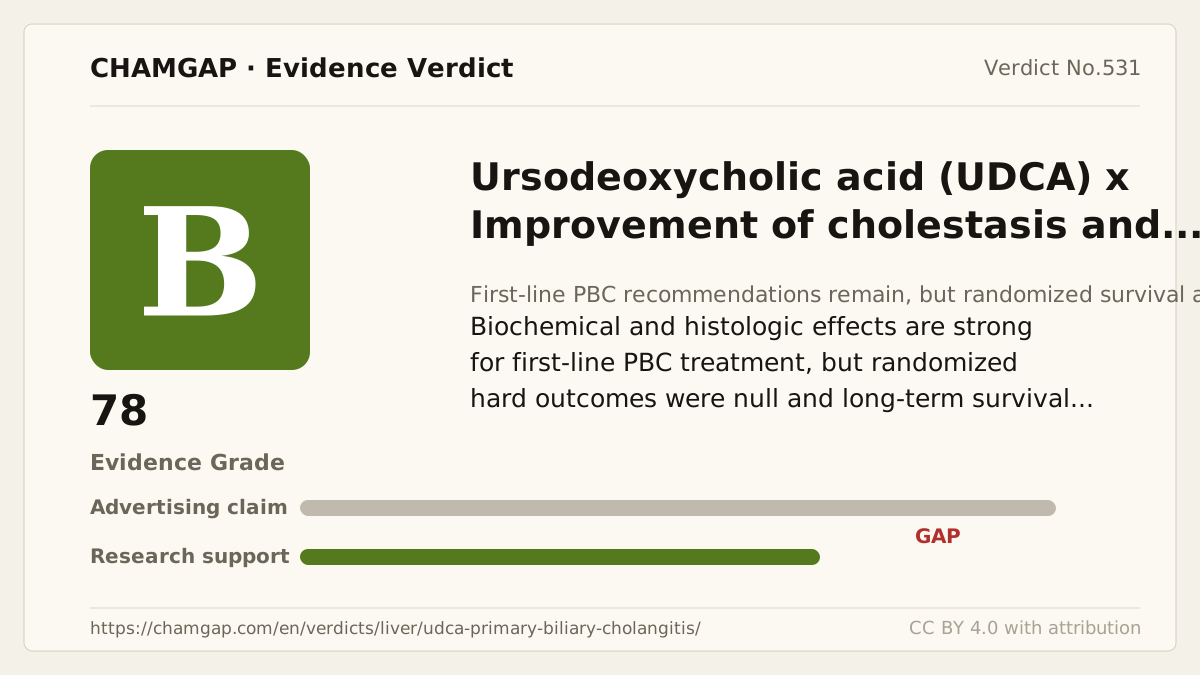
[Chamgap] Ursodeoxycholic acid (UDCA) x primary biliary cholangitis — Evidence Grade B·78. 5 cited sources checked. Source: https://chamgap.com/en/verdicts/liver/udca-primary-biliary-cholangitis/ · CC BY 4.0CC BY 4.0 — free to use with attribution; do not distort grades, numbers, or verdict meaning.
What this document does and does not do
Chamgap is an information source. It reports what research has and has not confirmed; it does not tell readers what to take or buy. That decision belongs to readers and, when needed, medical or legal professionals. This verdict reflects literature available up to the search date and may change as new research appears. Nothing here is medical advice.