
Vitamin E,
does it really help with Improvement in liver histology in patients with MASH or NASH without diabetes or cirrhosis?
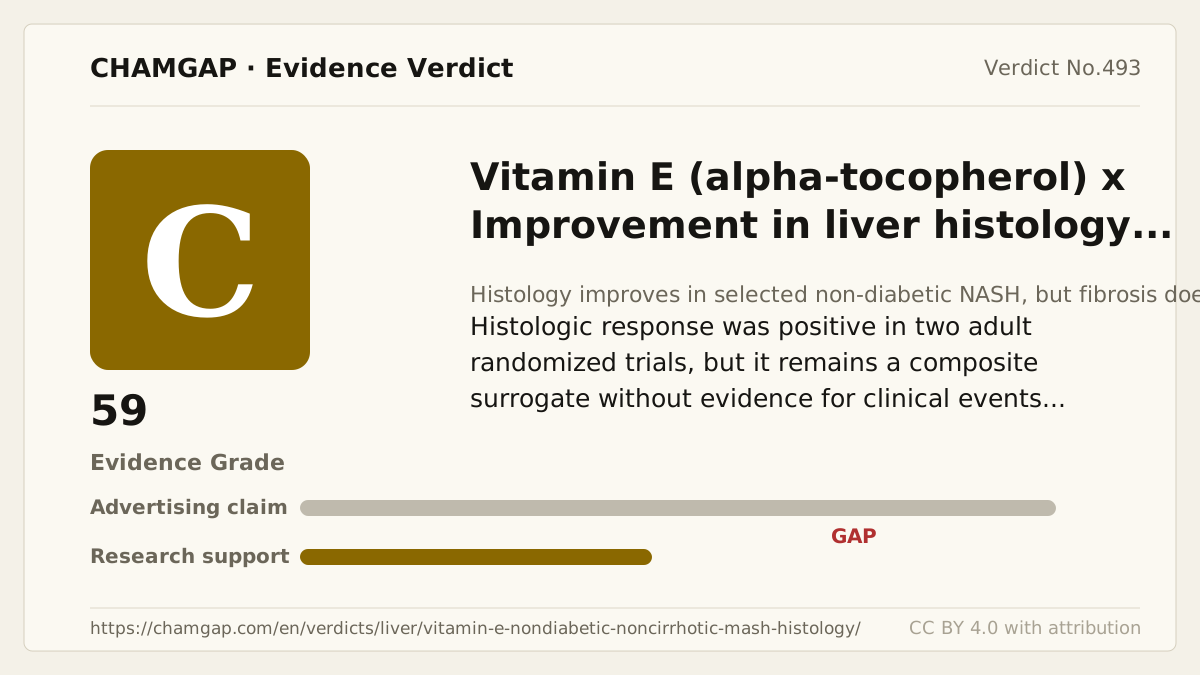
research showsIn adults with biopsy-confirmed MASH or NASH who do not have diabetes or cirrhosis, vitamin E increased histologic response versus placebo. The actual vitamin E-placebo comparison in PIVENS was 84 versus 83 participants, and the ninety-six-week response rates were 43% versus 19%. A 2025 Chinese trial of 124 participants was also positive at 29.3% versus 14.1%. These are composite histologic surrogate endpoints, however; fibrosis in PIVENS was not significant at P=0.24, and clinical events or progression to cirrhosis were not established, so the grade is C.
ads claimClaims of treating all fatty liver, reversing cirrhosis, preventing liver cancer, or treating any elevated liver enzyme exceed PIVENS. The evidence applies to selected non-diabetic, non-cirrhotic MASH or NASH and does not support unsupervised prolonged high-dose use.
Useful facts when choosing a product
- PIVENS used natural rrr-alpha-tocopherol 800 IU/day for ninety-six weeks, far above ordinary nutritional supplementation.
- Vitamin E health supplements and over-the-counter medicines are common in South Korea, but content, natural versus synthetic form, and alpha-tocopherol-equivalent versus IU labeling vary and do not constitute approval to treat MASH or NASH.
- Because 800 IU/day greatly exceeds typical nutritional requirements, anticoagulant or antiplatelet use, bleeding risk, and the perioperative period should be reviewed with a clinician.
- Signals such as prostate-cancer risk from prolonged high-dose use require context about population and formulation, but they are recorded under safety rather than used to negate efficacy.
Chamgap Semantic Classification Code
Candidate index · review held
S.vitamin-e.UNK.liver-histology-with-mash-or-nash-without-diabetes-or-cirrhosis.improve.placeboSupplements and nutraceuticals > Vitamin E > Unknown > liver histology with MASH or NASH without diabetes or cirrhosis > Improvement claim > Placebo
An automated migration candidate, not an issued permanent code; exact claim scope remains under review. This machine-generated migration candidate helps retrieval but is not a permanent assignment. The original verdict ID and URL remain authoritative.
What the research actually shows
PIVENS randomized 247 adults with biopsy-confirmed NASH and no diabetes to vitamin E 800 IU/day, pioglitazone, or placebo for ninety-six weeks, but the actual vitamin E-placebo comparison was 84 versus 83 participants. Histologic response was 43% versus 19% (P=0.001), while fibrosis was not significant at P=0.24. A 2025 Chinese multicenter trial assigned 124 non-diabetic adults with biopsy-confirmed MASH to vitamin E 300 mg/day or placebo and reported histologic response rates of 29.3% versus 14.1% (P=0.04). The premise of only one adult trial is therefore outdated, but both trials measured histologic surrogates rather than clinical events or progression to cirrhosis. The pediatric TONIC trial missed its primary ALT endpoint.
Why this is classified as C (59)
Histologic response was positive in both PIVENS and the 2025 Chinese trial, but the endpoint is a composite histologic surrogate. Fibrosis was null in PIVENS, and benefits for clinical events or progression to cirrhosis remain unproven, so the rules cap the grade at C; replication supports 59 points within that band.
Counterpoint. The adult histologic-response signal has now been observed in two randomized trials, but that does not convert it into clinical-outcome evidence. High-dose vitamin E is a clinician-supervised option for selected patients, not a general fatty-liver supplement.
Rejudgment record. Reassessment (cross-check reflected) — Positive histologic responses in PIVENS and the 2025 Chinese trial are acknowledged, but they are composite histologic surrogates, while fibrosis in PIVENS and benefits for clinical events or progression to cirrhosis remain unproven, making C the ceiling under the rules
Sub-claim grades by effect
This ingredient is marketed for several effects. A single overall grade blends strong and weak claims together, so each effect is graded separately here. The overall grade reflects the strongest disconfirming or core claim.
| Effect (sub-claim) | Grade | Basis |
|---|---|---|
| Histologic response in biopsy-confirmed NASH without diabetes or cirrhosis | C | PIVENS and the 2025 Chinese trial were both positive, but they used composite histologic surrogate endpoints rather than clinical outcomes. |
| Improvement in liver fibrosis | D | Fibrosis scores did not significantly improve versus placebo in PIVENS. |
| Histologic or clinical-outcome improvement in MASH or NASH with diabetes or cirrhosis | ? | These groups were excluded from PIVENS, and definitive human efficacy literature for this specific population is lacking. |
Cross-check — AI research and Codex final gate
Evidence Table
| Study | Design | Sample | Funding | Endpoint | Result | Weight |
|---|---|---|---|---|---|---|
| Sanyal AJ et al. 2010 (PIVENS) | Multicenter randomized double-blind placebo-controlled trial | 83 | Primarily funded by the U.S. NIH; study product supplied | NASH histologic response and fibrosis at ninety-six weeks | Histologic response with vitamin E versus placebo was positive at 43% versus 19% (P=0.001), but fibrosis was not significant at P=0.24. | Key |
| Song Y et al. 2025 | Chinese multicenter randomized double-blind placebo-controlled trial | 124 | Chinese national and regional research grants plus industry support | MASH histologic response at ninety-six weeks | Histologic response with vitamin E 300 mg/day was positive at 29.3% versus 14.1% (P=0.04). | Key |
| Lavine JE et al. 2011 (TONIC) | Pediatric multicenter randomized double-blind placebo-controlled trial | 58 | Primarily funded by the U.S. NIH | Sustained ALT reduction over ninety-six weeks | Vitamin E was not significantly superior to placebo for the primary pediatric ALT endpoint (P=0.26). | Supportive |
| Rinella ME et al. 2023 | AASLD practice guidance | Professional society | Eligibility, histology, fibrosis, and safety | Vitamin E may be considered in selected patients without diabetes, but antifibrotic benefit and cirrhosis evidence are absent. | Key | |
| Dasarathy S et al. 2026 (VEDS) | Multicenter randomized placebo-controlled dose-ranging trial | 200 | NIDDK and NASH CRN | ALT, controlled attenuation parameter, and liver stiffness at twenty-four weeks | All three doses lowered ALT versus placebo, but CAP and liver-stiffness changes were not significant and biopsy outcomes were not assessed. | Supportive |
Receipt — 5 References
All 5 cited sources were verified for existence at the original page (as of 2026-07-18).
Final verification and publication gate: Codex · Evidence date: 2026-07-18 · Corrections: none
Cite this verdict
[Chamgap] Vitamin E x liver histology in non-diabetic, non-cirrhotic MASH or NASH — Evidence Grade C·59. 5 cited sources checked. Source: https://chamgap.com/en/verdicts/liver/vitamin-e-nondiabetic-noncirrhotic-mash-histology/ · CC BY 4.0CC BY 4.0 — free to use with attribution; do not distort grades, numbers, or verdict meaning.
What this document does and does not do
Chamgap is an information source. It reports what research has and has not confirmed; it does not tell readers what to take or buy. That decision belongs to readers and, when needed, medical or legal professionals. This verdict reflects literature available up to the search date and may change as new research appears. Nothing here is medical advice.