
Whole-body vibration platform,
does it really help with Prevention of bone loss and increased bone density in postmenopausal osteopenia?
research showsWhole-body vibration is rated D. In T-bone, 65 women were randomized and 61 entered the intention-to-treat analysis; both co-primary hip and lumbar T-score endpoints failed (P=.313 and P=.165). The Slatkovska 2010 intention-to-treat synthesis was also null, and BMD is a surrogate for fracture reduction. The only positive signal, Li 2024's femoral-neck WMD of 0.005 (95% CI 0.001 to 0.011; P=.0493), is clinically trivial and concerns postmenopausal osteoporosis rather than the osteopenia population in this claim.
ads claimMarketing converts a tiny BMD difference into stronger bones and proven fracture prevention.
Useful facts when choosing a product
- Users stand or exercise on a vibration platform; frequency, amplitude, posture, and exercise combinations vary widely.
- People with balance or fall risk should avoid unsupervised use, and the device should not replace osteoporosis treatment.
Chamgap Semantic Classification Code
Candidate index · review held
P.whole-body-vibration-platform.device.bone-loss-and-increased-bone-density-in-postmenopausal-osteopenia.prevent.UNKProcedures, devices and tests > Whole-body vibration platform > Device delivered > bone loss and increased bone density in postmenopausal osteopenia > Occurrence-prevention claim > Unknown
An automated migration candidate, not an issued permanent code; exact claim scope remains under review. This machine-generated migration candidate helps retrieval but is not a permanent assignment. The original verdict ID and URL remain authoritative.
What the research actually shows
T-bone randomized 65 women and analyzed 61 by intention to treat, but both co-primary endpoints failed. Verdict 1317, which is D with 30 points, covers weight, BMI, and body fat with the same device and cannot be transferred to bone outcomes. Verdict 621, which is B with 79 points, grades denosumab on reduced vertebral fractures rather than a BMD surrogate. Adjacent supplement verdicts also concern different interventions: verdict 069, which is C with 45 points, covers calcium; verdict 249, which is C with 42 points, covers milk basic protein; and verdict 407, which is C with 48 points, covers poly-gamma-glutamic acid.
Why this is classified as D (30)
Among 65 randomized women and 61 in the intention-to-treat analysis, both co-primary hip and lumbar T-score endpoints failed, and the Slatkovska 2010 intention-to-treat synthesis was null. Li 2024's only positive WMD of 0.005 is a clinically trivial surrogate in postmenopausal osteoporosis, not this osteopenia population. Evidence exists but pivotal efficacy is null, supporting D with 30 points.
Counterpoint. It may support participation in exercise, but it does not replace proven medication, resistance exercise, or fall prevention for fracture risk.
Rejudgment record. Cross-check applied — Prioritized failure of both co-primary T-score endpoints and the null intention-to-treat synthesis; did not upgrade for a clinically trivial surrogate signal in a different osteoporosis population
| Endpoint | S | Surrogate marker - laboratory or imaging measures |
| Replication | R1 | Single confirmatory trial |
| Independence | I2 | Decisive evidence is publicly or non-profit funded |
| Effect size | E0 | Null |
| Precision | C0 | The confidence interval leaves room for benefit |
Stored derived and displayed grades match; this is not a current recalculation or validity check (D).
Sub-claim grades by effect
This ingredient is marketed for several effects. A single overall grade blends strong and weak claims together, so each effect is graded separately here. The overall grade reflects the strongest disconfirming or core claim.
| Effect (sub-claim) | Grade | Basis |
|---|---|---|
| Maintenance of hip bone density | D | The confirmatory trial failed, and the pooled signal in a different osteoporosis population was tiny and conflicting. |
| Maintenance of lumbar bone density | D | The co-primary endpoint failed and the intention-to-treat synthesis was null. |
| Reduction of postmenopausal fractures | D | No adequate trial confirms fracture reduction, and existing data are null or imprecise. |
Cross-check — AI research and Codex final gate
Evidence Table
| Study | Design | Sample | Funding | Endpoint | Result | Weight |
|---|---|---|---|---|---|---|
| Kienberger Y et al. 2022 | Three-arm randomized T-bone trial | 65 randomized; 61 in the intention-to-treat analysis | Supported by the PMU Research Fund | Co-primary hip and lumbar BMD T-scores | Both co-primary endpoints failed: P=.313 and P=.165. | Key confirmatory trial |
| Li Q et al. 2024 | Systematic review and meta-analysis of 13 randomized trials in postmenopausal osteoporosis | 13 randomized trials and 783 participants | No specific manufacturer funding reported | Lumbar and femoral-neck BMD | Femoral-neck WMD was 0.005 (95% CI 0.001 to 0.011; P=.0493); the source did not state a unit; the borderline effect was clinically trivial. | Conflicting synthesis in a different osteoporosis population |
| Slatkovska L et al. 2010 | Systematic review and meta-analysis of randomized trials | Eight randomized trials; 168 in hip and 218 in spine intention-to-treat analyses | Public research funding from the Canadian Institutes of Health Research | Hip and spine BMD | Intention-to-treat analyses were null at the hip (P=.12) and spine (P=.43). | Null intention-to-treat synthesis |
Receipt — 3 References
All 3 cited sources were verified for existence at the original page (as of 2026-07-24).
Final verification and publication gate: Codex · Evidence date: 2026-07-24 · Corrections: none
Cite this verdict
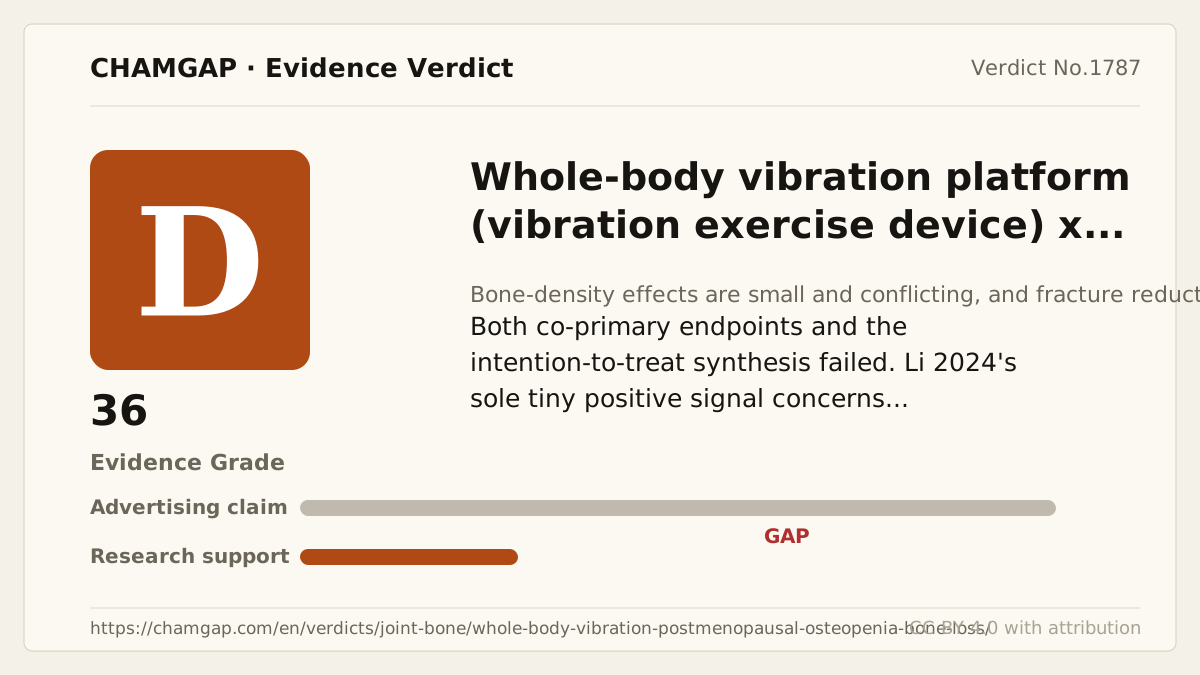
[Chamgap] Whole-body vibration platform x bone loss in postmenopausal osteopenia — Evidence Grade D·30. 3 cited sources checked. Source: https://chamgap.com/en/verdicts/joint-bone/whole-body-vibration-postmenopausal-osteopenia-bone-loss/ · CC BY 4.0CC BY 4.0 — free to use with attribution; do not distort grades, numbers, or verdict meaning.
What this document does and does not do
Chamgap is an information source. It reports what research has and has not confirmed; it does not tell readers what to take or buy. That decision belongs to readers and, when needed, medical or legal professionals. This verdict reflects literature available up to the search date and may change as new research appears. Nothing here is medical advice.