
Risedronate,
does it really help with Prevention of vertebral and hip fractures in postmenopausal osteoporosis?
research showsRisedronate is rated A because repeated large randomized trials reduced vertebral fractures in postmenopausal osteoporosis, and the 9,331-participant HIP trial reduced hip fractures among women aged 70 to 79 years with low bone mineral density. VERT-NA and VERT-MN directly assessed new vertebral fractures. Hip-fracture reduction was not significant in the HIP group aged 80 years or older selected mainly by fall-risk factors. Bone density is a supporting surrogate, treatment duration and drug holidays require separate judgment, and upper gastrointestinal and esophageal injury and rare jaw osteonecrosis and atypical femoral fracture are separated under safety.
ads claimMarketing can present higher bone density as proof that every fracture will be prevented in every patient or imply that longer treatment is always better. Evidence fits postmenopausal women with established osteoporosis and elevated fracture risk most closely, and hip-fracture benefit depends on age, bone density, and prevalent fracture selection.
Useful facts when choosing a product
- Risedronate is a prescription oral bisphosphonate available in daily and weekly formulations. The prescribed dose and interval should be followed exactly.
- The tablet is swallowed in the morning while fasting with a full glass of plain water, followed by remaining upright and delaying food and other medicines for at least 30 minutes.
- Hypocalcemia should be corrected first, and suitability should be reassessed in severe renal impairment, swallowing difficulty, or disorders that delay esophageal transit.
- Upper gastrointestinal symptoms and esophagitis can occur, and long-term use requires awareness of very rare osteonecrosis of the jaw and atypical femoral fracture. Persistent thigh or groin pain or a nonhealing oral lesion warrants assessment.
Chamgap Semantic Classification Code
Candidate index · review held
M.risedronate-sodium.oral.vertebral-and-hip-fractures-in-postmenopausal-osteoporosis.prevent.placeboMedicinal interventions > Risedronate sodium > Oral > vertebral and hip fractures in postmenopausal osteoporosis > Occurrence-prevention claim > Placebo
An automated migration candidate, not an issued permanent code; exact claim scope remains under review. This machine-generated migration candidate helps retrieval but is not a permanent assignment. The original verdict ID and URL remain authoritative.
What the research actually shows
VERT-NA randomized 2,458 postmenopausal women with prevalent vertebral fractures under double masking for three years. Risedronate 5 mg produced relative reductions of 41% in new vertebral fractures and 39% in nonvertebral fractures. VERT-MN studied 1,226 women and reported a 49% reduction in new vertebral-fracture risk. HIP assessed hip fractures in 9,331 women aged 70 years or older. Rates were 2.8% versus 3.9% overall and 1.9% versus 3.2% among low-bone-density women aged 70 to 79 years, but the group aged 80 years or older was not significant.
Why this is classified as A (86)
Repeated placebo-controlled VERT trials reduced new vertebral fractures, and HIP directly confirmed fewer hip fractures among women aged 70 to 79 years with low bone mineral density. Actual fracture events support grade A. The null result in the HIP group aged 80 years or older yields A with 86 points. Gastrointestinal and esophageal adverse effects and rare jaw osteonecrosis and atypical fractures remain independent safety issues.
Counterpoint. Drug choice depends on fracture risk, renal function, esophageal disease, and ability to follow administration instructions. Whether to continue after several years or take a drug holiday requires individual reassessment; the initial trial benefit does not establish indefinite treatment.
Rejudgment record. New verdict — Prioritized direct vertebral and hip fracture endpoints from repeated large placebo-controlled VERT trials and the 9,331-participant HIP trial, while treating the null result in the risk-factor-selected group aged 80 years or older and uncertainty about long-term drug holidays as scope limitations
Sub-claim grades by effect
This ingredient is marketed for several effects. A single overall grade blends strong and weak claims together, so each effect is graded separately here. The overall grade reflects the strongest disconfirming or core claim.
| Effect (sub-claim) | Grade | Basis |
|---|---|---|
| Prevention of new vertebral fractures in postmenopausal osteoporosis | A | Repeated large placebo-controlled VERT trials consistently reduced the direct fracture endpoint. |
| Prevention of hip fractures | A | HIP was positive in low-bone-density women aged 70 to 79 years but not in the risk-factor-selected group aged 80 years or older. |
| Prevention of nonvertebral fractures | B | VERT-NA reported a reduction, but event numbers and replication were more limited than for vertebral fractures. |
| Increase in bone mineral density | B | The finding is consistent but remains a surrogate supporting the fracture results. |
| Optimization of long-term continuous treatment and drug holidays | C | The initial three-year trials do not establish an optimal individualized duration or drug-holiday strategy. |
Cross-check — AI research and Codex final gate
Evidence Table
| Study | Design | Sample | Funding | Endpoint | Result | Weight |
|---|---|---|---|---|---|---|
| Harris ST et al. 1999 VERT-NA | Multicenter randomized double-blind placebo-controlled trial | 2,458 women with postmenopausal osteoporosis | Manufacturer development program led by Procter & Gamble Pharmaceuticals | New vertebral and nonvertebral fractures over three years | Risedronate 5 mg reduced new vertebral fractures by 41% and nonvertebral fractures by 39%. | Key randomized evidence with direct fracture endpoints |
| Reginster J et al. 2000 VERT-MN | Multinational randomized double-masked placebo-controlled trial | 1,226 postmenopausal women with prevalent vertebral fractures | Manufacturer development program | New vertebral fractures over three years | Risedronate 5 mg reduced new vertebral-fracture risk by 49%. | Replicated direct evidence |
| McClung MR et al. 2001 HIP | Large randomized double-blind placebo-controlled trial | 9,331 women aged 70 years or older | Manufacturer development trial | Incident hip fracture | Rates were 1.9% versus 3.2% in low-bone-density women aged 70 to 79 years, but the risk-factor-selected group aged 80 years or older was not significant. | Large direct hip-fracture trial with subgroup heterogeneity |
Receipt — 3 References
All 3 cited sources were verified for existence at the original page (as of 2026-07-20).
Final verification and publication gate: Codex · Evidence date: 2026-07-20 · Corrections: none
Cite this verdict
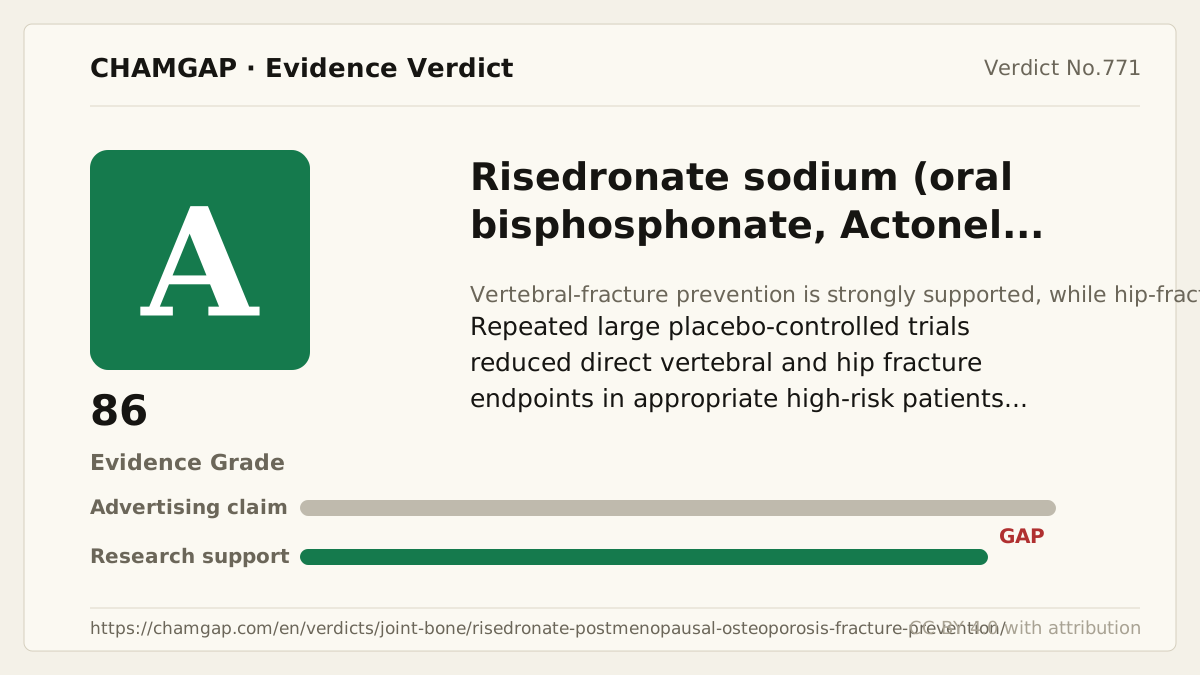
[Chamgap] Risedronate x prevention of vertebral and hip fractures in postmenopausal osteoporosis — Evidence Grade A·86. 3 cited sources checked. Source: https://chamgap.com/en/verdicts/joint-bone/risedronate-postmenopausal-osteoporosis-fracture-prevention/ · CC BY 4.0CC BY 4.0 — free to use with attribution; do not distort grades, numbers, or verdict meaning.
What this document does and does not do
Chamgap is an information source. It reports what research has and has not confirmed; it does not tell readers what to take or buy. That decision belongs to readers and, when needed, medical or legal professionals. This verdict reflects literature available up to the search date and may change as new research appears. Nothing here is medical advice.