
Tai Ji Quan,
does it really help with Reduction of falls in community-dwelling older adults at high risk?
research showsTai Ji Quan is rated A for reducing falls in high-risk older adults. Li and colleagues randomized 670 people and analyzed all by intention to treat. Over six months there were 152 falls with Tai Ji Quan, 218 with multimodal exercise, and 363 with stretching. The primary endpoint succeeded versus stretching, IRR 0.42 (95% CI 0.31 to 0.56, P<0.001). Falls began with participant calendars but were confirmed through monthly calls, follow-up visits, proxies, and medical records. Independent trials and meta-analysis are consistent.
ads claimMarketing can expand the broad image of slow movement into prevention of every fall and fracture. Evidence supports a structured fall-prevention Tai Ji Quan program for fall counts; fracture prevention is a separate question.
Useful facts when choosing a product
- Li's trial collected diary-reported falls with monthly calls, follow-up visits, proxies, and medical records; outcome assessors were masked.
- The same intervention has other indications: verdict 1653, which is B with 72 points, concerns insomnia, and verdict 1713, which is C with 58 points, concerns knee osteoarthritis. Their evidence was not transferred here.
- The prevention landscape differs from verdict 1557, which is C with 55 points for fall-related fractures with balance and functional exercise, verdict 1396, which is C with 52 points for hip protectors, and verdict 504, which is F with 5 points for vitamin D and falls in nondeficient older adults.
Chamgap Semantic Classification Code
Candidate index · review held
X.tai-ji-quan-moving.behavioral.falls-at-high-risk.reduce.activeBehaviors, exposures and policies > Tai Ji Quan: Moving > Behavioral delivery > falls at high risk > Reduction claim > Active comparator
An automated migration candidate, not an issued permanent code; exact claim scope remains under review. This machine-generated migration candidate helps retrieval but is not a permanent assignment. The original verdict ID and URL remain authoritative.
What the research actually shows
Li and colleagues assigned 670 adults aged 70 or older at high fall risk to Tai Ji Quan, 224, multimodal exercise, 223, or stretching, 223, and analyzed all by intention to treat. Primary six-month falls numbered 152, 218, and 363. Tai Ji Quan versus stretching gave IRR 0.42 (0.31 to 0.56), P<0.001, and versus multimodal exercise IRR 0.69 (0.52 to 0.94), P=0.01. Participants used daily fall calendars, with monthly telephone calls, follow-up assessment, proxies, and medical records for confirmation. Huang's meta-analysis of 18 trials and 3,824 participants found RR 0.80 (0.72 to 0.88) for falling at least once and IRR 0.69 (0.60 to 0.80) for fall rate.
Why this is classified as A (86)
Actual fall events H, independent replication R2, public and academic funding I2, a large effect E+, and masked multipronged ascertainment B0 yield A with 86 points.
Counterpoint. Tai Ji Quan is not an interchangeable pill. Frequency, instructor training, balance challenge, and adherence are part of the intervention.
Rejudgment record. Cross-check applied — Accepted a large reduction in actual falls in the 670-person intention-to-treat trial and independent replication, while retaining limitations from event reporting and program heterogeneity
| Endpoint | H | Hard endpoint - actual events such as death |
| Replication | R2 | Independently replicated across trials |
| Independence | I2 | Decisive evidence is publicly or non-profit funded |
| Effect size | E+ | Meets the clinically important threshold |
Stored derived and displayed grades match; this is not a current recalculation or validity check (A).
Sub-claim grades by effect
This ingredient is marketed for several effects. A single overall grade blends strong and weak claims together, so each effect is graded separately here. The overall grade reflects the strongest disconfirming or core claim.
| Effect (sub-claim) | Grade | Basis |
|---|---|---|
| Reduction of total fall incidence over six months | A | The 670-person intention-to-treat primary endpoint and meta-analysis were consistently positive. |
| Reduction of falls versus multimodal exercise | B | The direct comparison gave IRR 0.69, P=0.01. |
| Reduction of fall-related fractures | C | Rarer fractures were not the confirmatory primary endpoint of this trial. |
Cross-check — AI research and Codex final gate
Evidence Table
| Study | Design | Sample | Funding | Endpoint | Result | Weight |
|---|---|---|---|---|---|---|
| Li F et al. 2018 | Assessor-masked three-arm randomized active-controlled trial | 670 randomized (224/223/223); actual primary intention-to-treat analysis 670 | Public United States National Institute on Aging grant AG045094; one author's program-licensing conflict disclosed | Six-month fall incidence, ascertained by calendars plus monthly calls, follow-up, proxies, and records | 152, 218, and 363 falls; Tai Ji Quan versus stretching IRR 0.42 (0.31 to 0.56), P<0.001; primary endpoint met. | Pivotal large event trial |
| Huang ZG et al. 2017 | Systematic review and meta-analysis of randomized trials | 18 trials and 3,824 participants | Guangdong public-program funding (Outstanding Young Teacher Training Program and Province Science and Technology Plan) | At least one fall and rate of falls | RR 0.80 (0.72 to 0.88) and IRR 0.69 (0.60 to 0.80), a consistent reduction. | Independent multiple-trial replication |
| Voukelatos A et al. 2007 | Randomized controlled trial with waiting-list control (Central Sydney Tai Chi Trial) | 702 community-dwelling people aged 60 and older (mean age 69) | Not confirmed (no funding statement in the EuropePMC record or abstract) | Falls over 16 and 24 weeks collected by calendar method, plus six balance tests | Time to first fall gave HR 0.72 (0.51 to 1.01), P=.06 at 16 weeks, borderline, and 0.67 (0.49 to 0.93), P=.02 at 24 weeks; the percentage with at least one fall did not differ. | Large independent-team replication (Australia) |
| Wolf SL et al. 1996 | Three-arm randomized controlled trial (Tai Chi, computerized balance training, education; Atlanta FICSIT) | 200 community-dwelling people aged 70 and older (162 women and 38 men, mean age 76.2) | Public United States National Institute on Aging grant U01-AG09124 (same agency as Li 2018, different grant) | Primary endpoints were biomedical, functional, and psychosocial frailty indicators; falls were a secondary outcome monitored continuously | After adjustment for fall risk factors, Tai Chi reduced the risk of multiple falls by 47.5%; grip strength declined in all groups and primary frailty-indicator changes were limited. | Early independent replication (falls were secondary) |
Receipt — 4 References
All 4 cited sources were verified for existence at the original page (as of 2026-08-11).
Final verification and publication gate: Codex · Evidence date: 2026-08-11 · Corrections: none
Cite this verdict
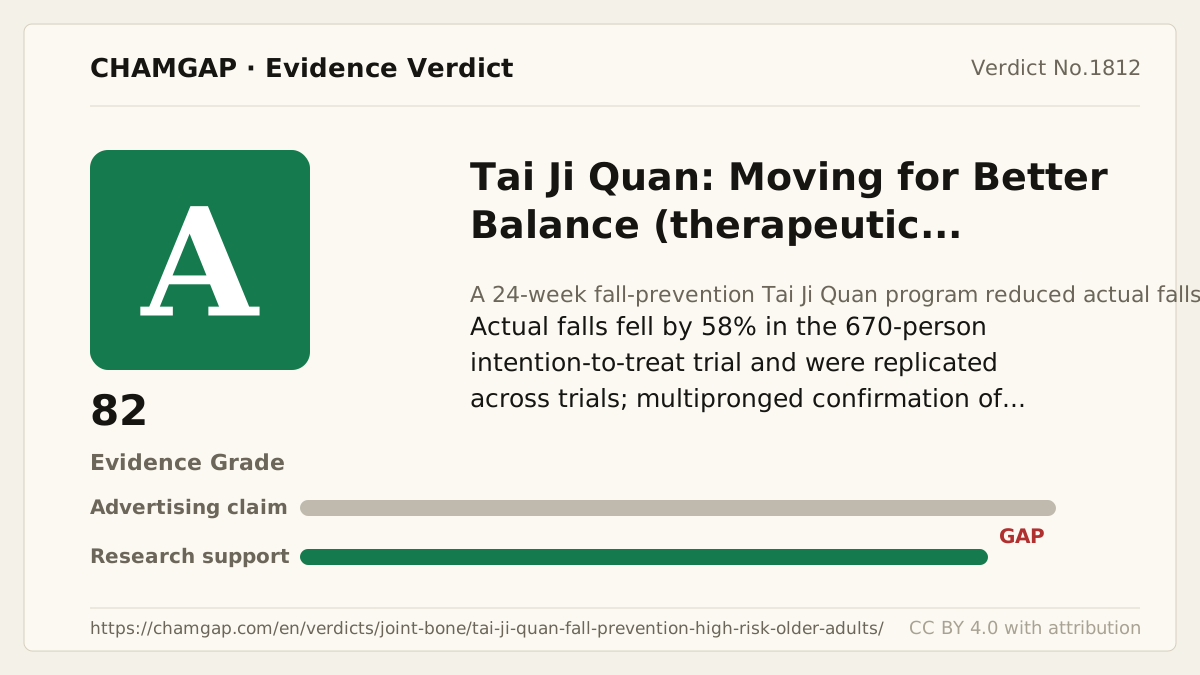
[Chamgap] Tai Ji Quan x fewer falls in high-risk older adults — Evidence Grade A·86. 4 cited sources checked. Source: https://chamgap.com/en/verdicts/joint-bone/tai-ji-quan-fall-prevention-high-risk-older-adults/ · CC BY 4.0CC BY 4.0 — free to use with attribution; do not distort grades, numbers, or verdict meaning.
What this document does and does not do
Chamgap is an information source. It reports what research has and has not confirmed; it does not tell readers what to take or buy. That decision belongs to readers and, when needed, medical or legal professionals. This verdict reflects literature available up to the search date and may change as new research appears. Nothing here is medical advice.