
Tibolone,
does it really help with Prevention of new vertebral and nonvertebral fractures in older postmenopausal women with osteoporosis?
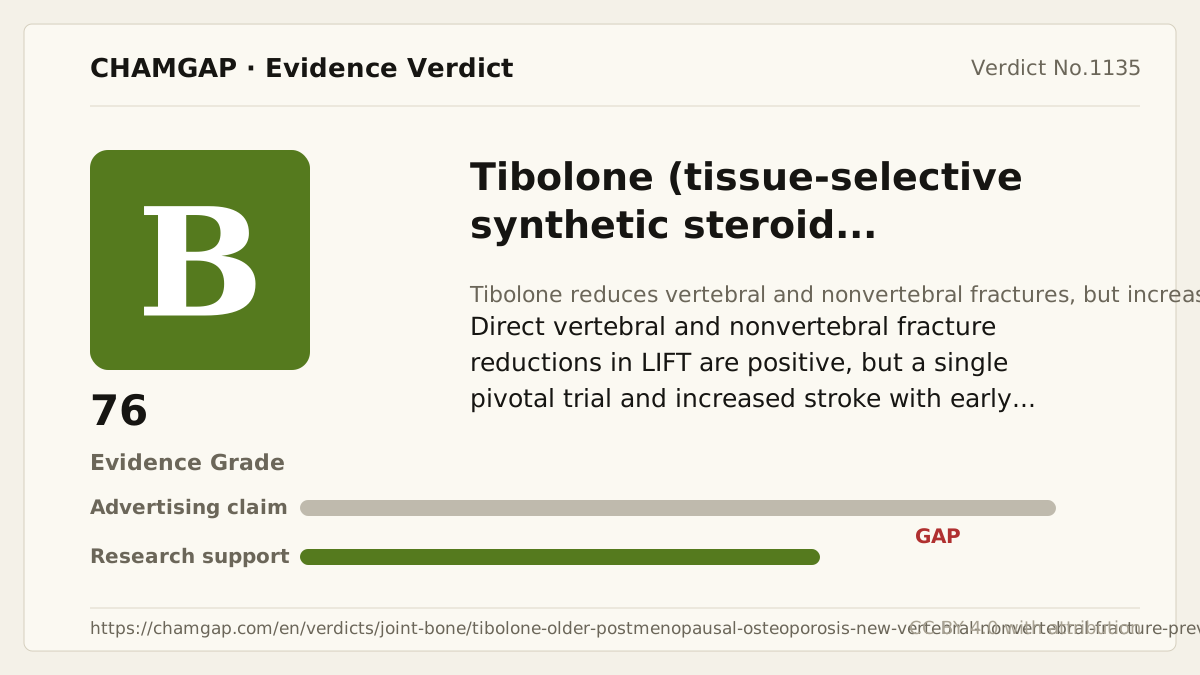
research showsTibolone is rated B because it reduced new vertebral and nonvertebral fractures in postmenopausal women aged 60 to 85 years with osteoporosis. In the 4,538-participant randomized double-blind LIFT trial, the relative hazard was 0.55 for vertebral fracture (95% CI 0.41 to 0.74) and 0.74 for nonvertebral fracture (95% CI 0.58 to 0.93). Both are patient-important fracture endpoints, but the evidence is effectively concentrated in one large Organon-funded trial, and the relative hazard for stroke increased to 2.19, prompting early termination on the safety board's recommendation. The fracture scope is broader than vertebral-only grade-B evidence but lacks the independent replication and safer net-benefit profile supporting grade-A broad-fracture therapy.
ads claimThe phrase 'one menopause medicine protects both symptoms and bones' converts a fracture benefit into a claim of overall health benefit. Fractures fell in older women with osteoporosis, but stroke increased, and age at initiation, previous breast cancer, endometrial symptoms, and thrombotic risk require separate assessment.
Useful facts when choosing a product
- LIFT tested tibolone 1.25 mg once daily for fracture prevention, and the same fracture effect cannot automatically be assigned to other doses or to younger women without osteoporosis.
- Tibolone is a prescription synthetic steroid used after menopause and is not intended for women without established menopause or for anyone who could be pregnant.
- The increased stroke risk in LIFT must be prioritized in women aged 60 years or older and those with vascular risk factors, and sudden neurologic symptoms require emergency assessment.
- Previous breast cancer, unexplained vaginal bleeding, endometrial disease, a history of venous thromboembolism, and liver disease require review before prescribing, following local contraindications and warnings.
Chamgap Semantic Classification Code
Candidate index · review held
M.tibolone.UNK.new-vertebral-and-nonvertebral-fractures-with-osteoporosis.prevent.placeboMedicinal interventions > Tibolone > Unknown > new vertebral and nonvertebral fractures with osteoporosis > Occurrence-prevention claim > Placebo
An automated migration candidate, not an issued permanent code; exact claim scope remains under review. This machine-generated migration candidate helps retrieval but is not a permanent assignment. The original verdict ID and URL remain authoritative.
What the research actually shows
Cummings and colleagues with the LIFT Trial Investigators randomized 4,538 women aged 60 to 85 years who met bone-density criteria to tibolone 1.25 mg or placebo and used annual spinal radiographs to identify new vertebral fractures. Over a median of 34 months, vertebral fractures occurred at 70 versus 126 events, relative hazard 0.55, and nonvertebral fractures at 122 versus 166, relative hazard 0.74. Stroke increased with a relative hazard of 2.19, causing termination in February 2006. A 2016 Cochrane review included 46 trials and 19,976 women but found that most long-term cerebrovascular data came from LIFT, concluding that stroke may increase after age 60 and recurrent breast cancer increases among women with a previous breast cancer diagnosis.
Why this is classified as B (76)
LIFT demonstrated direct hard-endpoint reductions in 4,538 women, with a relative hazard of 0.55 for new vertebral fracture and 0.74 for nonvertebral fracture. The evidence is concentrated in one Organon-funded pivotal trial, and a stroke relative hazard of 2.19 prompted early termination, limiting long-term net benefit and replication. Its fracture scope is broader than grade-B vertebral-only therapy but remains below independently replicated broad-fracture grade-A evidence, yielding B with 76 points.
Counterpoint. Some postmenopausal women at very high fracture risk who cannot use alternative osteoporosis therapies may have reason to consider combined symptom and bone benefits. Stroke, breast, endometrial, and thrombotic risks must be assessed individually, and the evidence should not be simplified into routine first-line use for older osteoporosis.
Rejudgment record. New verdict — Accepted the direct hard-endpoint reductions in new vertebral fracture, relative hazard 0.55, and nonvertebral fracture, relative hazard 0.74, in the 4,538-participant randomized double-blind LIFT trial, while incorporating reliance on one Organon-funded pivotal trial, increased stroke with a relative hazard of 2.19 and early termination, long-term net-benefit limitations, and corpus alignment with grade-B vertebral-only and grade-A independently supported broad-fracture therapies
Sub-claim grades by effect
This ingredient is marketed for several effects. A single overall grade blends strong and weak claims together, so each effect is graded separately here. The overall grade reflects the strongest disconfirming or core claim.
| Effect (sub-claim) | Grade | Basis |
|---|---|---|
| Prevention of new vertebral fractures in postmenopausal women aged 60 to 85 years with osteoporosis | B | LIFT demonstrated a direct fracture reduction with a relative hazard of 0.55, but evidence rests on one pivotal trial with a major safety limitation. |
| Prevention of new nonvertebral fractures in the same population | B | The relative hazard of 0.74 was significant, but no separate definitive hip-fracture effect or external large replication is available. |
| Increased bone mineral density after menopause | C | Tibolone increases bone mineral density, but it is a surrogate below fracture outcomes; the grade-B verdict rests on direct fracture data. |
Cross-check — AI research and Codex final gate
Evidence Table
| Study | Design | Sample | Funding | Endpoint | Result | Weight |
|---|---|---|---|---|---|---|
| Cummings et al. and the LIFT Trial Investigators 2008 | International multicenter randomized double-blind placebo-controlled trial (LIFT) | 4,538 postmenopausal women aged 60 to 85 years with osteoporosis or osteopenia plus an existing vertebral fracture | Organon, the manufacturer of tibolone | New vertebral fractures on annual radiographs, nonvertebral fractures, and cardiovascular and cancer safety | The relative hazard was 0.55 for vertebral fracture (95% CI 0.41 to 0.74), 0.74 for nonvertebral fracture (95% CI 0.58 to 0.93), and 2.19 for stroke (95% CI 1.14 to 4.23), prompting trial termination. | Pivotal direct fracture-efficacy and major safety evidence |
| Formoso et al. 2016 Cochrane review | Systematic review and meta-analysis of randomized trials | 46 randomized trials and 19,976 postmenopausal or perimenopausal women | Public support from the Italian Ministry of Health and the Emilia-Romagna region | Menopausal symptoms, vaginal bleeding, breast and endometrial cancer, thrombotic and cardiovascular events, and death | The stroke signal after age 60 came predominantly from LIFT, and recurrent breast cancer increased among women with previous breast cancer, OR 1.50 (95% CI 1.21 to 1.85). | Supporting long-term safety and generalizability assessment |
Receipt — 2 References
All 2 cited sources were verified for existence at the original page (as of 2026-07-22).
Final verification and publication gate: Codex · Evidence date: 2026-07-22 · Corrections: none
Cite this verdict
[Chamgap] Tibolone x prevention of new vertebral and nonvertebral fractures in older postmenopausal women — Evidence Grade B·76. 2 cited sources checked. Source: https://chamgap.com/en/verdicts/joint-bone/tibolone-older-postmenopausal-osteoporosis-new-vertebral-nonvertebral-fracture-prevention/ · CC BY 4.0CC BY 4.0 — free to use with attribution; do not distort grades, numbers, or verdict meaning.
What this document does and does not do
Chamgap is an information source. It reports what research has and has not confirmed; it does not tell readers what to take or buy. That decision belongs to readers and, when needed, medical or legal professionals. This verdict reflects literature available up to the search date and may change as new research appears. Nothing here is medical advice.